
Quick Answer:
9mm equals 0.9 cm, 0.354 inches, 0.0295 feet, or 0.009 meters. It is roughly comparable to the diameter or width of a small button, bead, or drinking straw.
If you are trying to picture 9 millimeters without holding a ruler, the number can feel surprisingly abstract. It is less than one centimeter and a little over one-third of an inch, so we are talking about a relatively small dimension found in many everyday objects.
Understanding how big is 9mm can be useful when checking the diameter of hardware, jewelry, craft supplies, electronic components, or other compact items. Familiar objects provide a much quicker visual reference than trying to imagine millimeters on their own.
Below, you will find exact conversions, practical ways to estimate the measurement, and ten recognizable objects that can help you build a realistic mental picture.
9mm Conversion Chart
Quick and accurate measurement conversions
| Unit | Converted Value |
|---|---|
| Inches | 0.354 in |
| Feet | 0.0295 ft |
| Centimeters | 0.9 cm |
| Millimeters | 9 mm |
| Meters | 0.009 m |
What Does 9mm Look Like?
Nine millimeters is a very short distance. On a metric ruler, it extends from the zero mark to the ninth small millimeter line, stopping just one millimeter before the 1-centimeter mark. In imperial units, the same dimension is approximately 0.354 inches, making it slightly more than one-third of an inch.
A useful way to picture this size is to think about the width or diameter of compact objects rather than their overall length. Small buttons, beads, screw heads, cable ends, and drinking straws can all fall somewhere around this range, although manufacturing differences mean they are not exact measuring tools.
Because the dimension is so small, even a difference of one or two millimeters can be noticeable. For a quick visual estimate, imagine something just slightly narrower than a full centimeter.
Measurement Without a Ruler
Estimating such a small dimension without measuring equipment requires a familiar reference point. One of the easiest approaches is to start with a centimeter. Since one centimeter equals 10 millimeters, the target distance is simply 90% of that length. If you have centimeter-grid paper or another metric reference nearby, the difference is easy to visualize.
Everyday objects can also work as rough references. A small craft bead, narrow shirt button, compact screw head, or drinking straw may have a diameter close to this range. However, these objects are manufactured in many sizes, so they should only be used when an approximate estimate is sufficient.
For tasks involving jewelry, drilling, replacement parts, electronics, or precise fitting, use a metric ruler, caliper, or measuring gauge. Visual comparisons are excellent for understanding scale, but they cannot reliably replace proper measurement when tolerances matter.
Quick Size Comparison Table
| Object | Approximate Dimension | How It Compares |
|---|---|---|
| Pencil thickness | 7–9 mm | Some thick pencils approach 9 mm |
| Small bead | 8–10 mm diameter | Very close visual reference |
| Earbud speaker opening | 8–10 mm | Similar on some earbuds |
| Small shirt button | 8–10 mm diameter | Often close in size |
| Small screw head | 8–10 mm diameter | Useful hardware comparison |
| USB cable thickness | 6–9 mm | Thicker cables can approach it |
| Jewelry ring band width | 7–9 mm | Wide bands may match closely |
| Charging pin/connector diameter | 7–9 mm | Some larger connectors approach it |
| Watch crown | 6–9 mm diameter | Larger crowns can be similar |
| Drinking straw diameter | 8–10 mm | Common close comparison |
1. Pencil Thickness

A typical wooden pencil is often around 7 to 8 millimeters across, while thicker pencils can approach approximately 9 millimeters. Hexagonal and round pencils also differ slightly in how their width is measured. This means a chunky pencil provides a useful reference for visualizing a dimension close to 0.9 centimeter.
Pencils are particularly convenient comparison objects because almost everyone has handled one. Look at the pencil from its sharpened or eraser end rather than along its full length. The cross-sectional width gives you the relevant visual reference, making this small metric measurement much easier to understand.
A standard pencil may therefore be slightly narrower than the target dimension, while a thicker model can come quite close. Use this comparison for scale rather than precision, since pencil dimensions differ among brands and designs.
2. Small Bead

Craft and jewelry beads are manufactured in standardized nominal sizes, and beads around 8 to 10 millimeters in diameter are common. A bead sold as 9 mm would therefore provide an especially straightforward physical representation: its outside diameter measures approximately 0.9 centimeter from one edge to the other.
You will commonly see beads of this general size in bracelets, necklaces, decorative crafts, keychains, and DIY jewelry projects. Because they are small and usually round, they provide an intuitive way to understand millimeter-scale diameters without needing to imagine a line on a ruler.
If you have an 8 mm or 10 mm bead nearby, the desired dimension falls between them. A 10 mm bead is one millimeter wider, while an 8 mm bead is one millimeter narrower.
3. Earbud Speaker Opening

The speaker or nozzle area on an in-ear earbud can have dimensions in roughly the 8 to 10 millimeter range, depending heavily on the model and exactly which part is measured. A component measuring 9 mm across would have a diameter of 0.9 centimeter, making some earbuds a useful approximate visual reference.
Earbuds are familiar because their components are designed to fit comfortably around or inside the ear. Looking at the circular speaker housing or opening shows just how compact a sub-centimeter dimension is. Larger external housings should not be used for this comparison because they can be considerably wider.
For visualization, think about the small sound-producing or nozzle section rather than the complete earbud body. Designs vary significantly, so this is best treated as a rough comparison rather than a standardized measurement.
4. Small Shirt Button

Small shirt buttons commonly come in diameters around 8 to 11 millimeters, although clothing manufacturers use many different sizes. A button measuring 9 mm across is equal to 0.9 centimeter, putting it almost exactly at the target dimension from one outer edge to the opposite edge.
Buttons make particularly useful size references because they are flat, easy to inspect, and found on everyday clothing. Smaller buttons on dress shirts, cuffs, children’s garments, or decorative clothing may fall close to this range. Larger front buttons, coat buttons, and jeans buttons are usually considerably wider.
If you find a button that measures just under one centimeter across, you already have a strong visual approximation. Remember that the relevant dimension is its diameter, not its thickness.
5. Small Screw Head
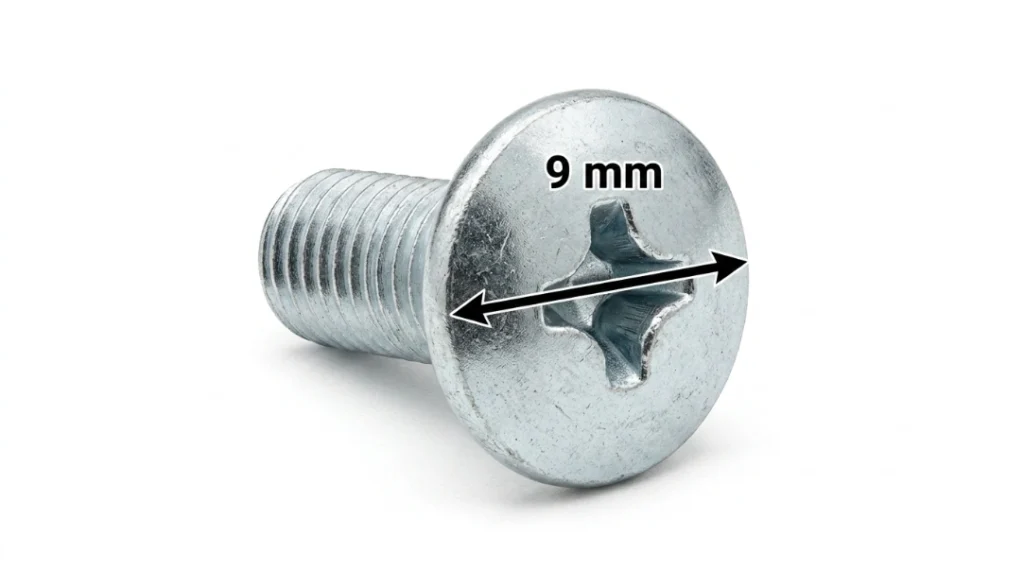
A small screw head can measure approximately 8 to 10 millimeters across, depending on the screw type, gauge, and head design. A 9 mm screw head is therefore another useful reference for this scale. The measurement should be taken across the widest part of the head rather than along the screw shaft.
Small screws appear in furniture, household fixtures, electronics, appliances, cabinets, and DIY projects. Their heads are easy to compare visually because the diameter is clearly defined. Phillips, slotted, Torx, and other head styles may have similar outside diameters even though their internal drive patterns look different.
Picture a compact screw with a head slightly smaller than one centimeter wide. That provides a reasonable mental reference, but hardware should always be measured directly when selecting replacement screws or tools.
6. USB Cable Thickness

USB cables vary substantially in thickness. Slim charging cables may be only a few millimeters wide, while heavily insulated, braided, or reinforced cables can approach 8 or 9 millimeters across. A particularly thick cable can therefore provide a practical comparison for a 0.9-centimeter dimension.
These cables are found around phones, tablets, computers, power banks, game controllers, and countless other electronic devices. Because people regularly handle them, comparing the width of a thicker cable with a centimeter scale can make this measurement easier to picture in daily life.
Do not assume every USB cable measures this amount. The cable itself, connector housing, and strain-relief section can all have very different dimensions. For visualization, use only a thick cable whose body appears slightly narrower than one centimeter.
7. Jewelry Ring Band Width

Ring bands are available in many widths, from very slim designs of only a few millimeters to broad bands measuring 8, 9, or even 10 millimeters. A 9 mm band is considered relatively wide and measures exactly 0.9 centimeter from one side of the band to the other.
Wide wedding bands, statement rings, and some men’s rings commonly use larger band widths. When worn on a finger, a band of this size covers a noticeable portion of the lower finger, which provides a useful way to visualize how a seemingly tiny metric number can look in practice.
A ring specifically listed with a 9 mm band width offers an accurate reference. Be careful not to confuse band width with ring diameter, thickness, or circumference, as those are separate measurements.
8. Charging Pin Diameter
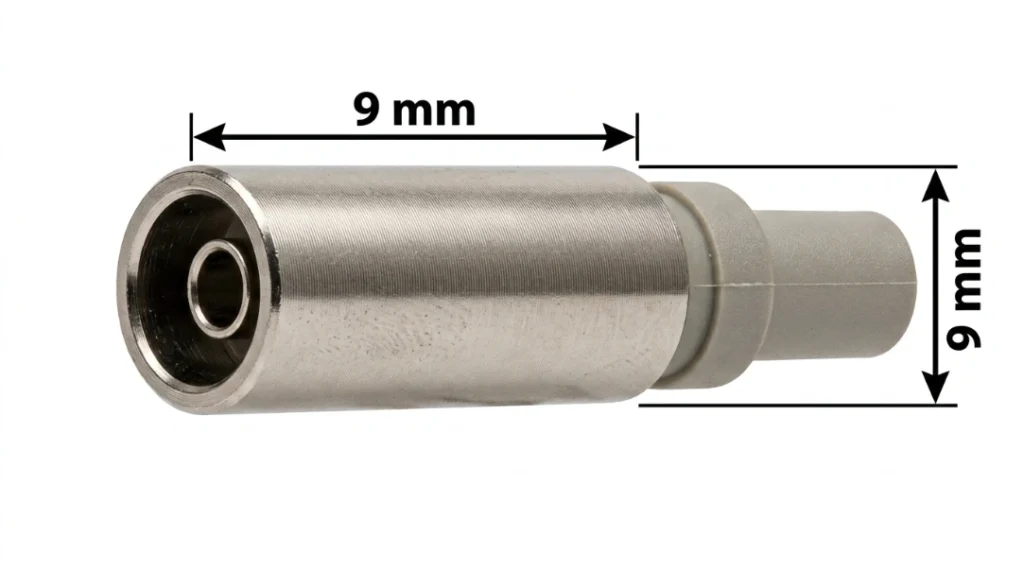
Charging connectors and pins come in many shapes and sizes, and some larger round connector sections or housings can measure approximately 7 to 9 millimeters across. A component at the upper end of that range can provide a useful visual reference for a dimension just under one centimeter.
Round charging connectors are commonly found on electronics, small appliances, older devices, power adapters, and specialized equipment. Their compact circular shapes make them convenient for understanding diameter. However, modern phone connectors such as USB-C are shaped differently and should not automatically be treated as equivalent.
For a rough visual estimate, picture a compact circular connector approaching one centimeter in outside diameter. Always use actual specifications when identifying replacement charging components because even small dimensional differences can prevent a proper fit.
9. Watch Crown
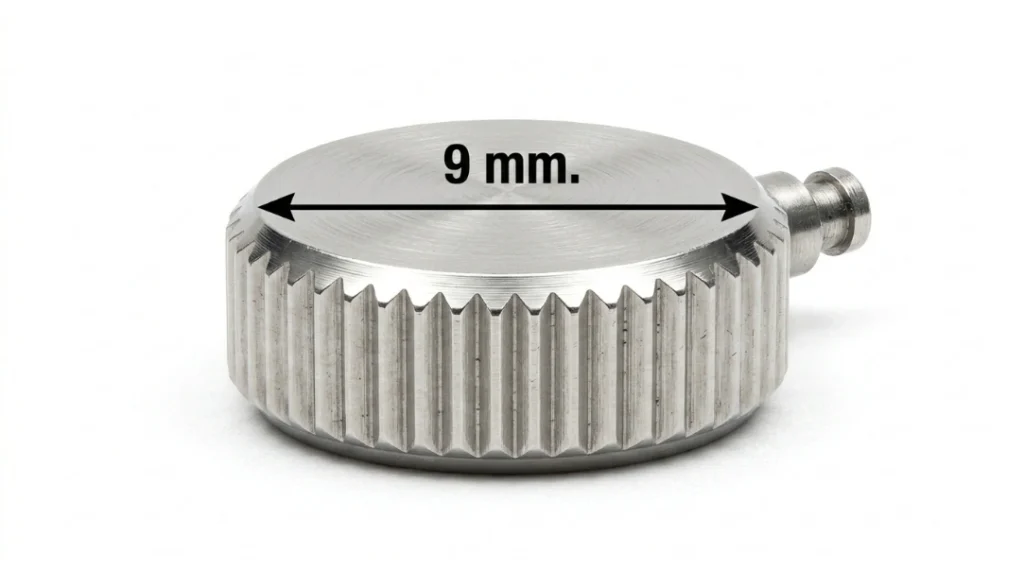
The crown is the small knob on the side of a watch case used to set the time, adjust functions, or wind certain mechanical watches. Crown diameters vary widely, but larger crowns can reach approximately 7 to 9 millimeters, placing them close to the measurement being visualized.
Watch crowns are useful because they demonstrate this dimension on a compact object most people recognize. Sports watches, pilot-style watches, and watches designed for easy manual adjustment may use larger crowns, while slim dress watches usually have considerably smaller ones.
Imagine the diameter of a relatively prominent watch crown viewed directly from the side. If it reaches about 9 mm, it provides a close physical reference, although individual watch specifications should be checked for an exact figure.
10. Standard Drinking Straw Diameter

Many common drinking straws have outside diameters somewhere around 6 to 10 millimeters, depending on their intended use. Wider standard or reusable straws can be approximately 8 to 10 millimeters across, putting a 9 mm straw directly in the middle of that range at 0.9 centimeter.
Straws are useful references because their circular cross-sections make diameter easy to understand. You see them with soft drinks, iced coffee, smoothies, reusable drinkware, and restaurant beverages. Smoothie and bubble-tea straws, however, can be much wider than ordinary drinking straws.
Look straight at the open end of a straw measuring slightly less than one centimeter across. That circular opening provides one of the simplest ways to picture this scale, provided you remember that straw diameters vary.
How Accurate Are Everyday 9mm Comparisons?
Everyday comparisons are best used for visualization, not precision. A button described as small or a cable described as thick does not have a universal diameter. Two visually similar products can differ by several millimeters, which becomes significant when the dimension itself is less than one centimeter.
For a better estimate, keep these practical points in mind:
- 1 centimeter equals 10 millimeters, so 9 mm is 90% of a centimeter.
- 9 mm equals about 0.354 inches, or slightly more than one-third of an inch.
- Manufactured objects can differ between brands, models, and product types.
- A metric ruler is suitable for ordinary measurements.
- Digital or vernier calipers are better when diameter and thickness need to be measured precisely.
These references answer how big is 9mm visually, but they should not replace accurate measuring equipment when fitting parts, drilling holes, choosing hardware, or checking technical specifications.
Read: What Is 5’3 in Inches?
Read: What Is 5’0 in Inches?
Read: What Is 5’2 in Inches?
Read: How Long Is 17 Inches?
Read: How Big Is 9cm?
Read: How Long Is 50 Feet?
Read: How Long Is 100 Feet?
Frequently Asked Questions
Is 9mm the same as 1 cm?
No. One centimeter equals 10 millimeters, so 9 mm is 1 millimeter shorter than 1 cm. In decimal form, it equals exactly 0.9 cm.
How many inches is 9 millimeters?
Nine millimeters equals approximately 0.354 inches. That makes it slightly more than one-third of an inch, since one-third of an inch is about 8.47 mm.
Can I estimate this size with my fingers?
You can make a rough visual estimate, but finger dimensions differ significantly between people. A centimeter reference, small button, bead, or measured straw is generally more useful for estimating such a short distance.
What common object is closest to this measurement?
A 9 mm craft bead or a button manufactured with a 9 mm diameter would be among the closest examples. Certain drinking straws, screw heads, wide ring bands, and watch crowns can also approach this size.
What is the best tool for measuring millimeters accurately?
A metric ruler works well for simple lengths. For small diameters, thicknesses, holes, jewelry, or mechanical parts, a digital or vernier caliper usually provides a more precise measurement.
Conclusion
So, how big is 9mm in everyday terms? It equals 0.9 centimeters or approximately 0.354 inches, placing it just below the 1-centimeter mark. Small beads, shirt buttons, screw heads, thick cables, wide ring bands, watch crowns, and some drinking straws can provide useful visual references.
For casual visualization, picture a small object roughly nine-tenths of a centimeter across. When accuracy matters, especially for hardware, jewelry, electronics, or replacement components, compare the item against a metric ruler or use calipers instead of relying solely on household objects.