
Quick Answer:
50 feet equals 15.24 meters, 1,524 centimeters, 15,240 millimeters, or 600 inches. It is roughly comparable to the width of an NBA basketball court.
If you hear that something is 50 feet long, the number may not immediately create a useful picture in your mind. It is much longer than most rooms, vehicles, and everyday household objects, yet short enough to visualize using familiar structures and sports spaces.
Understanding How long is 50 Feet can be useful when estimating property dimensions, building heights, vehicle lengths, outdoor distances, landscaping projects, or recreational spaces. Real-world comparisons make the distance far easier to judge than numbers alone.
Below, you’ll find exact conversions, recognizable objects and structures, height comparisons, walking estimates, and practical ways to approximate this distance when you do not have a tape measure available.
50 Feet Conversion Chart
Quick and accurate measurement conversions
| Unit | Converted Value |
|---|---|
| Feet | 50 ft |
| Inches | 600 in |
| Yards | 16.67 yd |
| Centimeters | 1,524 cm |
| Millimeters | 15,240 mm |
| Meters | 15.24 m |
How Long Is 50 Feet, Really?
A distance of 50 feet is exactly 600 inches or 16⅔ yards. In metric measurements, that converts to 15.24 meters. For perspective, it is slightly shorter than the 18.29-meter length of a standard competition swimming pool lane measuring 20 yards, while being substantially longer than an ordinary passenger vehicle.
One of the easiest visual references is a basketball court. An NBA court measures 50 feet across, so standing on one sideline and looking directly toward the opposite sideline gives you an excellent representation. This makes a regulated basketball court particularly useful because its dimensions are standardized rather than based on a rough estimate.
In residential terms, the same dimension could span several rooms placed end to end or approximate the height of a smaller five-story structure, depending on floor heights. Outdoors, it is a noticeable but easily walkable distance.
How Does 50 Feet Appear in Height?
Vertically, 50 feet equals 15.24 meters, which is high enough to extend well above a typical two-story house. Residential stories commonly have floor-to-floor dimensions of roughly 9 to 12 feet, meaning this height can be comparable to a building containing around four to five levels, although actual building dimensions vary considerably.
Another useful reference is a mature tree. Many medium-to-large trees reach or pass the 50-foot mark, although species, climate, soil, age, and growing conditions all influence their final height. Looking upward at a tree around this size gives the measurement a much different visual scale than seeing the same distance horizontally.
It is also slightly taller than each letter of the Hollywood Sign, which stands approximately 45 feet high. Adding another five feet above one of those letters would bring the total close to the target height.
15 Daily Use Things That Measure 50 Feet
| Object or Reference | Approximate Size | How It Compares |
|---|---|---|
| Standard fire hose section | 50 ft | Can match exactly |
| Large railroad boxcar | Around 50–60 ft | Similar length |
| Aerial fire truck | Around 40–50+ ft | Similar vehicle scale |
| NBA basketball court width | 50 ft | Exact |
| Futsal court width | Around 49–82 ft | 50 ft fits permitted ranges |
| 50-foot yacht | 50 ft | Exact nominal length |
| Five-story building | Around 50–60 ft | Approximate height |
| Adult humpback whale | Around 40–60 ft | Similar body length |
| 20 walking steps | Around 50 ft | Approximate |
| Large tanker truck | Around 40–50+ ft | Similar overall scale |
| Mature white pine | 50 ft or taller | Useful vertical reference |
| Five 9-ft ping pong tables | 45 ft | 5 ft short |
| 2.5 shipping containers | 50 ft | Exact using 20-ft containers |
| Semi-trailer | Commonly 48–53 ft | Very close |
| Hollywood Sign letter | 45 ft high | About 5 ft shorter |
1. Standard Fire Hose

Fire hose is commonly manufactured in standardized sections, and 50-foot lengths are widely used. A 50-foot section measures 15.24 meters from end to end when laid straight. Hose diameter varies according to its purpose, with different sizes used for attack lines, supply operations, and other firefighting applications.
You will normally see these hoses stored folded or rolled on fire engines rather than stretched completely straight. During an emergency or training exercise, firefighters connect individual sections as needed to create a hose line long enough to reach the fire from a hydrant, engine, or other water source.
If you can picture a fully extended 50-foot hose section, you have an unusually convenient real-world reference because this example can represent the distance directly rather than through multiplication or a loose estimate.
2. Large Railroad Boxcar
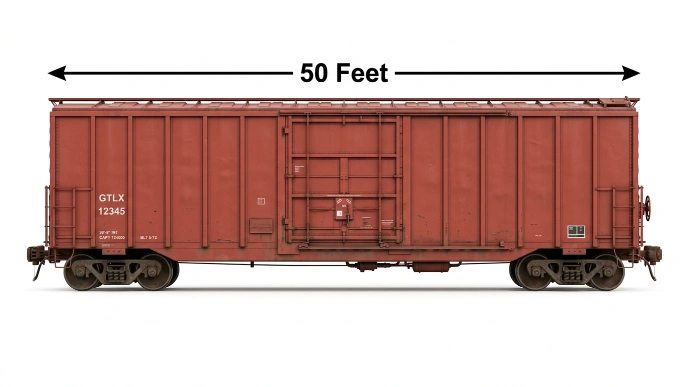
Railroad boxcars vary substantially in size, but many modern freight boxcars have interior or exterior lengths in the neighborhood of 50 to 60 feet. A car close to 50 feet would therefore measure about 15.24 meters long, excluding differences created by couplers and specific railcar designs.
These enclosed freight cars are used to transport products that benefit from protection from weather. They can carry packaged foods, paper products, manufactured goods, building materials, and other freight. Their large rectangular bodies make their overall length relatively easy to judge when viewed from the side.
Picture one substantial freight boxcar standing by itself on a straight section of track. Depending on the exact model, its body provides a useful approximation of the distance, though railcars should not be assumed to have one universal length.
3. Aerial Fire Truck

Large aerial fire apparatus can reach roughly 40 to 50 feet or more in vehicle length, depending on the configuration. The truck itself should not be confused with its aerial ladder, which can extend far beyond the vehicle and may reach 75, 100 feet, or more on certain apparatus.
These vehicles are typically used where firefighters need elevated access, substantial equipment capacity, or specialized rescue capabilities. Their long wheelbases, rear equipment sections, ladder assemblies, and multiple axles make them noticeably larger than ordinary emergency vehicles.
A particularly large aerial apparatus can therefore give you a reasonable impression of this horizontal dimension. Just remember that models differ, so a specific truck’s published overall length is necessary when precision matters.
4. NBA Basketball Court Width
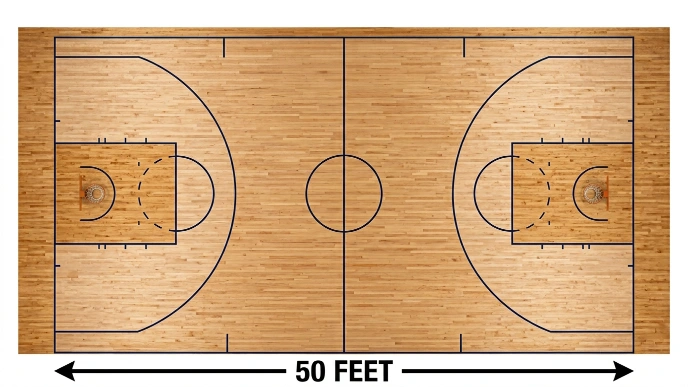
An NBA basketball court provides one of the best exact comparisons on this list. Regulation NBA courts measure 94 feet long and exactly 50 feet wide, meaning the distance from one sideline directly across to the other is 15.24 meters.
Basketball courts are familiar spaces in schools, sports centers, arenas, and recreational facilities. Even if you have never measured one yourself, standing near the center of a regulation professional court makes its width easy to appreciate visually.
Imagine walking straight from one sideline to the opposite sideline rather than toward either basket. That single cross-court trip represents the target distance exactly, making this far more dependable than comparisons involving variable-sized natural objects.
5. Futsal Court Width
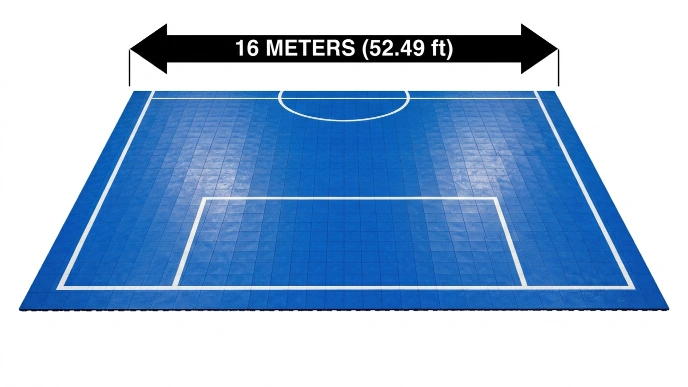
Futsal courts do not have one universal width for every competition. Under standard Laws of the Game dimensions, non-international courts can fall within an allowed range, while international-match dimensions have tighter requirements. A width around 15 meters, or approximately 49.2 feet, can therefore be remarkably close to 50 feet in appropriate settings.
Futsal is played on a hard court with smaller dimensions than a conventional outdoor soccer field. Because the game is designed for five-player teams and quick close-control play, the playing surface feels compact compared with full-size association football.
A court measuring roughly 15 meters across leaves a difference of only about 0.24 meter, or 9.45 inches, from 50 feet. It is therefore a useful visual approximation when the specific court dimensions are known.
6. A 50-Foot Yacht
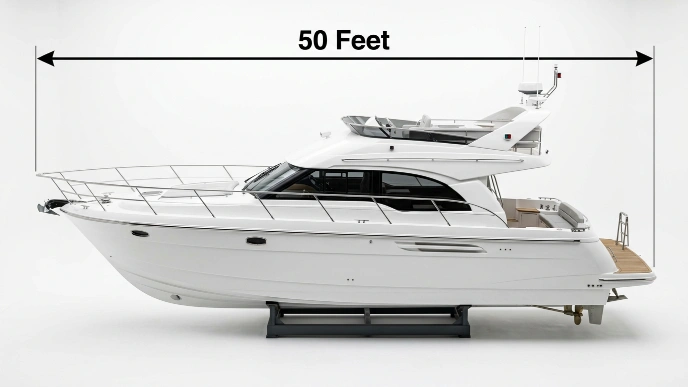
A yacht described as a 50-foot yacht gives you a direct nominal comparison. Fifty feet converts to 15.24 meters, although the precise published length of a boat may vary depending on whether the manufacturer is referring to overall length, hull length, or a model designation.
Boats in this size category are substantial recreational vessels. Depending on their design, they can include sleeping cabins, bathrooms, a galley, indoor seating, exterior entertaining areas, and considerable storage space. Seen beside a small recreational boat, their scale becomes immediately apparent.
Imagine one of these vessels removed from the water and viewed directly from the side. From bow to stern, a yacht with a true overall length of 50 feet demonstrates exactly how much horizontal space the measurement occupies.
7. Five-Story Building
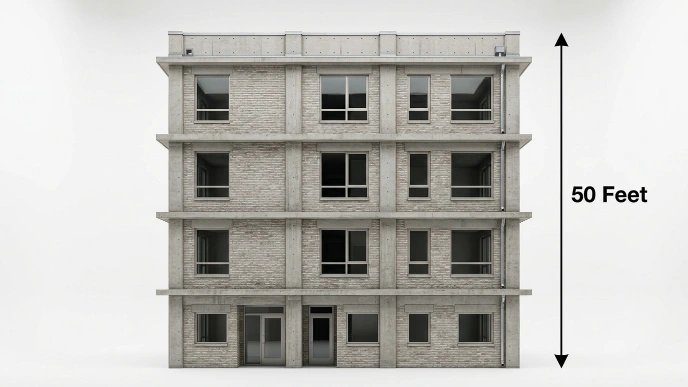
A five-story building can stand around 50 to 60 feet tall, although there is no fixed height because ceiling heights, structural floors, ground-floor design, roofs, and mechanical spaces vary. Using roughly 10 feet per level produces a simple estimate of approximately 50 feet.
You can find buildings of this scale in apartment developments, commercial districts, university campuses, and mixed-use neighborhoods. A modern commercial five-story building may be taller than the estimate because individual floors frequently require greater floor-to-floor clearance than basic residential construction.
For visualization rather than engineering measurement, imagine a modest five-story residential building with relatively standard floor heights. The ground-to-roof distance can put you in roughly the right vertical range, but actual plans should always be consulted for precise dimensions.
8. Adult Humpback Whale
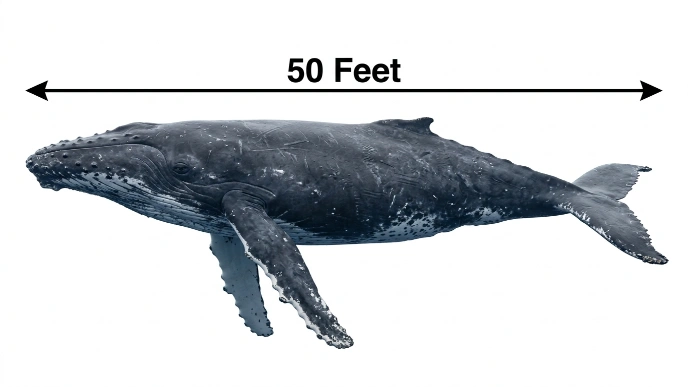
Adult humpback whales commonly reach lengths of roughly 40 to 60 feet, with females generally growing larger than males. That places a 50-foot individual directly in the middle of a useful approximate range. At that length, the whale would measure 15.24 meters from head toward the tail.
Humpbacks inhabit oceans around the world and are famous for breaching, complex songs, long migrations, and enormous pectoral fins. Their sheer scale can be difficult to appreciate from photographs because there is often no familiar object immediately beside them.
Imagine an adult humpback laid out lengthwise across the width of an NBA basketball court. A specimen around 50 feet long could span almost the entire width, creating a striking biological comparison for this measurement.
9. Twenty Average Walking Steps

Twenty adult walking steps can cover approximately 50 feet if each step averages around 2.5 feet, or 30 inches. Multiplying 2.5 feet by 20 gives exactly 50 feet. However, individual step length changes with height, walking speed, terrain, age, and gait.
This method is useful because walking requires no special equipment. People often estimate garden dimensions, room sizes, driveways, outdoor layouts, and property distances by pacing from one point to another and counting their steps.
If your natural walking step is close to 30 inches, taking 20 consistent steps gives you a practical approximation. For better accuracy, measure your personal step length first rather than assuming every person covers the same distance.
10. Large Tanker Truck
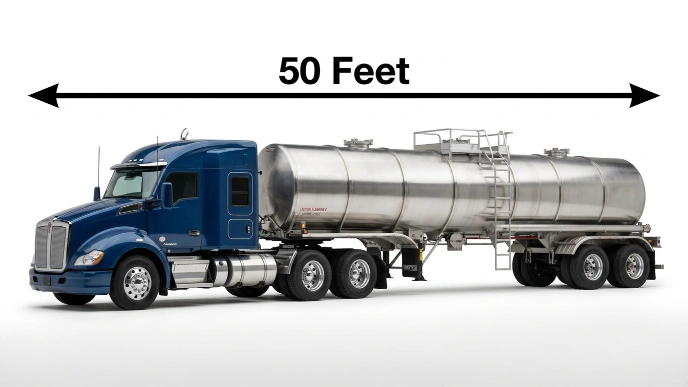
A large tractor-tanker combination can occupy roughly 40 to 50 feet or more, depending on tractor design, tank length, axle configuration, and applicable regulations. Some combinations exceed this range, so tanker trucks are best treated as broad visual references rather than exact 50-foot objects.
Tankers are common on highways and industrial routes, transporting liquids, fuels, chemicals, food-grade products, and other bulk materials. Their cylindrical tanks make them easy to distinguish from conventional box trailers, while the tractor adds substantial length ahead of the tank.
Visualize a large tanker combination from its front bumper to its rear-most point. A vehicle configuration near the upper end of the approximate range gives you a useful sense of how far 50 feet stretches along a roadway.
11. Mature White Pine Tree

Eastern white pine can grow considerably taller than 50 feet, with mature specimens commonly reaching roughly 50 to 80 feet or more under favorable conditions. A younger mature-looking specimen near the lower end of that range can therefore provide a convenient vertical comparison.
These evergreen trees develop straight trunks and layered branches and are found naturally across parts of eastern North America. Their eventual size depends on growing conditions, competition, age, climate, disease, and available soil and moisture.
To picture the target height, imagine a white pine that has reached approximately 50 feet from its base to its highest point. Because trees vary greatly, this works as a visualization aid rather than a reliable field measurement.
12. Five Ping Pong Tables
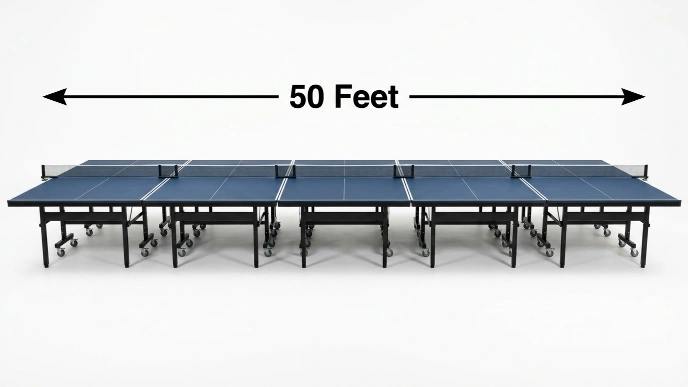
A regulation table tennis table measures 9 feet long, so five tables positioned end to end would span 45 feet, or 13.716 meters, before accounting for gaps. You would need another 5 feet beyond them to reach a full 50-foot distance.
Table tennis tables are familiar in recreation centers, schools, clubs, offices, and homes. Their regulated playing dimensions make them more consistent references than many everyday objects, although the space required to play around each table is much larger than the tabletop itself.
Picture five regulation tables touching end to end in one straight line, then add a five-foot extension. That complete line gives you the target distance while showing why five tables alone are slightly too short.
13. Two and a Half 20-Foot Containers

A standard 20-foot intermodal shipping container has a nominal exterior length of 20 feet. Two complete container lengths plus half of another therefore represent 50 nominal feet. In metric terms, the target distance is 15.24 meters.
Shipping containers are common at ports, freight terminals, warehouses, construction sites, and storage facilities. Standardized container dimensions make them useful visual references, though their precise ISO external dimensions are expressed metrically and the term “20-foot” functions as a nominal size designation.
Picture two 20-foot containers arranged end to end, producing about 40 nominal feet. Add another half-container length—roughly 10 feet—and the combined visual span reaches approximately the target.
14. Semi-Trailer
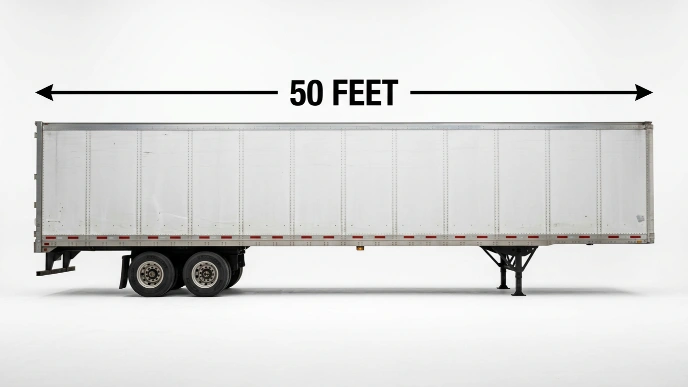
A full-size semi-trailer provides one of the easiest highway-based comparisons. Common dry-van trailers in North America are often 48 or 53 feet long. A 48-foot trailer is two feet short, while a 53-foot model is three feet longer than the target.
You see these trailers constantly on interstate highways, at distribution centers, warehouses, truck stops, and retail loading docks. Their long rectangular profile makes them especially convenient for visualizing length when viewed directly from the side.
Picture a 53-foot dry van and mentally remove three feet from its rear. Alternatively, add two feet to a 48-foot trailer. Either method produces a very practical approximation without needing an unusual object.
15. Height of the Hollywood Sign
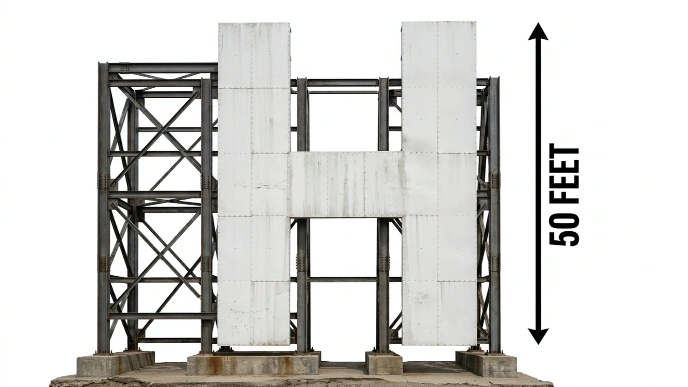
Each famous letter of the Hollywood Sign is approximately 45 feet tall, not 50 feet. That makes the letters about five feet shorter than the target height. In metric units, 45 feet equals roughly 13.72 meters, compared with 15.24 meters for the full measurement.
The sign sits on Mount Lee overlooking Los Angeles and appears smaller from distant viewpoints because of its position on the hillside. Up close, however, its individual letters are enormous structures rather than ordinary sign lettering.
Imagine placing a person approximately five feet tall directly above the top of a 45-foot letter. The combined height would be close to 50 feet, making the Hollywood Sign an effective near-match while keeping the comparison factually accurate.
Measure 50 Feet Without Any Tools
You can approximate this distance without a tape measure by using your own walking stride. If one natural step covers about 2.5 feet, approximately 20 steps will span 50 feet. Because stride length differs from person to person, this approach works best after you have previously measured your normal walking step over a known distance.
A regulation NBA court offers another option when one is available. Its width is exactly 50 feet, so crossing from sideline to sideline gives you the complete distance. A 48-foot or 53-foot semi-trailer can also serve as a visual reference when you only need an approximate mental estimate.
For home or outdoor estimates, pacing is generally the most convenient method. Walk naturally, avoid deliberately stretching your stride, and repeat the count several times. Averaging repeated attempts can reduce some of the inconsistency created by individual steps.
Two Measuring Mistakes Worth Knowing About 50 Feet
The first common mistake is treating every real-world comparison as exact. Trees, whales, trucks, buildings, boats, and human steps all vary. They are useful for building a mental picture, but they should not replace a tape, measuring wheel, laser distance meter, or verified specification when accuracy matters.
The second mistake is confusing horizontal length with vertical height. Mathematically, 50 feet remains 50 feet regardless of orientation, but human perception handles the two differently. A 50-foot building can appear more imposing than the same distance marked along flat ground because we encounter horizontal distances more frequently.
It is also worth checking whether a quoted dimension refers to overall length, usable length, height, width, or a nominal product category. This is particularly important with vehicles, boats, shipping containers, and construction materials, where naming conventions may differ from precise physical dimensions.
How Far Is 50 Feet to Walk?
Walking 50 feet is a very short trip for most able-bodied adults. The distance equals 16.67 yards or 15.24 meters. At an ordinary walking pace of around 3 miles per hour, covering it takes approximately 11 to 12 seconds, although actual time varies with pace and mobility.
In step terms, someone whose walking step measures around 2.5 feet would need about 20 steps. A person with a shorter stride may need more, while someone with a longer stride may reach the same point in fewer steps. This is why step counting is better for estimation than precise measurement.
For a simple experiment, find a regulation basketball court and walk directly across its 50-foot width. Count your natural steps and remember the result. You then have a personalized pacing reference that can help with future outdoor estimates.
When Is a 50-Foot Estimate Accurate Enough?
Approximation works well when you are trying to understand scale, compare spaces, plan a rough layout, or decide whether something is broadly larger or smaller than expected. For example, pacing can help you estimate a backyard before deciding whether a proposed feature is worth measuring more carefully.
Rough comparisons are less appropriate for construction, property boundaries, material ordering, safety clearances, engineering work, or anything where a small error can create additional cost or risk. Those situations call for proper measuring equipment and, where applicable, professional surveying or technical plans.
A useful rule is to match the method to the task:
- Use walking steps for quick outdoor estimates.
- Use known court dimensions for visual reference.
- Use a tape measure for shorter precision work.
- Use a measuring wheel for longer ground distances.
- Use a laser distance meter where direct electronic measurement is practical.
Visual comparisons answer “roughly how much space is that?” Measuring equipment answers “what is the actual dimension?” Knowing which question you need answered prevents unnecessary errors.
Read: What Is 5’2 in Inches?
Read: How Long Is 18 Inches?
Read: How Big Is 3 Inches?
Read: How Tall Is 40 Inches?
Read: How long is 16 Inches?
Read: How Long Is 12 Inches?
Read: How Tall is 60 Inches?
Read: How Long Is 14 Inches?
Frequently Asked Questions
How many inches are in 50 feet?
There are 600 inches in 50 feet. Since every foot contains 12 inches, multiplying 50 by 12 gives 600.
How many yards is this distance?
It equals approximately 16.67 yards, or exactly 16⅔ yards. Three feet make one yard, so the conversion is calculated by dividing 50 by 3.
How many meters is 50 feet?
How long is 50 Feet in metric units? It is exactly 15.24 meters, because one foot equals exactly 0.3048 meter.
How many steps does it take to walk this distance?
About 20 steps if each walking step covers approximately 2.5 feet. Your actual count can be higher or lower depending on your natural stride length.
Is an NBA basketball court 50 feet wide?
Yes. A regulation NBA basketball court measures 94 feet long by 50 feet wide. This makes the distance between its two sidelines an excellent exact visual reference.
Is a Hollywood Sign letter 50 feet tall?
No. The letters of the Hollywood Sign are approximately 45 feet tall, making each about five feet shorter than 50 feet.
Conclusion
How long is 50 Feet? It equals 600 inches, 16⅔ yards, 15.24 meters, 1,524 centimeters, or 15,240 millimeters. The width of an NBA basketball court is one of the clearest exact comparisons, while semi-trailers, whales, yachts, buildings, trees, and other large objects can provide useful approximate references.
For quick visualization, think of walking about 20 average 2.5-foot steps or crossing a regulation NBA court from sideline to sideline. When exact dimensions matter, however, rely on a proper measuring tool rather than an object comparison or estimated stride.