
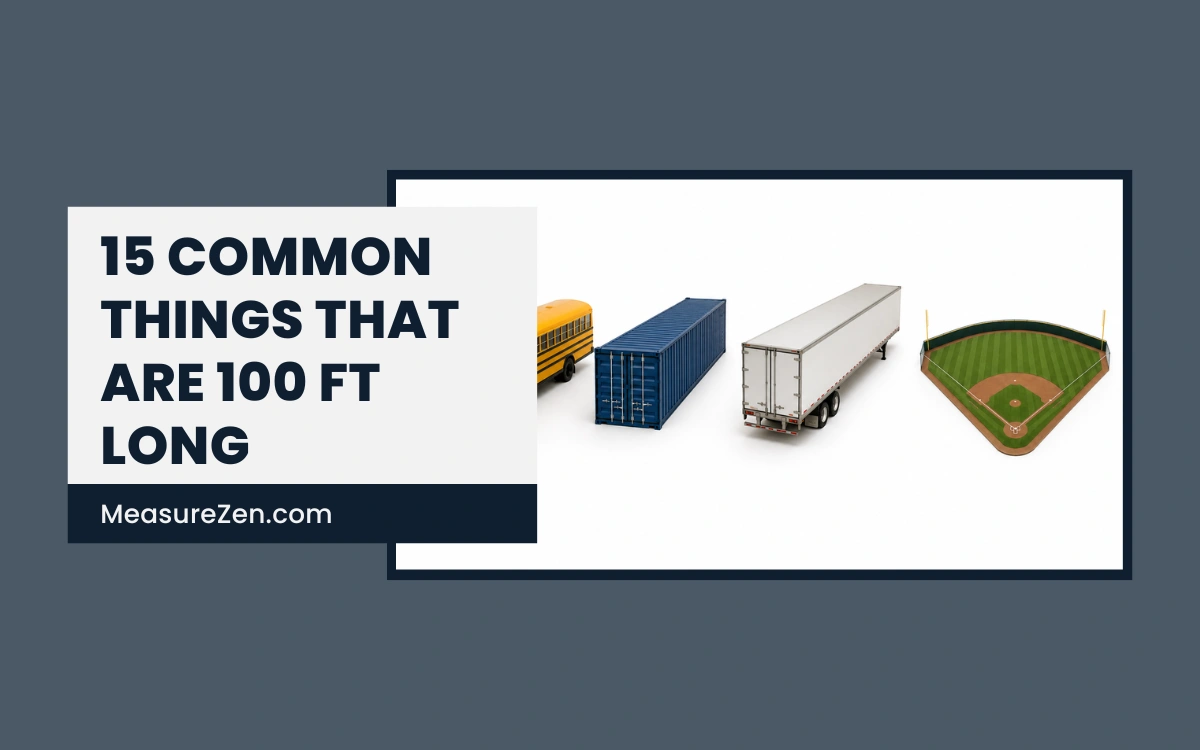
Quick Answer:
100 feet equals 1,200 inches, 30.48 meters, 3,048 centimeters, or 30,480 millimeters. It is roughly the length of a basketball court with a few extra feet added.
If you are trying to picture a distance of 100 feet, numbers alone may not help much. A measurement this long is easier to understand when you compare it with familiar structures, vehicles, sports areas, and objects you have probably seen in everyday life.
Knowing how long is 100 feet can be useful when estimating property dimensions, outdoor spaces, building heights, walking distances, sports fields, landscaping projects, and construction layouts. Real-world comparisons turn an abstract number into something you can mentally picture.
Below, you will find accurate conversions, familiar examples, walking estimates, and 15 practical comparisons. Some objects are almost exactly 100 feet long, while others provide an approximate visual reference.
100 Feet Conversion Chart
Quick and accurate measurement conversions
| Unit | Converted Value |
|---|---|
| Feet | 100 ft |
| Inches | 1,200 in |
| Yards | 33.33 yd |
| Centimeters | 3,048 cm |
| Millimeters | 30,480 mm |
| Meters | 30.48 m |
How Far Is 100 Feet?
A distance of 100 feet equals about 33.33 yards or 30.48 meters. On level ground, that is a moderate distance that most people can walk in well under a minute. It is long enough to span a large yard, stretch across part of a sports facility, or cover the frontage of some commercial and residential properties.
One of the easiest ways to picture it is with a regulation NBA basketball court, which measures 94 feet from baseline to baseline. Imagine walking the entire length of that court and continuing another 6 feet. That gives you a very close representation of the full distance without needing a tape measure.
Another useful reference is a football field. The 100-yard playing field is 300 feet long, excluding the end zones. Therefore, 100 feet represents exactly one-third of that 300-foot playing length.
What Measures 100 Feet in Length?
Objects measuring exactly 100 feet are less common than objects measuring a few inches or several feet. At this scale, the best references tend to be vehicles, buildings, athletic spaces, large animals, construction materials, and multiple smaller objects placed end to end.
A Boeing 737-500 is particularly useful because its overall length is about 101 feet 9 inches, putting it extremely close to the target. A very large blue whale can also approach 100 feet, although individual animals vary considerably. Regulation basketball courts and some hockey rink dimensions provide additional recognizable references.
For objects that are shorter, several identical items can be combined. Five 20-foot shipping containers, for example, give an exact nominal total of 100 feet when placed end to end without gaps.
Things That Measure 100 Feet in Length
| Object | Approximate Length | How It Compares |
|---|---|---|
| 10-story building | Around 100–120 ft tall | Approximate vertical comparison |
| One-third of football field | 100 ft | Exact for 300-ft playing field |
| Two school buses | Around 70–90 ft | Usually shorter |
| Large oak tree | Up to around 100 ft tall | Approximate height |
| Large blue whale | Around 90–100 ft | Very close |
| Boeing 737-500 | 101 ft 9 in | About 1 ft 9 in longer |
| Ten 10-ft kayaks | 100 ft | Exact if each is 10 ft |
| Rope bridge or zipline | Around 100 ft | Depends on installation |
| International hockey rink width | About 98.4 ft | Very close |
| NBA basketball court | 94 ft | 6 ft shorter |
| Two 53-ft semi-trailers | 106 ft | 6 ft longer |
| Two-thirds Olympic pool | About 109.4 ft | Around 9.4 ft longer |
| Five 20-ft containers | 100 ft | Exact nominal total |
| Ten 10-ft ladders | 100 ft | Exact nominal total |
| Twenty-five 4-ft tables | 100 ft | Exact nominal total |
1. A 10-Story Building

A 10-story building can provide a rough vertical comparison for 100 feet. Floor-to-floor height in many buildings is approximately 10 to 12 feet, meaning a 10-story structure may rise around 100 to 120 feet before rooftop equipment or architectural features are considered. Commercial buildings can have even taller floors.
You commonly see buildings of this scale in city centers, business districts, apartment developments, hospitals, and university campuses. Because ceiling heights, structural systems, and mechanical spaces differ, the number of floors should never be treated as a precise method of determining a building’s height.
Still, imagining the distance from the ground to roughly the upper portion of a 10-story building provides a useful vertical sense of scale. A building with approximately 10-foot floor-to-floor spacing would come especially close to 100 feet.
2. One-Third of a Football Field
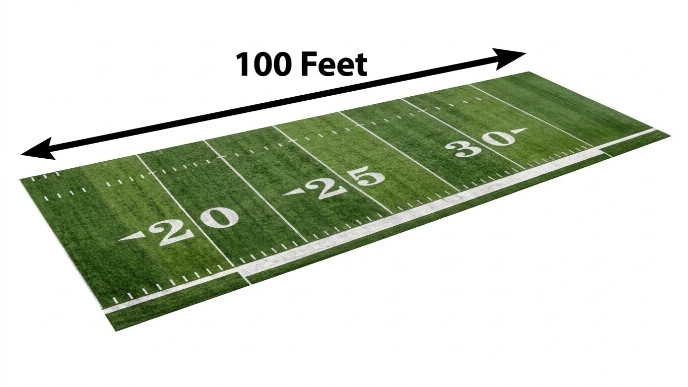
A standard American football playing field between the goal lines measures 100 yards, which equals 300 feet. Dividing that playing length into three equal sections gives exactly 100 feet, or approximately 30.48 meters. This makes one-third of the main field an especially accurate visual comparison.
Football fields are common at schools, universities, stadiums, athletic parks, and training facilities. If you have ever stood beside one, you already have a large reference surface that can make longer distances much easier to estimate than using smaller household objects.
Picture the distance from one goal line to a point one-third of the way toward the opposite goal line. That section measures 100 feet. Remember that this calculation refers to the 300-foot playing area between goal lines, not the additional end zones.
3. Two School Buses Parked End to End
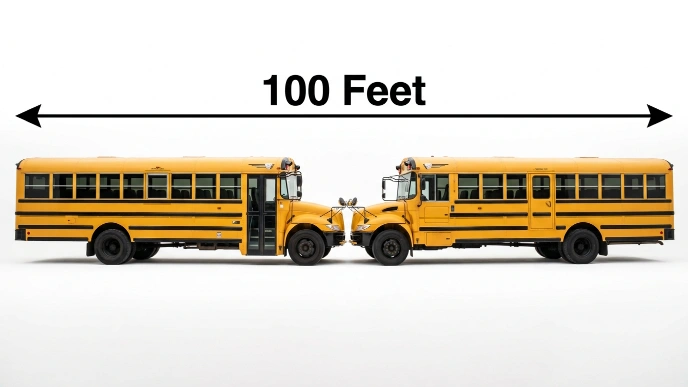
A full-size school bus is commonly around 35 to 45 feet long, although exact dimensions depend on the manufacturer, body style, and passenger capacity. Two 40-foot buses placed bumper to bumper would therefore cover roughly 80 feet, leaving another 20 feet needed to reach the target distance.
School buses are familiar because they regularly appear outside schools, on neighborhood streets, at transportation depots, and along highways. Their large rectangular bodies also make them particularly easy to use for visual estimation. Smaller school buses, however, can be considerably shorter than full-size models.
Two buses alone will usually not equal 100 feet, but they establish most of the distance. Picture two large 40-foot buses followed by another 20-foot section—roughly half the length of another similar bus—to visualize the full span more accurately.
4. A Large Oak Tree
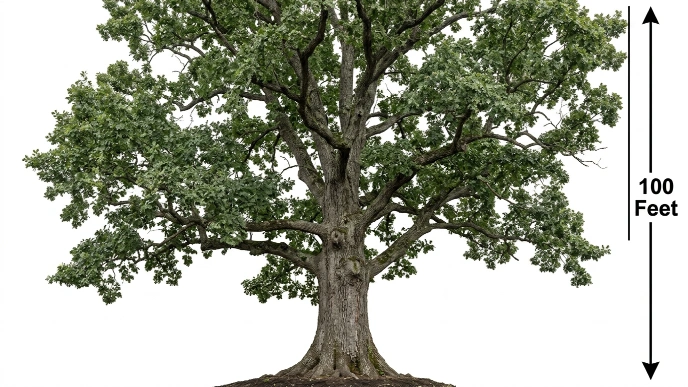
Mature oak trees vary substantially in height depending on species, age, climate, soil conditions, and growing environment. Many mature examples stand 50 to 80 feet tall, while certain large species and exceptional specimens can reach approximately 100 feet or more. That makes a particularly tall oak a useful vertical comparison.
Oak trees are common in parks, forests, large gardens, historic properties, and suburban landscapes. Their wide crowns can make them appear even more imposing than their measured height suggests. Because trees grow naturally rather than to standardized dimensions, no two mature specimens should be assumed to have identical measurements.
If you can picture an unusually tall mature oak reaching close to 100 feet into the air, rotate that height mentally onto the ground. It gives you a practical sense of how substantial this distance looks horizontally.
5. A Blue Whale
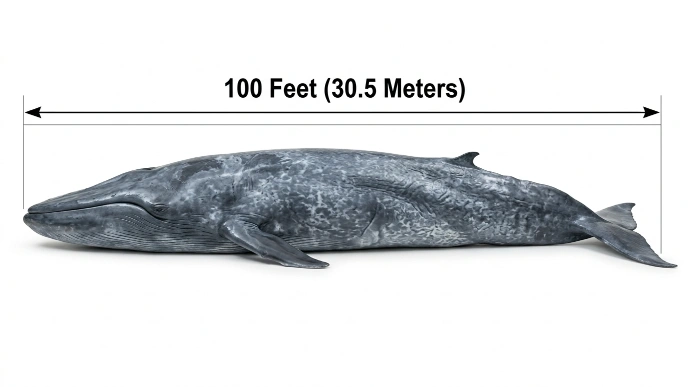
Blue whales are the largest animals known to have lived on Earth. Large adults can reach roughly 80 to 100 feet in length, with exceptional individuals approaching the upper end of that range. A 100-foot whale would measure approximately 30.48 meters from its snout to the end of its tail.
These enormous marine mammals live in oceans rather than places where people can easily stand beside them, which makes their scale difficult to appreciate. Museum exhibits, documentaries, life-size models, and skeleton displays can provide a better sense of just how much physical space such an animal occupies.
Imagine a very large blue whale laid out across the ground. An individual near the species’ maximum commonly cited size can provide one of the most memorable natural-world comparisons for a distance close to 100 feet.
6. The Boeing 737-500
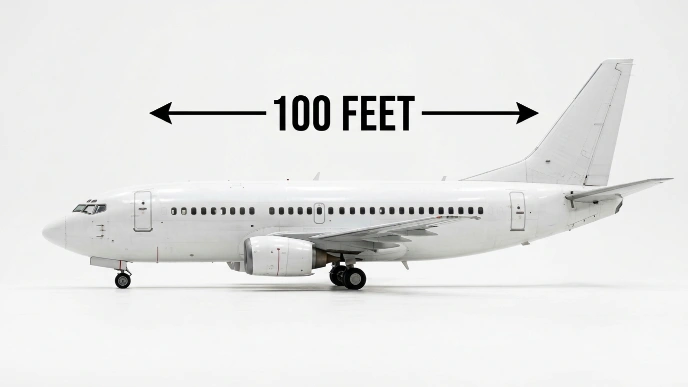
The Boeing 737-500 has an overall length of approximately 101 feet 9 inches, or about 31 meters. That puts the aircraft only 1 foot 9 inches beyond 100 feet, making it one of the closest single-object comparisons on this list.
Aircraft of this type may be seen at airports, aviation museums, maintenance facilities, or in historical airline photographs. Unlike comparisons involving trees or animals, an aircraft model has a defined manufactured dimension, making it a much more consistent reference.
Picture the entire fuselage length of a 737-500 and remove just under two feet from the total. What remains is approximately 100 feet. For people familiar with commercial aircraft, this provides a particularly effective sense of scale.
7. Ten Kayaks End to End
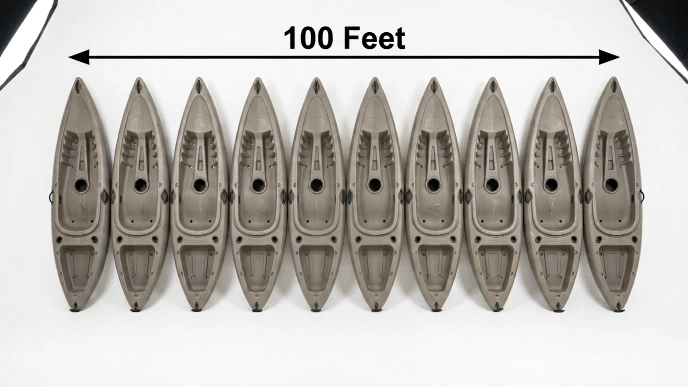
Recreational kayaks come in numerous sizes, but many common models are approximately 10 feet long. Ten kayaks measuring 10 feet each would produce a combined nominal length of exactly 100 feet when arranged end to end without spaces. That equals 1,200 inches or 30.48 meters.
Kayaks are frequently seen around lakes, rivers, beaches, rental centers, sporting-goods stores, and outdoor recreation areas. Their narrow shape makes them particularly easy to imagine in a straight row compared with wider objects such as vehicles or furniture.
Visualize ten standard 10-foot recreational kayaks lined up bow to stern. That entire row would extend about 100 feet, provided each kayak actually measures 10 feet and there are no gaps between them.
8. A Small Rope Bridge or Zipline
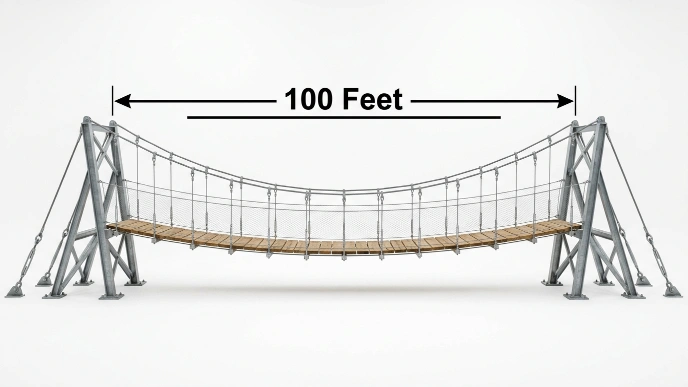
A small recreational rope bridge, suspension crossing, or backyard-to-commercial zipline can have a span around 100 feet, although these installations vary enormously. A 100-foot span equals approximately 30.48 meters, which is enough to cross a small ravine, stream, landscaped area, or section of an adventure course.
You may encounter installations of this general scale at adventure parks, camps, outdoor recreation facilities, playgrounds, and private properties. Professional ziplines can be hundreds or even thousands of feet long, so 100 feet should be viewed as a modest example rather than a universal standard.
If you have seen a short zipline stretching across an open recreational area, imagine a span of about 30 meters. That gives a useful visual reference for the distance, although the actual installation should be measured rather than estimated by appearance.
9. A Hockey Rink Width
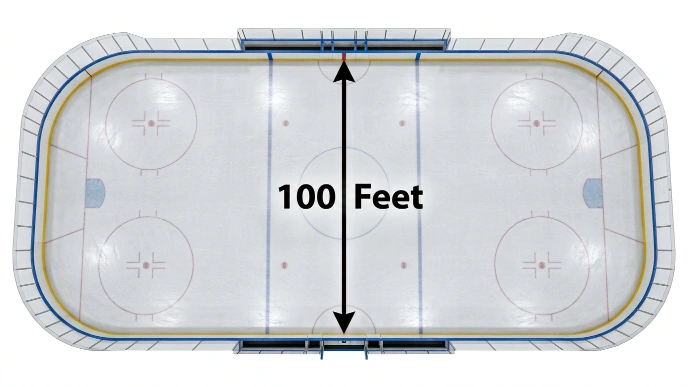
Hockey rink dimensions depend on the governing standard. An NHL rink is 85 feet wide, so it falls 15 feet short of the target. An international-size rink can be approximately 30 meters wide, equal to about 98.4 feet, making that version a much closer comparison.
Hockey rinks are found in professional arenas, community ice centers, schools, training facilities, and recreational complexes. Their clearly defined boards and rectangular layout make rink dimensions easier to visualize than irregular natural objects such as trees.
Picture crossing the width of an international rink measuring about 30 meters. At approximately 98.4 feet, you would need only another 1.6 feet to reach 100 feet. It is therefore an excellent near-match rather than an exact one.
10. A Basketball Court

An NBA basketball court is 94 feet long and 50 feet wide. Its full length equals approximately 28.65 meters, leaving a difference of only 6 feet from the target. Some other basketball courts use different dimensions, so the professional NBA standard is the relevant reference here.
Basketball courts are among the easiest large spaces to recognize because they appear in arenas, gyms, schools, universities, recreation centers, and outdoor parks. The baseline-to-baseline distance provides a clear, uninterrupted visual reference that many people have personally walked across.
Imagine standing at one baseline and looking toward the opposite baseline on an NBA-size court. The court covers 94 feet. Add another 6-foot strip beyond the far baseline, and you have a very practical representation of 100 feet.
11. Two Semi-Trailers
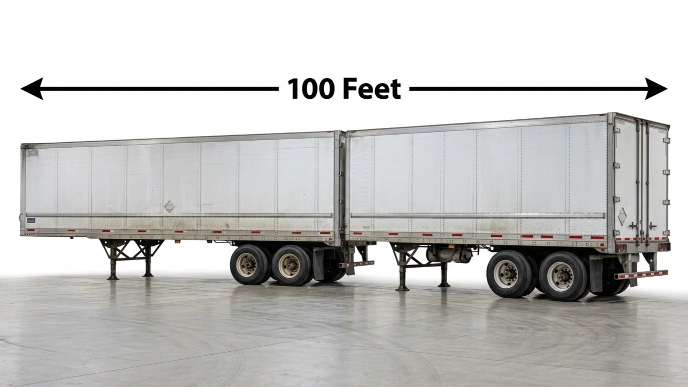
A common full-size semi-trailer in North America is approximately 53 feet long. Two such trailers placed directly end to end would therefore span about 106 feet, or roughly 32.31 meters, before accounting for any gaps. That is 6 feet longer than the target.
Semi-trailers are commonly seen on interstate highways, at warehouses, logistics centers, distribution facilities, truck stops, and loading docks. Their standardized rectangular shape makes them useful visual references, although trailer lengths vary and the tractor itself should not be included in this particular comparison.
Picture two 53-foot trailers arranged end to end and then remove 3 feet from each trailer’s combined visual span. The remaining 100-foot section gives a useful large-scale comparison that is easy to recognize around industrial or transportation areas.
12. Two-Thirds of an Olympic Swimming Pool
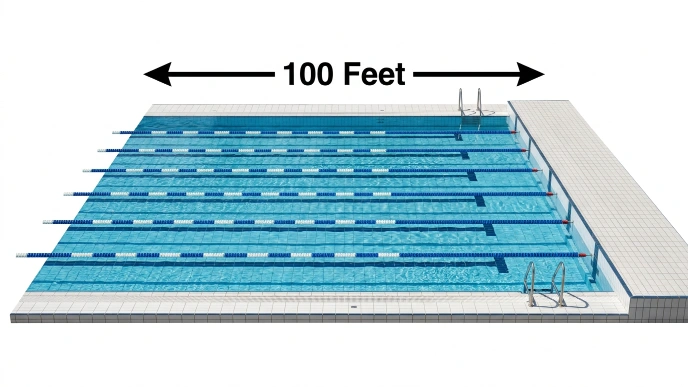
An Olympic swimming pool is 50 meters long, equivalent to approximately 164 feet. Two-thirds of that length is about 33.33 meters, or roughly 109.4 feet. Therefore, two-thirds of an Olympic pool is actually around 9.4 feet longer than 100 feet.
Olympic-size pools are found at major aquatic centers, universities, competition venues, and specialized training facilities. Their long, straight lanes provide an excellent reference for judging substantial distances because swimmers and spectators can see the entire length clearly.
For a more precise visualization, 100 feet represents about 61% of a 50-meter pool’s length. Imagine traveling slightly more than three-fifths of the way from one end to the other, rather than using two-thirds as an exact match.
13. Five 20-Foot Shipping Containers End to End
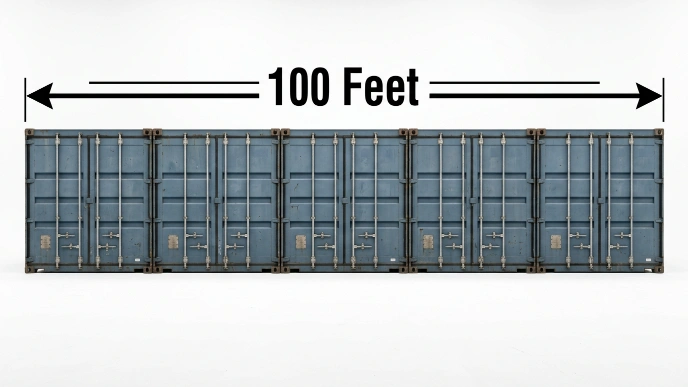
A standard 20-foot intermodal shipping container has a nominal exterior length of 20 feet. Five placed end to end therefore represent a nominal combined distance of exactly 100 feet, assuming the comparison uses their stated 20-foot length and does not introduce gaps between the containers.
Shipping containers are common at ports, freight terminals, warehouses, construction sites, storage facilities, rail yards, and industrial properties. Their standardized proportions make them especially helpful for estimating large dimensions. A 20-foot container is also substantial enough that only five are required for this comparison.
Imagine five standard 20-foot containers arranged in one straight line. Their nominal lengths add up neatly: 20 × 5 = 100 feet. This is one of the simplest large-object methods for mentally dividing the distance into equal sections.
14. Ten 10-Foot Ladders End to End

Ten ladders that each measure exactly 10 feet would create a nominal combined length of 100 feet when laid flat and placed end to end. A 10-foot ladder measures 120 inches or 3.048 meters, so ten of them represent 1,200 inches or 30.48 meters.
Ladders of this size are frequently used for home maintenance, painting, construction, warehouse tasks, landscaping, and access to moderately elevated areas. Keep in mind that ladder dimensions and usable working heights are different concepts, particularly for step and extension ladders.
For visualization purposes, picture ten actual 10-foot lengths arranged consecutively on level ground. Each ladder accounts for one-tenth of the full distance, making this comparison useful when mentally breaking a large measurement into manageable sections.
15. Twenty-Five 4-Foot Tables End to End
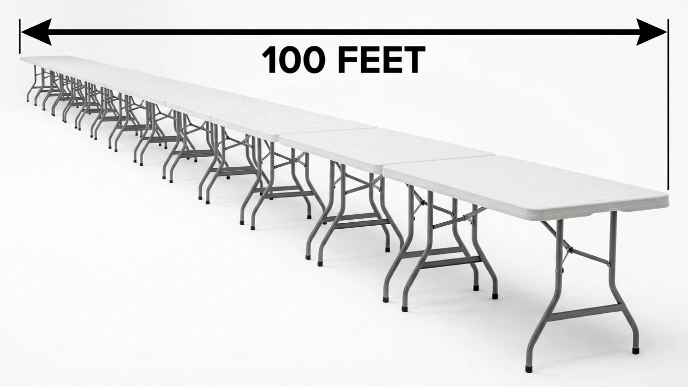
A table measuring exactly 4 feet in length contributes 48 inches, or approximately 1.219 meters, to a straight row. Twenty-five such tables placed end to end would produce a nominal total of exactly 100 feet because 25 multiplied by 4 equals 100.
Four-foot folding tables are often used at schools, offices, community halls, conferences, exhibitions, markets, parties, and temporary events. Their familiar size makes them useful for visual estimation, particularly if you regularly work with folding furniture or event layouts.
Imagine a continuous row of 25 four-foot tables with their short ends touching. The resulting line would extend 100 feet. This example also demonstrates how quickly a familiar small dimension becomes a substantial distance when repeated many times.
How Long Is 100 Feet to Walk?
Walking 100 feet usually takes only a short amount of time. At a typical adult walking speed of roughly 3 miles per hour, a person travels about 4.4 feet per second. At that pace, covering 100 feet would take approximately 23 seconds, assuming level ground and uninterrupted movement.
Actual walking time depends on age, stride length, physical condition, terrain, footwear, crowds, and whether the person is walking casually or briskly. Someone moving at 2 miles per hour would take roughly 34 seconds, while a brisk walker moving around 4 miles per hour could cover the same distance in about 17 seconds.
Another way to estimate the distance is with steps. If an average walking step covers roughly 2.3 to 2.6 feet, 100 feet may take approximately 38 to 44 steps. Individual stride patterns vary, so this method works best for rough estimation rather than precise measurement.
Why Use the Foot?
The foot is a unit of length in the U.S. customary and imperial measurement traditions. One foot contains exactly 12 inches and is defined internationally as exactly 0.3048 meter. Therefore, 100 feet converts precisely to 30.48 meters.
Feet remain widely used in the United States for building dimensions, room sizes, property measurements, construction, aviation, human height, sports, and numerous everyday applications. Even where the metric system is dominant, feet may still appear in specialized contexts or alongside meters.
Understanding the relationship between feet and metric units makes larger dimensions easier to communicate internationally. If someone is more comfortable with meters, simply remembering that 100 feet is a little over 30 meters provides a quick and practical reference.
Why 100 Feet Matters in Everyday Life
A 100-foot dimension appears frequently enough in property planning, architecture, sports, construction, landscaping, and outdoor recreation to be worth understanding. A property boundary might extend approximately this far, while building setbacks, parking areas, gardens, utility layouts, and recreational spaces may involve similar distances.
It is also a useful benchmark for estimating larger environments. A 100-foot tape measure, for instance, is a practical tool for surveying yards and construction sites. In sports, the same distance can be compared with portions of football fields, basketball courts, and other standardized playing surfaces.
Once you recognize that this measurement equals about 30.5 meters or one-third of a football field’s 300-foot playing length, estimating it visually becomes much easier. Familiar references reduce the need to mentally process large numbers of inches or centimeters.
How to Visualize 100 Feet Without a Measuring Tape
If you do not have a long tape measure, standardized spaces and repeated known lengths can provide a reasonable estimate. A regulation NBA court is particularly useful: its 94-foot length gets you within 6 feet. One-third of the 300-foot playing area of an American football field provides an exact reference.
You can also estimate the distance by walking. Depending on your natural step length, around 40 ordinary steps may put you somewhere near 100 feet. For better results, first measure your average step length over a known distance and then calculate how many steps are required.
Other useful reference methods include:
- Football field: one-third of the 300-foot goal-line-to-goal-line length.
- NBA court: 94 feet plus another 6 feet.
- Metric estimate: picture approximately 30.5 meters.
- 20-foot containers: five nominal container lengths.
- 10-foot sections: repeat a known 10-foot length ten times.
These methods are useful for rough visualization. For construction, property boundaries, safety clearances, or any task requiring precision, use a suitable measuring tool rather than relying on visual estimates.
Read: What Is 5’2 in Inches?
Read: How Long Is 18 Inches?
Read: How Big Is 3 Inches?
Read: How Tall Is 40 Inches?
Read: How long is 16 Inches?
Read: How Long Is 12 Inches?
Read: How Tall is 60 Inches?
Read: How Long Is 14 Inches?
Frequently Asked Questions
Is 100 feet equal to 30 meters?
Not exactly. One hundred feet equals precisely 30.48 meters. Saying 30 meters is acceptable for a quick visual estimate, but it is about 1.57 feet shorter than the exact distance.
How many yards are in 100 feet?
There are approximately 33.33 yards in 100 feet. Since one yard equals 3 feet, divide 100 by 3 to get 33⅓ yards.
How many steps does it take to walk this distance?
For many adults, it may take roughly 38 to 44 ordinary walking steps. The actual number depends on step length. Someone with shorter steps will need more, while someone with a longer stride will need fewer.
Is a basketball court 100 feet long?
No. A regulation NBA basketball court is 94 feet long. It is therefore 6 feet shorter than 100 feet, making it a close and convenient comparison rather than an exact match.
Is 100 feet one-third of a football field?
Yes, when referring to the 100-yard playing area between the goal lines. That section measures 300 feet, so one-third equals exactly 100 feet. If the two 10-yard end zones are included, the field’s total length is 360 feet.
Conclusion
So, How Long Is 100 Feet? It equals 1,200 inches, 33⅓ yards, or exactly 30.48 meters. At this scale, familiar references are usually more useful than raw numbers. One-third of a football field’s 300-foot playing length is exact, while a 94-foot NBA court and a 101-foot-9-inch Boeing 737-500 provide close visual comparisons.
For quick estimation, think of five nominal 20-foot shipping containers or ten 10-foot lengths arranged end to end. These simple comparisons make the distance easier to picture without repeatedly converting between feet, inches, and metric units.