Quick Answer:
10 feet equals 120 inches, 304.8 cm, 3,048 mm, or 3.048 meters. It is roughly the height of a basketball hoop or the width of a typical room.
Trying to picture a distance without a tape measure can be surprisingly difficult, especially when it is longer than most household objects. Comparing the distance with familiar furniture, rooms, sports equipment, and outdoor items makes it much easier to understand visually.
A length of 10 Feet is large enough to span part of a room, reach the height of a basketball hoop, or cover the combined length of several everyday objects. These comparisons are useful when estimating furniture placement, ceiling clearance, garden layouts, storage areas, and other spaces.
Below, you will find exact conversions along with 12 practical real-world examples. Since manufactured products and room dimensions vary, most object comparisons are approximate rather than universal measurements.
10 Feet Conversion Chart
Quick and accurate measurement conversions
| Unit | Converted Value |
|---|---|
| Feet | 10 ft |
| Inches | 120 in |
| Centimeters | 304.8 cm |
| Millimeters | 3,048 mm |
| Meters | 3.048 m |
| Yards | 3.33 yd |
Ten feet converts to exactly 120 inches because each foot contains 12 inches. In the metric system, the same distance is exactly 304.8 centimeters, 3,048 millimeters, or 3.048 meters. These conversions are particularly useful when specifications are provided in a measurement system different from the one you normally use.
For a quick mental estimate, think of the distance as slightly more than three meters or about three and one-third yards. That gives you several ways to interpret the same dimension depending on whether you are measuring furniture, room dimensions, construction materials, or outdoor spaces.
Keeping these conversions in mind also makes the comparisons below more useful. Instead of relying on an object as a precise measuring device, you can use it as a visual reference and then confirm the actual distance with a tape measure when accuracy matters.
How Big Is 10 Feet?
A ten-foot distance is substantial in an ordinary indoor setting. It equals 120 inches from one end to the other and extends slightly beyond three meters. If you marked that distance across a floor, it could represent the width of a modest room or occupy a significant portion of a larger living space.
Vertically, this height reaches the rim of a regulation basketball hoop, which is positioned 10 feet above the playing surface. That makes a basketball goal one of the easiest references for understanding the scale. Horizontally, imagine stretching the same distance across a bedroom, dining area, patio, or small office.
The measurement can therefore feel different depending on its orientation. Ten feet overhead looks quite tall, while the same distance across a floor appears more manageable. Furniture, ladders, boats, rugs, benches, and room dimensions provide useful references for building a more accurate mental picture.
Quick Comparison Table: Things That Are 10 Feet Long
Everyday objects rarely measure exactly the same length across all brands, models, and designs. The examples in this table are therefore best treated as visual references. Some are close to ten feet individually, while others reach approximately that distance when two objects are combined.
Looking at several categories also provides a better sense of scale than relying on one comparison alone. A room width helps with indoor visualization, a basketball hoop demonstrates vertical height, and objects such as boats, rugs, ladders, and patio umbrellas show how the distance appears outdoors.
| Object | Approximate Length/Size | How It Compares |
|---|---|---|
| Standard room width | 10 ft | Can be close to the full measurement |
| Two sofas together | About 10–14 ft | Shorter sofas can approach 10 ft combined |
| Large dining table | About 8–10 ft | Largest models can reach roughly 10 ft |
| Medium-sized ladder | About 10 ft | Common direct comparison |
| Small boat | About 8–12 ft | Some compact boats are near 10 ft |
| Pickup truck bed | About 5.5–8 ft | Shorter than 10 ft on most pickups |
| Basketball hoop height | 10 ft | Exact regulation rim height |
| Two doors stacked | About 13–16 ft | Usually longer than 10 ft |
| Large carpet or rug | About 10 ft on one side | Common rug dimension |
| Short garden hose | 10 ft | Available as a short hose length |
| Two park benches | About 10–12 ft | Close when placed end to end |
| Large patio umbrella | About 10–11 ft diameter | Similar across its canopy |
These references also demonstrate why approximate comparisons should be checked carefully. A basketball hoop gives an exact standardized height, whereas sofas, doors, truck beds, and benches can vary considerably. For casual visualization, however, each provides a familiar scale that makes the distance easier to imagine.
1. Standard Room Width

A smaller bedroom, office, or similar residential room may measure around 10 feet across one dimension, equal to about 3.05 meters or 304.8 centimeters. Room dimensions vary substantially by building design, but a roughly 10-foot wall-to-wall span is common enough to provide a practical reference for this distance.
You can encounter a space around this width in bedrooms, home offices, compact dining rooms, and smaller living areas. Walking from one wall to the opposite wall gives you a physical sense of the distance that is often easier to remember than simply looking at a number on a measuring tape.
To visualize the target length, picture standing beside one wall of a room that measures approximately 10 feet wide and looking directly toward the opposite wall. The full gap between those surfaces provides a straightforward indoor comparison, although the actual dimensions of your room should be measured before using it as a reference.
2. Two Sofas Placed Together

A standard three-seat sofa is often somewhere around 6 to 7 feet long, although compact models can be shorter and oversized designs can be longer. Two typical sofas placed end to end would therefore usually exceed ten feet, potentially producing a combined length of roughly 12 to 14 feet.
Sofas are familiar fixtures in living rooms, family rooms, hotel lounges, waiting areas, and offices. Because most people have regularly sat on or walked past one, they offer an accessible visual reference. Smaller loveseats or compact sofas placed together may produce a combined span closer to the target distance.
For a reasonably close visualization, imagine two compact sofas measuring about 5 feet each positioned end to end. Their combined length would be around 10 feet. If you use full-size sofas instead, remember that the resulting distance will generally be noticeably longer, so this comparison depends heavily on the furniture dimensions.
3. Large Dining Table
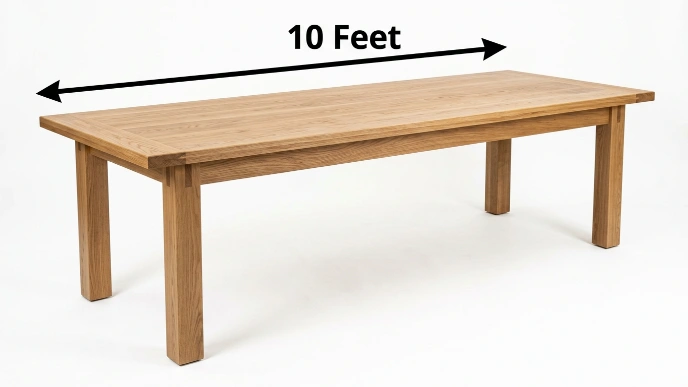
Large dining tables designed for eight to twelve people may range from roughly 8 to 10 feet in length. A table at the upper end of that range measures about 120 inches or 304.8 centimeters long, making it a convenient single-object reference for understanding a ten-foot horizontal span.
Tables of this scale are most commonly found in spacious dining rooms, conference spaces, banquet areas, restaurants, and large family homes. Their extended surface provides room for numerous chairs, serving dishes, or meeting materials. Extension tables can also reach these dimensions when their additional leaves are fully installed.
Picture yourself standing at one end of a very long dining table and looking toward someone seated at the opposite end. A table measuring approximately ten feet gives you nearly the full distance in one familiar object, making it especially useful for imagining the measurement across an indoor floor.
4. Medium-Sized Ladder

Many ladders are sold in nominal sizes around 10 feet, though their usable height, overall length, and reach can differ according to ladder type and manufacturer specifications. A straight ladder with an actual length close to 10 feet measures roughly 3.05 meters from one end to the other.
Ladders of this general size are used for home maintenance, painting, accessing elevated storage, trimming trees, and reaching moderately high areas. They may be stored horizontally in garages or sheds, which can make their full physical length easier to appreciate than when they are positioned vertically against a structure.
Imagine a 10-foot straight ladder laid flat on the ground. The distance from its bottom to its top offers a simple visual representation of the measurement. When using a ladder as a reference, check its actual dimensions because nominal ladder sizes and safe working heights are not necessarily the same thing.
5. Small Boat

Small recreational boats, dinghies, tenders, and compact fishing boats can fall within an approximate range of 8 to 12 feet in overall length. A model measuring around 10 feet would extend about 3.05 meters from bow to stern, providing another useful comparison for this distance.
Boats in this size category are commonly used on calm lakes, ponds, protected coastal waters, or as tenders for larger vessels. Depending on the design, they may accommodate only a few people and can sometimes be transported on a trailer or carried with specialized equipment.
Visualize a compact boat sitting beside a dock and measure mentally from the front tip of its bow to the rear of the hull. A model close to ten feet long represents the target distance well. Boat dimensions vary widely, however, so this comparison works best with smaller craft whose specifications are known.
6. Pickup Truck Bed

Pickup beds are useful references, but most standard production trucks do not have a 10-foot factory bed. Common bed lengths are approximately 5.5, 6.5, or 8 feet. An 8-foot bed is about 96 inches long, leaving roughly another 24 inches, or 2 feet, to reach the full target distance.
Pickup trucks are frequently seen on roads, construction sites, farms, and residential properties. Their cargo beds are designed to transport equipment, building materials, furniture, and other bulky items. Because truck beds have clearly defined front and rear boundaries, their dimensions are relatively easy to visualize.
To estimate ten feet, picture a long 8-foot pickup bed and mentally add another 2 feet beyond the tailgate. That extra section is approximately the length of a standard school ruler placed end to end twice. This makes a long-bed pickup a useful partial reference rather than an exact one-object comparison.
7. Basketball Hoop Height

A regulation basketball rim is exactly 10 feet, or 3.048 meters, above the playing surface. This standardized height makes a basketball hoop one of the most accurate everyday references on this list. The measurement is taken vertically from the floor or court surface to the upper edge of the rim.
You can see hoops at schools, parks, gyms, recreation centers, driveways, and professional basketball arenas. Although backboard sizes and support structures differ, the standard rim height remains the familiar reference used in regulation play. Adjustable residential hoops, however, may be positioned lower for younger players.
Stand beneath a correctly adjusted regulation hoop and look upward at the rim. The vertical distance from the ground to that rim is exactly the measurement being visualized. Because this comparison does not rely on approximate furniture dimensions, it provides a particularly reliable sense of how tall the distance looks.
8. Two Standard Doors Stacked

A standard residential door is commonly around 80 inches tall in the United States, or approximately 6 feet 8 inches. Two such doors stacked end to end would measure about 160 inches, equal to 13 feet 4 inches, meaning this combination is actually more than three feet longer than ten feet.
Interior and exterior doors are useful references because their height is familiar from everyday experience. You pass through them at homes, offices, schools, shops, and public buildings. Taller doors also exist, including 7-foot and 8-foot designs, so exact dimensions depend on the building and door specification.
Rather than treating two full doors as an exact match, picture one 80-inch door plus another 40 inches of a second door. That combined span equals 120 inches, or ten feet. This adjusted comparison provides a much more accurate way to use standard residential doors as a visual reference.
9. Large Carpet or Rug
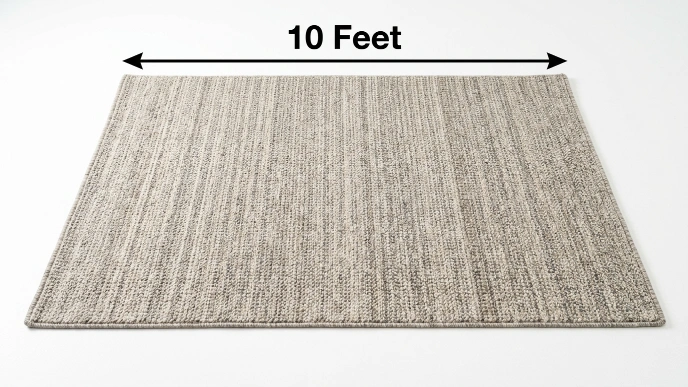
Large area rugs commonly come in standardized nominal dimensions such as 8 × 10 feet or 9 × 12 feet. An 8 × 10 rug therefore has one side that measures approximately 10 feet, though actual manufactured dimensions can be slightly smaller than the advertised nominal size.
These rugs are commonly placed beneath dining tables, beds, sofas, and living-room seating arrangements. Because an area rug lies flat on the floor, it clearly outlines a measurable rectangular space. This makes it especially helpful for understanding how much floor area a particular furniture arrangement may occupy.
If you have seen an 8 × 10 rug, focus on its longer edge. That side provides a close representation of the target length from one corner to the other. Unlike comparisons involving multiple objects, a rug allows you to see nearly the entire distance marked clearly along a single straight floor-level boundary.
10. Garden Hose (Short Length)

Garden hoses are manufactured in many lengths, with 25, 50, and 100 feet being common for general outdoor watering. Short leader or utility hoses are also available in lengths around 10 feet. A hose of this size measures 120 inches or approximately 3.05 meters when stretched straight.
Short hoses are often used for connecting hose reels, reaching nearby planters, linking equipment, washing small outdoor areas, or making connections where a full-length garden hose would be unnecessarily bulky. Their flexibility means they may look much shorter when they are coiled or curved during storage and use.
To visualize the measurement correctly, imagine a 10-foot hose pulled straight along a driveway, patio, or lawn rather than coiled. The distance between its two connectors then represents the full span. This is particularly useful because the hose itself can physically trace the length across a surface.
11. Two Park Benches Placed End to End

Many park benches are approximately 5 to 6 feet long, although compact and oversized models are also available. Two 5-foot benches placed directly end to end would create a combined span of approximately 10 feet, while a pair of 6-foot benches would extend closer to 12 feet.
Benches of these sizes are frequently found in public parks, walking trails, schools, transit areas, gardens, and outdoor recreation spaces. A five-foot model provides enough seating for several people while remaining relatively compact. Since benches have long straight seating surfaces, estimating their total length is visually straightforward.
Imagine two shorter park benches, each about five feet long, positioned so that the end of one touches the beginning of the other. Together, their seating lengths create a useful ten-foot reference. If the benches are six-foot models, mentally remove about one foot from each to reach the same target distance.
12. Large Patio Umbrella Diameter

Large market and patio umbrellas are commonly available with canopy diameters around 9, 10, or 11 feet. A round umbrella with a 10-foot diameter spans approximately 120 inches or 304.8 centimeters across its widest point when the canopy is completely open.
Umbrellas of this size are often used over large outdoor dining tables, poolside seating, commercial patios, and backyard entertainment areas. The broad canopy provides shade for several chairs at once. Because the umbrella spreads horizontally overhead, its size may appear surprisingly large compared with the same measurement marked along the ground.
Picture a large open patio umbrella and draw an imaginary straight line from one edge of its canopy through the center pole to the opposite edge. On a model with a 10-foot diameter, that line gives you the full target distance and demonstrates how much horizontal space the measurement can cover.
Easy Ways to Visualize This Distance Without a Tape Measure
If you do not have measuring equipment nearby, combining familiar standardized or reasonably predictable references can help you estimate the distance. The result will not be precise enough for construction or technical work, but it can help when you only need a quick mental approximation.
A few useful approaches include:
- Imagine the vertical distance from a basketball court to a regulation rim.
- Use the longer side of a nominal 8 × 10-foot area rug.
- Picture two objects that are each approximately 5 feet long placed end to end.
- Start with an 8-foot pickup bed and mentally add another 2 feet.
- Think of slightly more than three meters when using the metric system.
For furniture purchases, construction, interior layouts, or any task where a few inches matter, always replace visual estimation with a proper tape measure or laser measuring device. 10 Feet is easy to approximate with familiar references, but everyday objects often vary enough to create significant measurement errors.
Read: How Big Is 5cm?
Read: How Tall Is 40 Inches?
Read: How Big Is 40cm?
Read: How Big Is 7cm?
Read: How Big Is 3 Centimeters?
Read: How long is 16 Inches?
Read: How Big Is 10mm?
Read: How Long Is 12 Inches?
Read: How Big Is 7mm?
Read: How Long Is 20 Feet?
Frequently Asked Questions
How Many Inches Are in Ten Feet?
There are exactly 120 inches in ten feet. Each foot contains 12 inches, so multiplying 10 by 12 gives 120. This conversion is useful when working with furniture dimensions, construction plans, room measurements, and products whose specifications are listed in inches rather than feet.
How Many Meters Is This Distance?
The distance converts to exactly 3.048 meters. Since one foot equals exactly 0.3048 meters, multiplying that value by ten produces 3.048 meters. For quick visualization rather than precise measurement, you can think of it as just over three meters.
Is a Basketball Hoop Really This High?
Yes. A regulation basketball rim is positioned exactly 10 feet, or 3.048 meters, above the playing surface. Adjustable recreational hoops may be set lower, so make sure you are looking at a regulation-height hoop if you want to use it as a visual reference.
Is a Typical Ceiling This Tall?
Some residential ceilings are approximately 10 feet high, but many homes use lower ceiling heights, such as 8 or 9 feet. Ceiling dimensions vary according to the property, room, building period, and architectural design, so a ceiling should not automatically be assumed to provide an exact reference.
Can I Estimate This Length Using My Steps?
Yes, but only approximately. An adult walking step can vary considerably based on height, gait, and walking speed. Several normal steps may cover roughly this distance, but pacing should not replace a tape measure when you need accurate dimensions for furniture, construction, or installation work.
Conclusion
10 Feet equals 120 inches, 304.8 centimeters, 3,048 millimeters, or 3.048 meters. A regulation basketball hoop provides one of the clearest exact references, while large rugs, ladders, compact boats, room widths, and patio umbrellas can offer useful approximate comparisons.
For everyday visualization, choose an object you already know well and compare the required space against it. Just remember that sofas, doors, benches, boats, truck beds, and other manufactured objects vary in size. When precise dimensions affect whether something will fit, use these comparisons for perspective and a measuring tool for the final check.