Quick Answer:
40 feet is equal to 12.192 meters, 1,219.2 centimeters, 12,192 millimeters, or 480 inches. It is roughly the length of a standard 40-foot shipping container.
If you are trying to picture a distance of 40 feet without pulling out a tape measure, everyday objects can make the number much easier to understand. On paper, 40 feet sounds straightforward, but estimating that span across a room, yard, road, or building is considerably harder.
Understanding how long is 40 feet can be useful when planning outdoor spaces, estimating building dimensions, choosing ladders, comparing vehicles, or simply developing a better sense of scale. Familiar objects provide a practical visual reference when precise measuring tools are unavailable.
Below, you will find exact conversions, explanations of its overall size and height, plus 10 recognizable real-world comparisons that help put this measurement into perspective.
40 Feet Conversion Chart
Quick and accurate measurement conversions
| Unit | Converted Value |
|---|---|
| Feet | 40 ft |
| Inches | 480 in |
| Yards | 13.33 yd |
| Centimeters | 1,219.2 cm |
| Millimeters | 12,192 mm |
| Meters | 12.192 m |
How Long Is 40 Feet?
A length of 40 feet stretches exactly 480 inches from one end to the other. In metric measurements, that works out to 12.192 meters. If you walked this distance at a normal pace, it would take roughly 15 to 20 average adult steps, depending on your stride. That makes it large enough to cross a substantial room, driveway, or section of a backyard.
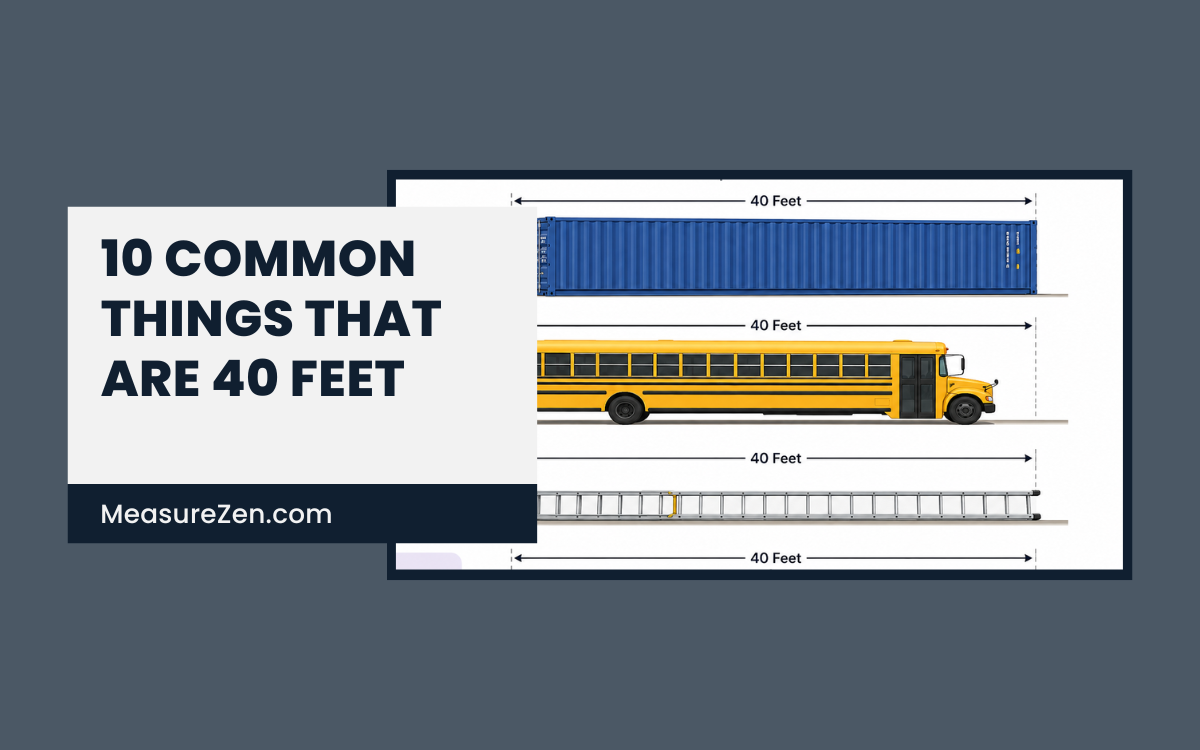
For another perspective, imagine placing four 10-foot sections end to end. You could also picture a full-size 40-foot intermodal shipping container, one of the most convenient near-exact references. The distance is considerably longer than a typical passenger car and approaches the length of larger road vehicles such as some school buses.
Because this dimension can represent length, width, or height, the way it appears changes with orientation. Forty feet horizontally may seem manageable, while the same distance viewed vertically can look surprisingly high.
How Big Is 40 Feet?
Forty feet is a substantial dimension in most everyday environments. It equals about 13⅓ yards, meaning you would need more than thirteen standard 3-foot yardsticks placed end to end to cover it. In residential settings, this span may represent the width of a large lot section, the depth of a backyard, or the length of a sizable room or garage area.
In vehicle terms, a typical passenger car is only around 14 to 16 feet long. Placing roughly two and a half average cars bumper to bumper would therefore produce a distance close to this measurement. A standard 40-foot shipping container gives an even simpler visual because its nominal exterior length is essentially the target dimension.
Scale also depends heavily on surroundings. Outdoors, 40 feet can appear relatively modest across an open field. Indoors or vertically beside a building, however, the exact same measurement feels much larger because nearby objects provide stronger visual references.
How High Is 40 Feet in the Air?
A height of 40 feet reaches approximately 12.2 meters above ground level. In building terms, it is comparable to the overall height of roughly a three- to four-story structure, although actual story heights differ considerably between residential and commercial buildings. Standing at ground level and looking upward makes this distance feel far greater than seeing the same span laid horizontally.
Another useful reference is a mature tree or tall utility-style pole. Many medium-sized trees eventually reach the 30- to 50-foot range, putting their upper canopy near this height. Certain outdoor lighting poles can also approach 40 feet, particularly those designed to illuminate roads, parking areas, and larger public spaces.
If you need to estimate this height visually, count building levels rather than trying to judge the open air itself. Assuming roughly 10 feet per level gives a simple mental estimate of four stories, though it should not replace an actual measurement where accuracy or safety matters.
What Does 40 Feet Look Like in Real Life?
Real-world objects are often more useful than numbers when estimating a large distance. A shipping container offers the cleanest reference, but vehicles, trees, sports courts, ladders, and buildings can also provide a reasonable sense of scale.
Some comparisons are almost exact, while others depend on the specific model, species, or design. For example, school buses come in different lengths, and tree heights vary considerably with age and growing conditions. These examples should therefore be treated as visualization aids rather than precision measuring tools.
The following 10 comparisons show how this distance can appear horizontally and vertically, making it easier to recognize in everyday surroundings.
| Object | Approximate Size | How It Compares |
|---|---|---|
| Standard shipping container | 40 ft long | Almost exact |
| Six 6.5-ft Christmas trees | 39 ft combined | Very close |
| Full-size school bus | 35–40+ ft long | Close |
| Tall light pole | Around 40 ft | Close |
| Large whale shark | Up to around 40 ft | Close |
| Multi-story building | Around 40 ft | Approximate |
| Tennis court length | 78 ft | About half |
| Extension ladder | Up to 40 ft | Near exact |
| Basketball court length | 94 ft | Slightly under half |
| Mature maple or oak | Around 40+ ft tall | Approximate |
1. A Standard Shipping Container
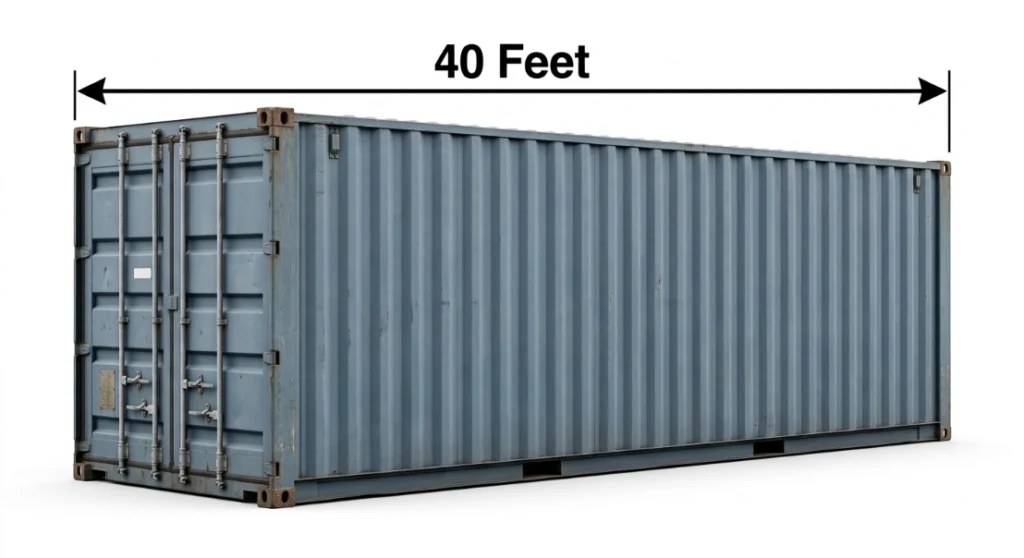
A standard long intermodal shipping container is the most direct comparison on this list. A nominal 40-foot container measures about 40 feet externally, or approximately 12.2 meters. Its width and height are much smaller, so its long rectangular shape makes the full distance particularly easy to see.
These containers are commonly transported by cargo ships, freight trains, and semi-trailer trucks. You may also see them at construction sites, warehouses, ports, storage facilities, and properties where they have been converted into workshops or modular structures.
If you have ever stood beside one from end to end, you have essentially seen this target length in physical form. Because the comparison requires no multiplication or stacking of objects, it is one of the easiest references to remember.
2. Six Christmas Trees
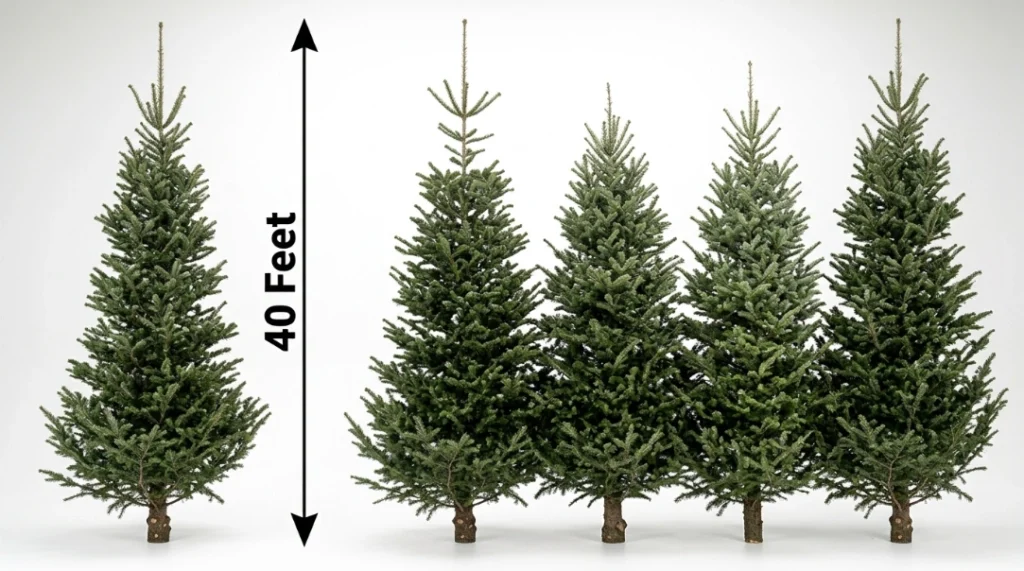
A common medium-to-tall household Christmas tree is around 6 to 7 feet high. Six trees averaging about 6 feet 8 inches each would total approximately 40 feet when imagined end to end. Six 6.5-foot trees would reach about 39 feet, leaving only a one-foot difference.
Trees in this size range are commonly used in homes with standard or moderately high ceilings. Artificial versions are particularly useful for comparison because manufacturers usually list their height clearly, making them familiar reference points during the holiday season.
Picture six typical living-room Christmas trees lying horizontally with their bases and tops aligned. Their combined length would give you a surprisingly accurate mental picture of the distance being discussed.
3. A Standard School Bus

Full-size school buses commonly fall somewhere in the neighborhood of 35 to 40-plus feet long, depending on their chassis, passenger capacity, and configuration. Larger models can therefore provide a strong visual approximation of this measurement, although not every school bus is exactly the same length.
School buses are familiar because their long bodies are easy to recognize on roads, outside schools, and in parking areas. Their proportions also make them useful for estimating larger dimensions that would otherwise be difficult to judge by eye.
Imagine the distance from the front bumper to the rear of a large full-size school bus. That gives you a practical idea of what a roughly 40-foot horizontal span looks like without needing to measure the ground directly.
4. A Light Pole

Tall outdoor light poles used along roadways, in large parking lots, and around commercial properties can reach approximately 30 to 40 feet or more. A 40-foot pole extends about 12.2 meters vertically, making it a useful reference for understanding the target measurement as height rather than length.
Unlike shorter residential lamp posts, commercial poles are designed to spread light over wide areas. Their extra height allows fixtures to illuminate roads, parking spaces, intersections, and public areas more efficiently.
Standing near a tall parking-lot or roadway light pole provides a strong visual impression of this scale. Looking upward also demonstrates why 40 feet feels significantly larger when oriented vertically than when measured along flat ground.
5. A Whale Shark
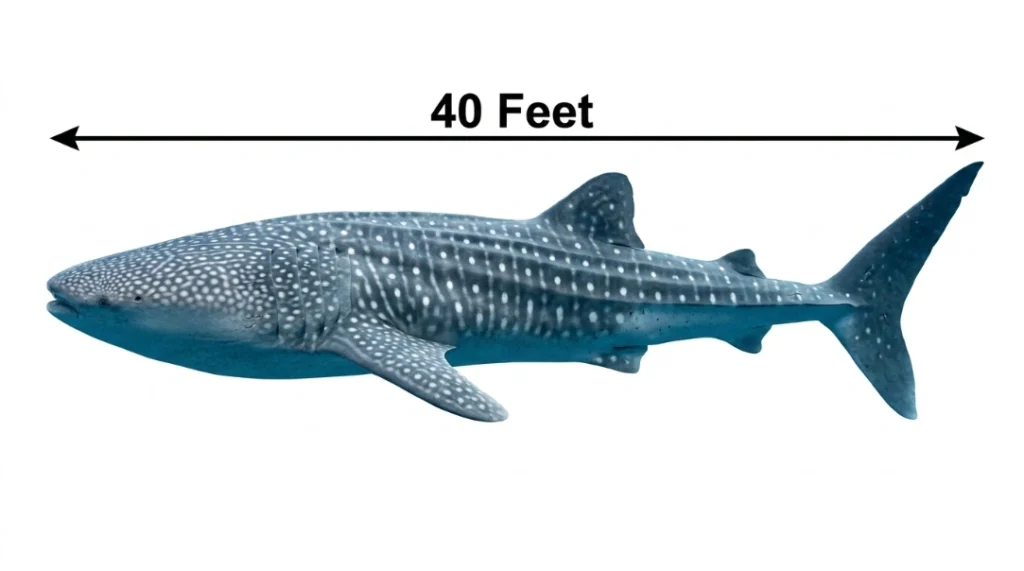
Whale sharks are the world’s largest living fish, and exceptionally large individuals can approach roughly 40 feet or more in length. Because individual animals vary substantially, this is best treated as an approximate biological comparison rather than an exact measuring reference.
These enormous filter-feeding sharks inhabit warm tropical and subtropical waters. Despite their intimidating size, they primarily consume plankton and small organisms. Seeing one beside a diver in underwater photography makes its enormous scale much easier to appreciate.
Imagine a very large whale shark stretched from nose to tail. Its body can provide a striking natural visualization of this distance, particularly because few familiar living creatures approach such a substantial length.
6. A 4-Story Building

A building around four stories tall can sometimes approach 40 feet in occupied-floor height if each level averages roughly 10 feet. However, actual buildings may be considerably taller once floor structures, ceilings, roof systems, and different architectural designs are taken into account.
Multi-story buildings are common in apartment complexes, offices, hotels, and urban neighborhoods. Because most people already have an intuitive sense of how tall several floors appear from street level, buildings make useful references for estimating vertical dimensions.
Picture looking from the sidewalk toward approximately the fourth-floor level of a building with relatively compact stories. That gives a rough sense of a 40-foot rise, though it should be considered an estimate rather than a universal architectural rule.
7. Half the Length of a Tennis Court
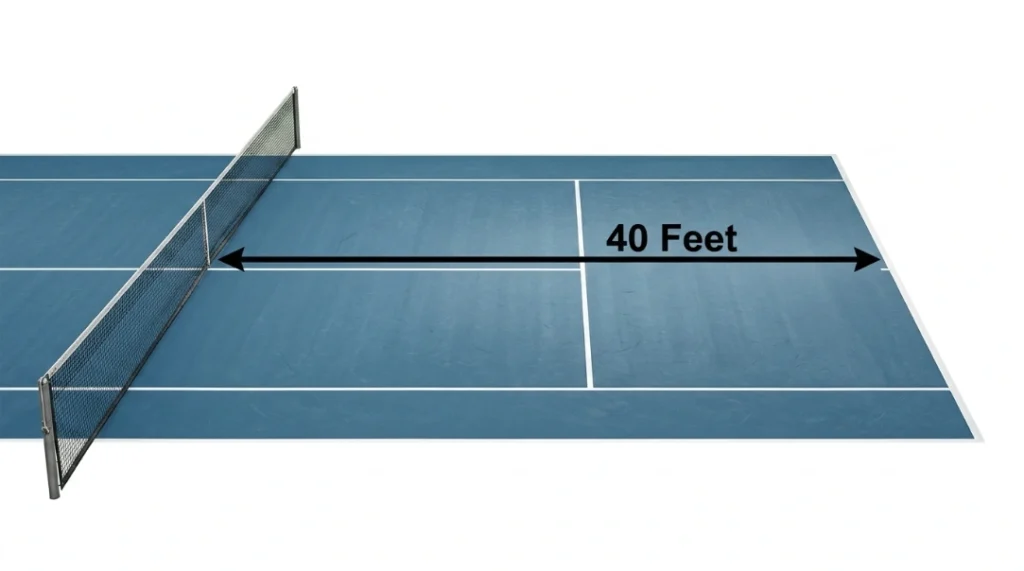
A regulation tennis court measures 78 feet from baseline to baseline. Half of that distance is 39 feet, which is only one foot shorter than the measurement we are visualizing. This makes half a tennis court one of the closest sports-based comparisons available.
Tennis courts are found in schools, clubs, parks, gyms, and residential recreation areas. Their clearly marked lines make distances easier to judge than they would be across an unmarked field or open yard.
Visualize standing around the net and looking toward one baseline. That span is approximately 39 feet. Add another foot beyond the baseline, and you have essentially reached the full target distance.
8. Extension Ladder
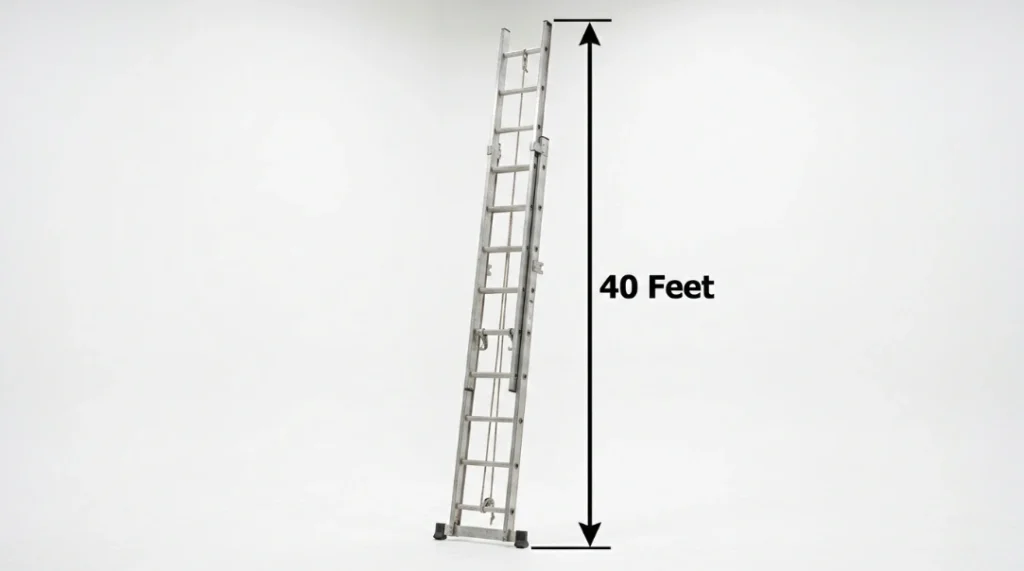
Extension ladders are manufactured in numerous sizes, with larger models reaching nominal lengths of 32, 36, or even 40 feet. A 40-foot extension ladder therefore provides an almost direct physical representation when considered at its nominal extended length.
Long extension ladders are generally associated with building maintenance, roofing, exterior work, and access to elevated areas. Their segmented construction allows them to retract for storage and extend when additional reach is needed.
A fully extended 40-foot ladder laid flat provides a straightforward length reference. When raised against a structure, however, its vertical reach will not equal its full nominal length because safe ladder setup requires an angle and overlap between ladder sections.
9. Half the Length of a Basketball Court
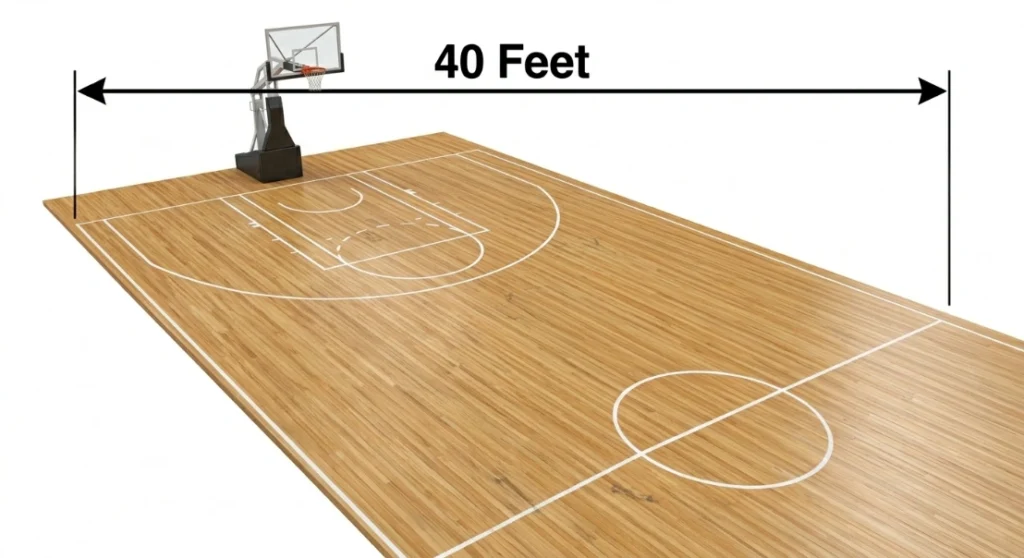
A regulation NBA basketball court is 94 feet long, so half the court measures 47 feet. That means 40 feet is seven feet shorter than the distance from the baseline to the center line. It is not an exact half-court comparison, but the marked playing surface still provides a useful scale reference.
Basketball courts are familiar spaces in schools, gyms, recreation centers, and sports arenas. Their painted lines provide recognizable landmarks that can help people estimate distances without specialized measuring equipment.
Start at one baseline and picture a point seven feet before the center line on an NBA-size court. The distance between those two positions is about 40 feet, giving you a practical sports-based visualization.
10. A Red Maple and English Oak
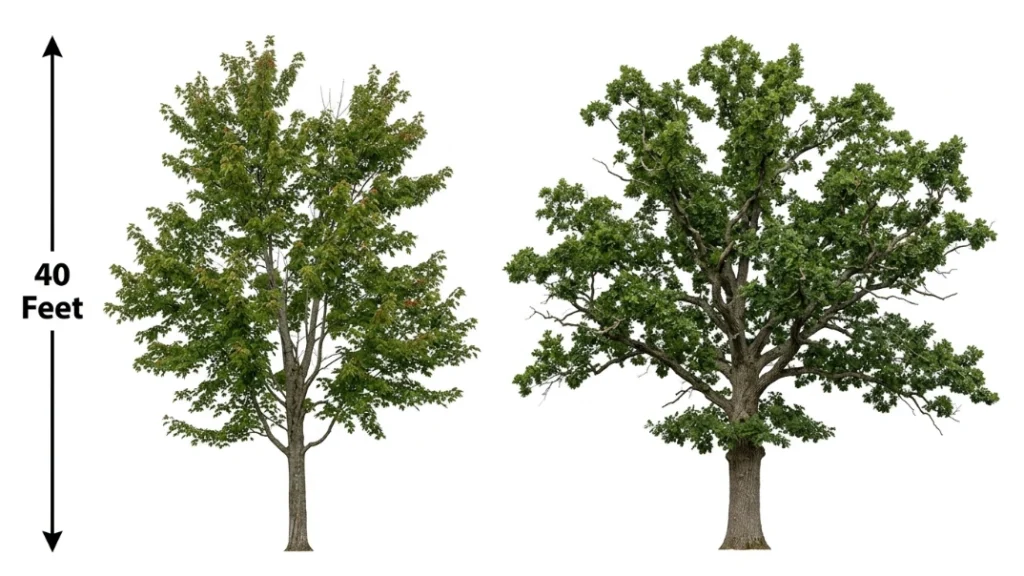
Mature red maples can grow roughly 40 to 60 feet tall, while English oaks can eventually grow substantially taller under favorable conditions. A smaller mature specimen around 40 feet high therefore offers a reasonable natural reference, although tree dimensions vary widely.
Both species are recognizable landscape trees. Maples are common in yards, parks, and streetscapes, while English oaks are known for their broad crowns and substantial mature size. Soil, climate, age, pruning, and growing space all affect final height.
If you see a mature tree that stands around four residential-story equivalents above the ground, its height may be close to this measurement. Trees are especially useful for developing an intuitive sense of vertical scale outdoors.
Easy Ways to Estimate 40 Feet Without a Tape Measure
When exact measurement is unnecessary, familiar objects and known dimensions can help you estimate how long is 40 feet. The goal is not precision down to the inch but to create a reliable mental reference that works in yards, rooms, parking areas, sports spaces, and other everyday environments.
Useful estimation methods include:
- Picture the full length of a standard 40-foot shipping container.
- Use about half of a 78-foot tennis court, which equals 39 feet.
- Compare the span with a large full-size school bus.
- Think of four consecutive 10-foot sections.
- Estimate roughly 16 average walking steps if your stride is close to 2.5 feet.
For construction, property boundaries, ladder placement, or any situation where accuracy affects safety or cost, use a tape measure, laser distance meter, or another calibrated measuring tool instead of visual estimation.
Read: What Is 5’3 in Inches?
Read: What Is 5’0 in Inches?
Read: What Is 5’2 in Inches?
Read: How Long Is 17 Inches?
Read: How Big Is 9cm?
Read: How Long Is 50 Feet?
Read: How Long Is 100 Feet?
Frequently Asked Questions
How many inches are in 40 feet?
There are exactly 480 inches. Since one foot contains 12 inches, multiplying 40 by 12 gives 480.
How many yards is 40 feet?
Forty feet equals approximately 13.33 yards, or 13⅓ yards. Divide the number of feet by three because one yard contains exactly three feet.
How many meters is 40 feet?
The exact conversion is 12.192 meters. One foot equals 0.3048 meters, so multiplying 40 by 0.3048 gives 12.192.
Is a school bus 40 feet long?
Some large full-size school buses are around 40 feet long, while others are shorter or slightly longer. Bus dimensions depend on model, chassis, seating capacity, and body configuration.
How many stories high is 40 feet?
It can be thought of as roughly three to four building stories, depending on floor-to-floor height. Actual buildings differ, so story count is useful only as a visual estimate.
Conclusion
Understanding how long is 40 feet becomes much easier when the number is connected to familiar objects. It equals 480 inches, 13⅓ yards, or 12.192 meters, and a standard 40-foot shipping container provides one of the clearest near-exact visual references.
For other situations, picture a large school bus, roughly half a tennis court, a long extension ladder, or the height of a mature tree. These comparisons are useful for everyday estimation, while a tape measure or laser distance meter remains the better choice whenever precise dimensions matter.