
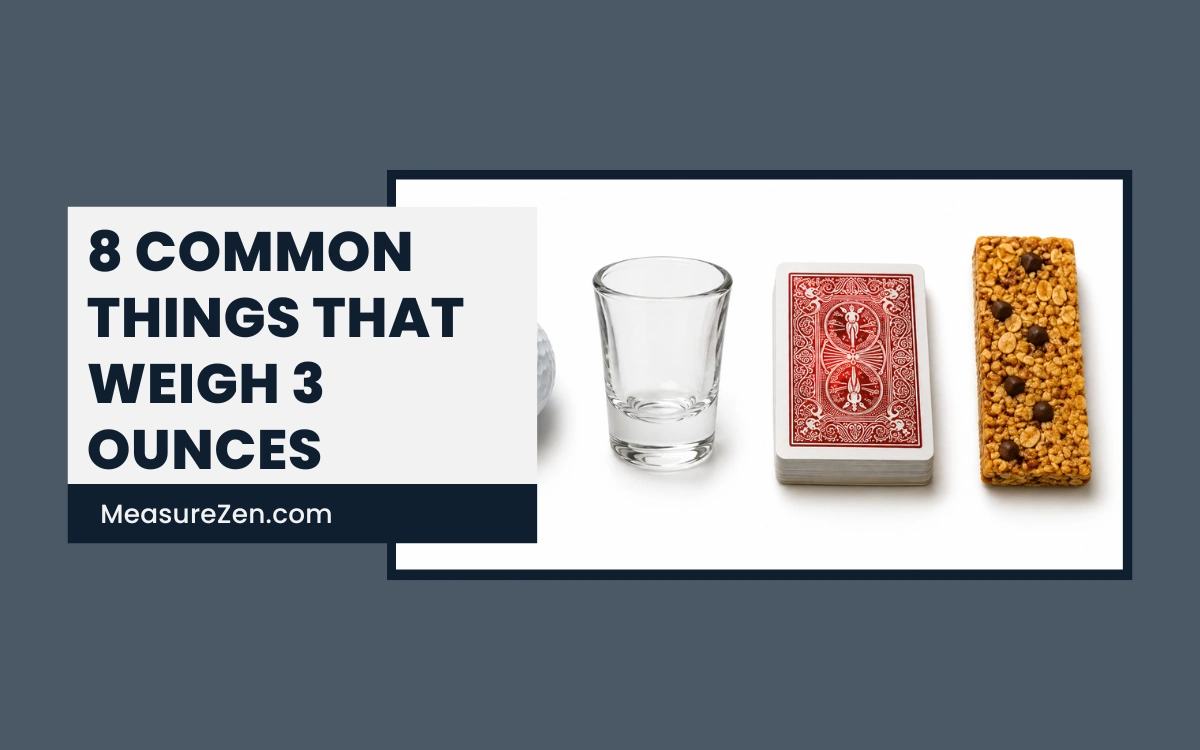
Quick Answer:
3 ounces equals approximately 85.05 grams, 0.1875 pounds, or 0.085 kilograms. For visualization, it is close to the weight of a small potato or a deck of playing cards.
Knowing what 3 ounces feels like is useful when a kitchen scale is unavailable or you simply need a quick mental reference. Weight can be difficult to picture from a number alone, especially when dealing with small food portions, household items, or ingredients.
If you need to weigh 3 ounces, familiar objects can provide a practical reference. Three ounces is fairly light—you can comfortably hold that amount in one hand—but it is still substantial enough to notice compared with very lightweight items such as a single pen or coin.
Below, you’ll find accurate conversions, liquid-ounce distinctions, eight everyday comparisons, and several practical methods for estimating this amount without a traditional weighing scale.
3 Ounces Conversion Chart
Quick and accurate measurement conversions
| Unit | Converted Value |
|---|---|
| Grams | 85.05 g |
| Kilograms | 0.085 kg |
| Pounds | 0.1875 lb |
| Milligrams | 85,048.6 mg |
| US Ounces | 3 oz |
The table above refers to ounces by weight (avoirdupois ounces). Fluid ounces are a measurement of volume, so they should not be treated as directly interchangeable with weight ounces unless the density of the substance is known.
What Is 3 Ounces?
Three ounces is a relatively small unit of weight commonly encountered in cooking, food packaging, portion sizes, mailing, and lightweight household products. One avoirdupois ounce equals approximately 28.35 grams, which means three ounces come to about 85.05 grams. In pounds, that is 3/16 of a pound, or 0.1875 pounds.
In practical terms, 85 grams is light enough to rest comfortably in your palm. A small piece of produce, a compact deck of cards, or a modest serving of meat may fall somewhere around this range. Exact weights differ because everyday products are manufactured in different sizes and materials.
It is also important to distinguish weight ounces from fluid ounces. An ounce marked oz normally describes weight, while fl oz measures volume. That distinction becomes particularly important when following recipes.
How Much Is Three Ounces?
Three ounces by weight is exactly 3/16 of a pound and approximately 85.05 grams. In metric measurements, it is about 0.085 kilograms or 85,049 milligrams. This makes it a useful small-weight reference for recipes, food portions, postal items, and products sold in relatively small packages.
To picture the amount, imagine something that sits easily in one hand without feeling completely weightless. A small potato can be near this range, while some full decks of playing cards also come reasonably close. The comparisons are estimates because the actual weight of manufactured and natural objects varies.
For food, three ounces is particularly familiar as a portion reference. Cooked meat or fish servings are often discussed in ounces, making an 85-gram portion a useful amount to recognize visually.
How Much Is 3 Ounces of Liquid?
When someone says “3 ounces of liquid,” they usually mean 3 US fluid ounces, which is a volume rather than a weight. Three US fluid ounces equal approximately 88.72 milliliters, 6 US tablespoons, or 18 US teaspoons. It is also equal to 3/8 of a standard US cup.
The distinction matters because three fluid ounces of different liquids do not necessarily weigh three ounces. Water is a useful example: 3 US fluid ounces of water weighs roughly 88.7 grams under ordinary conditions, which is slightly more than the 85.05 grams represented by three weight ounces.
For everyday cooking, the easiest way to measure this liquid volume is with a marked measuring cup or six level tablespoons. When a recipe lists simply “oz,” check whether it refers to ingredient weight or fluid volume before measuring.
| Liquid Measurement | Equivalent |
|---|---|
| US Fluid Ounces | 3 fl oz |
| Milliliters | 88.72 mL |
| US Tablespoons | 6 tbsp |
| US Teaspoons | 18 tsp |
| US Cups | 3/8 cup |
How Much Is 3 Ounces? 8 Common Things That Weigh 3 Ounces
Everyday objects are useful for developing a mental picture of a small weight, but they should be treated as approximations rather than substitutes for a calibrated scale. Natural products vary in size, while manufactured products can differ by brand, materials, packaging, and model.
An 85-gram object feels noticeably heavier than a few coins but remains easy to hold between your fingers or in your palm. Food portions are particularly useful references because many ingredients and serving recommendations are already expressed in ounces.
The following eight examples can fall near the target range or provide a practical reference for it. Where an object commonly differs from exactly three ounces, that variation is noted so the comparison remains realistic.
| Object | Approximate Weight | How It Compares |
|---|---|---|
| Two Large Eggs | 3.5–4 oz combined | Slightly heavier than 3 oz |
| Bar of Soap | 2.5–3.5 oz | Can be very close |
| Small Jar of Spices | Around 3 oz net weight | Close depending on contents |
| Standard Lime | Around 2.5–3.5 oz | Often close to 3 oz |
| Deck of Playing Cards | 3–3.5 oz | Good everyday comparison |
| Small Potato | Around 3 oz | One of the closest references |
| Small TV Remote | 2–4 oz | Depends on model and batteries |
| Lightweight Sunglasses | Usually under 3 oz | Lighter unless paired |
1. Two Large Eggs
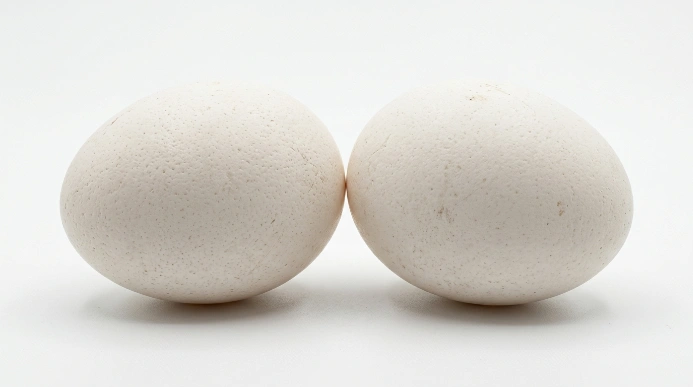
A typical large chicken egg weighs roughly 50 grams without the shell, so two large eggs usually provide around 100 grams, or approximately 3.5 ounces, of edible egg. With shells included, the total may be slightly higher. Therefore, two full large eggs are somewhat heavier than an exact three-ounce measurement.
Eggs are easy references because they are found in most kitchens and their sizes are relatively standardized in commercial packaging. They are frequently used for baking, breakfast dishes, sauces, and other recipes where knowing approximate ingredient weight can be useful.
For visualization, think of slightly less than two large eggs to approach 85 grams more closely. Two eggs remain a convenient rough comparison, but a kitchen scale is preferable when a recipe requires exactly three ounces.
2. A Bar of Soap

Individual soap bars vary substantially by manufacturer. Small bath or hotel-style bars may weigh around 2.5 to 3 ounces (71 to 85 grams), while many standard full-size bath bars are closer to 3.5 or 4 ounces. A smaller commercial bar can therefore provide a close physical comparison.
Bar soap is familiar because it is compact, dense, and easy to hold in one hand. Unlike a fluffy or hollow object, most of its weight is concentrated within a relatively small rectangular shape, making its weight easy to perceive when picked up.
A soap bar labeled 3 oz or 85 g is one of the more useful comparisons because its package provides an actual stated weight. Check the wrapper rather than assuming every soap bar weighs the same amount.
3. A Small Jar of Spices

A small spice container can provide another useful reference, although its total weight depends heavily on the jar and its contents. A container holding around 2 to 3 ounces of spice by net weight may feel close to the target, but the complete jar will weigh more once its packaging is included.
Small spice jars are common in kitchen cabinets and typically contain dried herbs, ground spices, seasoning blends, or seeds. Dense ingredients such as certain seeds or salts can place more weight into a small volume than lightweight dried herbs.
If you use this comparison, check the net weight printed on the label. A spice package marked 3 oz contains about 85 grams of product, making it much more reliable than estimating based solely on the container’s dimensions.
4. A Standard Lime

Limes naturally vary in size, but a medium-to-large lime can approach 3 ounces, or about 85 grams. Smaller limes may weigh considerably less, while particularly large fruit can exceed this amount. Variety, moisture content, and maturity all influence the final weight.
Limes are common in kitchens, grocery stores, restaurants, and drink preparation. Their compact, dense structure makes them a useful reference because most of the fruit’s mass is concentrated into something that fits comfortably in the palm of your hand.
When you picture an approximately 3-ounce lime, imagine a relatively plump specimen rather than the smallest fruit in a bag. Produce is never a precision measuring tool, but the comparison gives a reasonable sense of how light 85 grams feels.
5. A Deck of Playing Cards

A complete deck of standard playing cards often weighs somewhere around 3 to 3.5 ounces (85 to 100 grams), depending on cardstock thickness, finish, jokers, and packaging. Some lightweight decks may fall closer to the lower end, making a deck a convenient approximate comparison.
Playing cards are particularly useful as a mental reference because their dimensions are standardized more consistently than natural objects. Most people have handled a deck during card games, travel, family gatherings, or recreational activities and already recognize how it feels in one hand.
If your deck weighs close to 85 grams, holding it provides a good sense of the target weight. The cardboard tuck box adds a little extra mass, so the cards alone and a packaged deck may produce slightly different readings.
6. A Small Potato

A small potato can weigh approximately 3 ounces, or around 85 grams, although potatoes naturally have a broad size range. Very small potatoes may weigh only an ounce or two, while medium and large varieties can easily reach 5, 8, or more ounces.
Potatoes are familiar objects in supermarkets and home kitchens, making them practical for visualizing food weights. Their relatively high density also means that an 85-gram potato remains compact enough to fit easily within the palm rather than occupying much physical space.
Choose a genuinely small potato for the closest comparison. If it is roughly palm-sized but noticeably smaller than a typical medium baking potato, it may provide a reasonable visual and tactile approximation of three ounces.
7. A Small TV Remote

A compact television or streaming-device remote may weigh approximately 2 to 4 ounces (57 to 113 grams) with batteries installed. The precise figure depends on its length, casing, battery type, electronics, and overall design, so only some smaller remotes land close to 85 grams.
Remote controls are useful household references because they are handled frequently. Lightweight streaming remotes in particular can be much smaller than traditional television remotes filled with numerous buttons and powered by larger batteries.
A compact remote weighing about 85 grams gives you an immediate tactile reference for this amount. Because models vary widely, checking its specification or weighing it once is advisable before relying on it as a repeated comparison.
8. A Pair of Lightweight Sunglasses

Sunglasses vary considerably in weight according to their lenses, frame material, hinges, and overall size. Many genuinely lightweight pairs weigh well below 3 ounces, often around 1 ounce or less, while heavier eyewear and its protective case can bring the combined weight considerably closer to 3 ounces.
Sunglasses remain useful for understanding just how light this measurement is. Plastic frames tend to be much lighter than thick acetate or substantial metal designs, while a hard protective case can weigh as much as—or more than—the glasses themselves.
For a closer comparison, think of a heavier pair of sunglasses together with a lightweight case rather than assuming ordinary lightweight sunglasses alone equal 85 grams. Exact measurement requires a scale because eyewear weights vary significantly.
How to Measure 3 Ounces Without a Scale
Measuring weight accurately without a scale is difficult because volume, size, and weight are different properties. Still, you can make reasonable estimates when precision is not critical. The best method depends on whether you are working with liquids, food portions, or another material.
For liquids measured in fluid ounces, standard kitchen utensils work well because fluid ounces describe volume. For solid foods, visual portion methods provide only estimates because two foods occupying the same amount of space can have completely different weights.
When accuracy matters for baking, nutrition tracking, shipping, or scientific work, use a digital scale. The following methods are better suited to everyday situations where a close approximation is sufficient.
Use a Liquid Measuring Cup
If the recipe requires 3 US fluid ounces, a liquid measuring cup with ounce or milliliter markings is the most straightforward option. Fill the cup to the 3-fluid-ounce line, or approximately 88.7 milliliters, while keeping the cup on a flat, level surface.
This method measures volume, not mass. It works for water, milk, juice, oil, and other liquids when the recipe specifically lists fluid ounces. Read the measurement at eye level to reduce errors caused by viewing the markings from above or below.
Do not use the method to assume that every 3-fluid-ounce portion weighs exactly three ounces. Different liquids have different densities, so equal volumes can have different weights.
Count 6 Tablespoons
Three US fluid ounces equal exactly 6 US tablespoons because one US fluid ounce contains two tablespoons. If you do not have a measuring cup with ounce markings, filling a standard tablespoon six times provides a straightforward way to measure the required volume.
This technique is particularly convenient for sauces, milk, water, oils, syrups, and other liquid recipe ingredients. Level or fill each tablespoon consistently so that the accumulated measurement remains reasonably accurate.
Again, six tablespoons represent three fluid ounces of volume, not automatically three ounces by weight. For dry ingredients, the weight of six tablespoons depends entirely on the density of the ingredient being measured.
Use the Palm Method for Proteins
A palm-sized serving of cooked meat, poultry, or fish is commonly used as a rough visual estimate for a portion of around 3 to 4 ounces. Thickness and hand size affect the estimate, so this technique is best for portion control rather than precise recipe measurements.
The method is useful at restaurants, barbecues, cafeterias, or while traveling when a food scale is unavailable. A piece of cooked chicken or fish roughly matching the area and thickness of your palm may provide a practical serving-size reference.
For calorie or macronutrient tracking, remember that visual estimation introduces uncertainty. Weighing the food provides a more reliable number, particularly when nutritional calculations need to be precise.
Stack 12 US Quarters
Twelve modern US quarters do not weigh exactly three ounces. A standard US quarter weighs about 5.67 grams, so 12 quarters weigh approximately 68.04 grams, or 2.4 ounces. This makes a stack of 12 noticeably lighter than the target.
For a much closer reference, 15 US quarters weigh about 85.05 grams, which is almost exactly three avoirdupois ounces. This works because the specified weight of an individual modern quarter is standardized, making the calculation unusually convenient.
If you have modern US quarters available, a stack of 15 is therefore a substantially better reference than 12. It is still an improvised comparison rather than a substitute for a properly calibrated weighing instrument.
3 Ounces in Cooking and Portion Control
Three ounces frequently appears in cooking and nutrition because many ingredients and serving sizes are measured by weight. An 85-gram serving is especially familiar for meat, poultry, and fish. Recognizing approximately what this portion looks like can make meal preparation and portion estimation easier when a food scale is unavailable.
Volume conversions require more caution. Three ounces by weight cannot be converted universally into cups or tablespoons because ingredient densities differ. Three ounces of flour occupies a different volume from three ounces of cheese, sugar, butter, or cooked chicken. Recipes written by weight are therefore best followed using a kitchen scale.
For general portion control, palm-sized comparisons can be convenient. For baking and other precision recipes, measuring 85.05 grams directly is considerably more reliable than estimating from spoons, cups, or visual size.
| Example | Approximate Amount | Practical Comparison |
|---|---|---|
| Weight | 3 oz | 85.05 g |
| Pounds | 3 oz | 0.1875 lb |
| US liquid volume | 3 fl oz | 88.72 mL |
| US tablespoons | 3 fl oz | 6 tbsp |
| US teaspoons | 3 fl oz | 18 tsp |
| Cooked protein | Around 3 oz | Small palm-sized portion |
Weight Ounces vs. Fluid Ounces: Why the Difference Matters
One of the easiest measurement mistakes is treating ounces and fluid ounces as identical. An ounce (oz) measures mass or weight in everyday US usage, whereas a fluid ounce (fl oz) measures volume. Three weight ounces equal about 85.05 grams, while three US fluid ounces equal about 88.72 milliliters.
This difference becomes important whenever you cook or convert a recipe. The volume occupied by an ingredient depends on its density, so there is no universal tablespoon or cup conversion for three ounces by weight.
A few practical rules help:
- Check whether the recipe specifies oz or fl oz.
- Use a scale when an ingredient is listed by weight.
- Use measuring cups or spoons for fluid-ounce measurements.
- Avoid converting solid ingredients to cups without an ingredient-specific conversion.
- For rough protein portions, use your palm only as an estimate.
Keeping weight and volume separate prevents one of the most common conversion errors and produces much more reliable results in cooking, nutrition tracking, and everyday measurement.
Read: How Long Is 21 Inches?
Read: How Long Is 2 Feet?
Read: How Long Is 3 Feet?
Read: How Tall Is 70 Inches?
Read: How Long Is 200 Feet?
Read: How Long Is 40 Inches?
Read: How Long Is 40 Feet?
Read: How big is 9mm?
Read: How Long Is 50 Inches?
Read: How Long Is 23 Inches?
Frequently Asked Questions
Is 3 ounces the same as 85 grams?
Almost. Three avoirdupois ounces equal approximately 85.05 grams. Rounding to 85 grams is accurate enough for many everyday purposes, although precise recipes or calculations may require the full converted value.
How many tablespoons are in 3 fluid ounces?
Three US fluid ounces equal 6 US tablespoons. This conversion applies to volume. Six tablespoons of a solid or dry ingredient will not necessarily weigh three ounces because ingredient densities differ.
Is 3 ounces half a cup?
No. Three US fluid ounces equal 3/8 cup, or 0.375 cup. Half a US cup contains 4 fluid ounces. Weight ounces cannot be converted directly to cups without knowing the ingredient involved.
How many quarters weigh about 3 ounces?
Fifteen modern US quarters weigh approximately 85.05 grams, which is almost exactly three ounces. Twelve quarters weigh only about 68 grams, or roughly 2.4 ounces.
What does a 3-ounce serving of meat look like?
A cooked 3-ounce portion of meat is often compared with the size of an adult palm or a deck of cards. These are approximate visual guides; thickness, shape, and the particular food can affect how large the portion appears.
Final Thoughts
Learning what it feels like to weigh 3 ounces becomes easier once you connect the number with familiar objects. The amount equals approximately 85.05 grams or 0.1875 pounds, while three US fluid ounces are a separate volume measurement equal to about 88.72 milliliters.
For quick visualization, a small potato, certain decks of playing cards, or 15 modern US quarters provide useful references. Everyday objects should still be treated as approximations because their weights vary. When accuracy matters—especially for recipes, nutrition, postage, or portion tracking—a digital scale remains the most dependable option.