
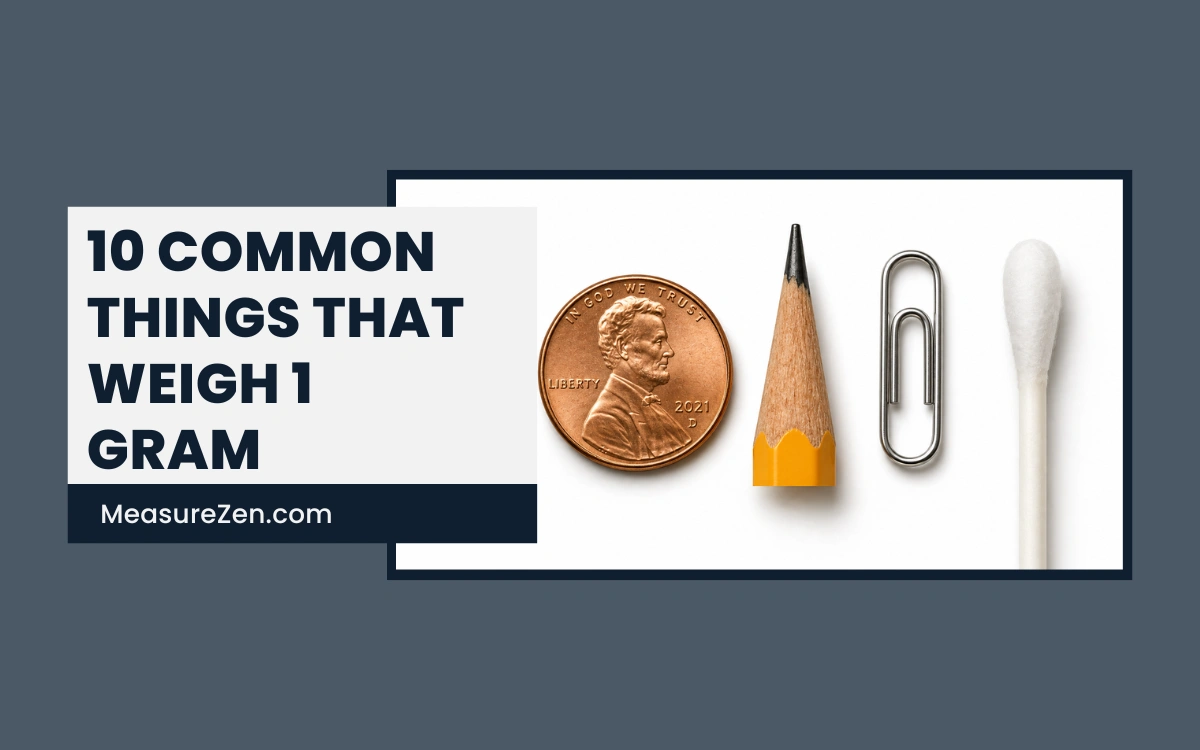
Quick Answer:
1 gram equals 1,000 milligrams, 0.001 kilograms, or about 0.0353 ounces. It is an extremely light amount, comparable to a small paper clip or a lightweight button.
Trying to picture a gram can be surprisingly difficult because it is far lighter than most objects we handle every day. Unlike centimeters or inches, which can be seen directly on a ruler, weight becomes easier to understand when you connect it with familiar items.
1 Gram is commonly used for measuring small quantities of food, medication ingredients, jewelry, powders, and lightweight materials. Everyday comparisons can make this tiny unit feel much more practical than simply looking at a number on a digital scale.
Below, you’ll find accurate conversions, a clear explanation of what a gram feels like, and 10 familiar objects that can weigh around this amount.
1 Gram Conversion Chart
Quick and accurate measurement conversions
| Unit | Converted Value |
|---|---|
| Milligrams | 1,000 mg |
| Kilograms | 0.001 kg |
| Ounces | 0.03527 oz |
| Pounds | 0.002205 lb |
| Micrograms | 1,000,000 µg |
How Big Is a Gram?
A gram measures mass rather than physical size, so there is no single length, width, or volume that represents it. Two objects can both have a mass of one gram while looking completely different because their materials have different densities. A tiny metal component, for example, may have the same mass as a much larger piece of lightweight material.
For everyday perspective, imagine holding a small paper clip, a lightweight shirt button, or another similarly tiny item. An individual gram feels almost insignificant in your hand. This is why kitchen scales designed for ordinary cooking may struggle to register such small amounts accurately unless they have 0.1-gram or finer precision.
Size also depends heavily on density. One cubic centimeter of water has a mass of approximately one gram under standard reference conditions, while one gram of cotton occupies much more space. Therefore, when asking how “big” a gram is, it is more useful to think about weight and familiar comparisons rather than dimensions.
How Much Is 1 Gram?
In the metric system, a gram is a small unit of mass equal to 1,000 milligrams. It represents one-thousandth of a kilogram, meaning you would need 1,000 grams to make one kilogram. Converted to the US customary system, a gram is approximately 0.03527 ounces or 0.002205 pounds.
That small quantity becomes easier to understand when compared with common household objects. Some small paper clips, buttons, thumbtacks, and lightweight stationery components can fall close to the one-gram range. Exact values vary because manufacturers use different materials, dimensions, and designs.
Grams are especially useful when kilograms would be unnecessarily large units. Food portions, spices, jewelry, laboratory samples, and small ingredients are frequently expressed in grams because the unit provides convenient precision.
What Weighs a Gram?
Several very small everyday objects can weigh approximately a gram, although few mass-produced items weigh exactly the same amount. A lightweight paper clip is one of the easiest examples to remember. Small buttons, birthday candles, pen caps, and thumbtacks can also approach this weight depending on their construction.
These comparisons should be treated as visual and practical estimates rather than calibration standards. A metal button may weigh considerably more than a thin plastic one, while paper clips come in several gauges and lengths. Packaging and moisture can also affect the mass of some materials.
For an exact one-gram measurement, a calibrated digital scale is the reliable choice. Still, familiar objects provide useful mental references when you simply want to understand how light this quantity feels.
What Is 1 Gram? 10 Common Things That Weigh 1 Gram
A gram is a metric unit of mass represented by the symbol g. It sits between milligrams and kilograms in everyday metric measurement: 1,000 milligrams make one gram, while 1,000 grams make one kilogram. Because it is such a small amount, it is commonly associated with lightweight objects and small portions of ingredients.
You encounter gram-scale quantities more often than you might realize. Nutrition labels, recipes, jewelry specifications, laboratory measurements, postage calculations, and product packaging frequently use grams. Digital kitchen and precision scales also commonly display measurements using this unit.
The following examples are approximate because real objects differ by size, material, and manufacturer. They are best used as practical references rather than exact substitute weights.
| Object | Approximate Weight | How It Compares |
|---|---|---|
| Small button | Around 1 g | Lightweight buttons can be close |
| Small birthday candle | Around 1 g | Depends on length and wax |
| 1 cm³ of water | About 1 g | Very close under standard conditions |
| ¼ teaspoon sugar | About 1 g | Depends on sugar type and measuring method |
| Small stick/piece of gum | Around 1–2 g | Lightweight pieces may approach 1 g |
| Small silica gel packet | Around 1 g | Small packets vary considerably |
| US dollar bill | About 1 g | Excellent familiar reference |
| Ballpoint pen cap | Around 1 g | Lightweight plastic caps may be close |
| Small paper clip | Around 1 g | One of the simplest comparisons |
| Thumbtack | Around 1 g | Depends on metal and plastic construction |
1. A Small Button
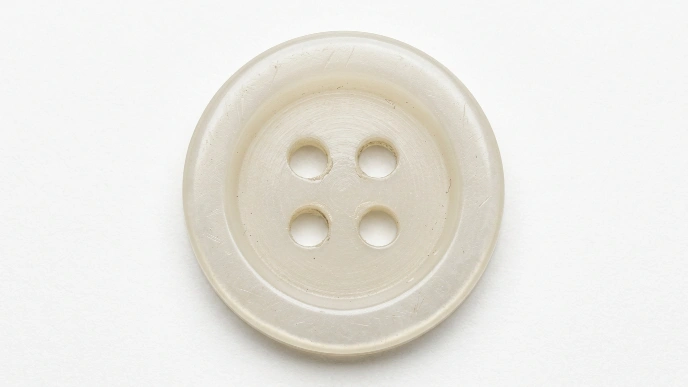
A very small lightweight button can weigh approximately one gram, although its exact mass depends on its diameter, thickness, and material. Thin plastic shirt buttons are generally much lighter than decorative metal, wooden, or oversized coat buttons. Even apparently identical buttons may differ slightly in weight.
Buttons are familiar objects found on shirts, jackets, trousers, uniforms, bags, and craft projects. Because they are easy to find around the home, they make convenient references when trying to understand very small amounts of mass without immediately reaching for a scale.
Hold a lightweight shirt button in your palm and notice how little pressure you feel. A button around the one-gram range gives you a practical sense of just how light this measurement is, although it should not be used for precision calibration.
2. A Small Birthday Candle

A short, thin birthday candle can weigh around a gram, though candle weights differ according to length, diameter, wick size, and wax composition. Larger decorative candles or thicker spiral designs can weigh several times more, so the comparison works best with basic lightweight cake candles.
These small candles are commonly placed on birthday cakes, cupcakes, and desserts. Their narrow wax bodies and lightweight cotton wicks make them useful examples of objects whose mass may sit near the lower end of what ordinary kitchen scales can reliably detect.
Picture a single slim birthday candle resting across your fingers. Its barely noticeable weight provides a useful everyday approximation of a gram and demonstrates why such small quantities are often better measured with a precision scale.
3. 1 cm³ of Water
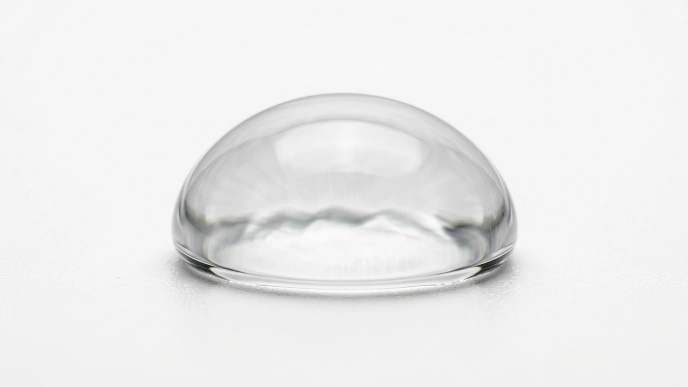
One cubic centimeter of pure water has a mass of approximately one gram, particularly near the conditions where water’s density is close to 1 g/cm³. A cubic centimeter is the same volume as one milliliter, making water especially useful for understanding the relationship between mass and volume.
This relationship appears frequently in kitchens, classrooms, laboratories, and science demonstrations. Water is often used to explain metric units because its density creates an unusually convenient connection between grams and milliliters that does not apply equally to other substances.
Visualize a tiny cube measuring 1 cm on each side filled with water. That quantity provides one of the clearest scientific representations of the target mass and explains why water is often used when introducing metric measurements.
4. One-Quarter Teaspoon of Sugar
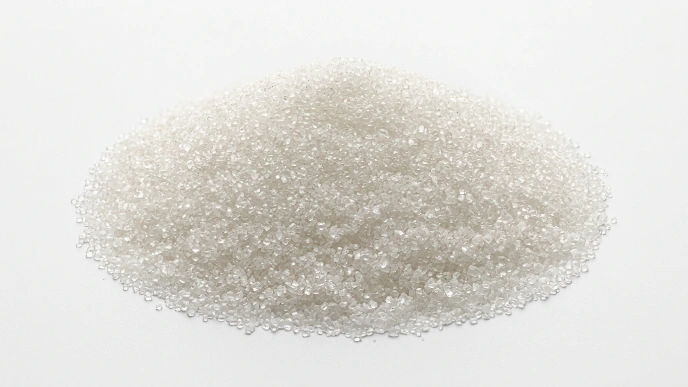
Approximately one-quarter teaspoon of granulated sugar can come close to one gram, though the precise amount depends on crystal size, how tightly the spoon is filled, and whether it is level. Standard nutrition references commonly place a teaspoon of granulated sugar at roughly four grams.
Sugar is measured frequently when preparing coffee, tea, baked goods, sauces, desserts, and other recipes. Because teaspoons are available in most kitchens, this comparison provides an accessible way to picture a very small mass without specialized equipment.
Imagine dividing one level teaspoon of granulated sugar into four roughly equal portions. One portion represents about a gram. For recipes requiring high precision, however, weighing the ingredient is more reliable than estimating it volumetrically.
5. One Stick of Chewing Gum

A small piece or stick of chewing gum may weigh roughly one to a few grams depending on its brand, dimensions, coating, and formulation. Many full-size commercial sticks exceed one gram, so a particularly small or lightweight piece is the more appropriate comparison.
Chewing gum is familiar from convenience stores, supermarkets, vending machines, and individual packets. Its compact dimensions make it easy to underestimate how much even a few grams can look like when formed into a dense, solid piece.
A lightweight piece of gum can therefore provide a rough mental reference, but it is less consistent than a paper clip or dollar bill. If accuracy matters, check the package’s net weight and divide it by the stated number of pieces.
6. A Small Silica Gel Packet

A very small silica gel packet may have a total mass around a gram, although packet sizes vary widely. The beads inside absorb moisture, while the wrapper itself contributes additional mass. Larger packets found in electronics or shoe boxes can weigh several grams or considerably more.
These packets are commonly included with shoes, handbags, electronics, medications, packaged foods, and other moisture-sensitive products. Their purpose is to reduce humidity inside sealed packaging and help protect products during storage and transportation.
One of the smallest packets provides a reasonable sense of gram-scale weight. Because packet contents and wrapper sizes are not standardized, however, it should only be considered an approximate visualization rather than an exact reference.
7. A US Dollar Bill
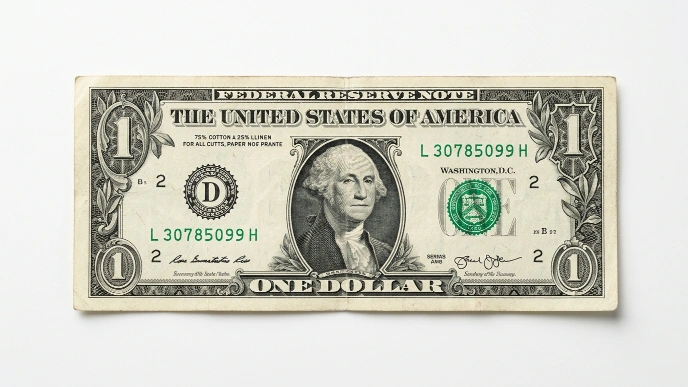
A US banknote weighs approximately one gram, making it one of the strongest everyday comparisons on this list. US bills have the same general dimensions regardless of denomination, so a one-dollar bill provides an especially convenient reference for understanding this tiny unit of mass.
Paper currency is handled constantly in stores, restaurants, banks, and everyday transactions. Despite being much wider and longer than a paper clip or button, a bill remains extremely light because it is made from a thin cotton-linen blend.
Place a single dollar bill on your palm and you have a remarkably intuitive representation of how light a gram feels. Normal wear, moisture, dirt, and condition can create small variations, so it still should not replace a calibrated weight.
8. Cap of a Ballpoint Pen

A small plastic ballpoint pen cap can weigh around one gram, depending on its design and the thickness of the plastic. Caps with clips, rubber components, or thicker walls may weigh more, while minimalist caps made from thin plastic can sit close to the target range.
Ballpoint pens are found in homes, offices, schools, banks, and workplaces, which makes this comparison easy to recreate. Removing the cap also demonstrates how little material is needed to create an object with a mass measured in only a few grams.
Holding a lightweight cap separately from the complete pen makes the difference particularly noticeable. The cap’s minimal weight provides a useful physical reference, although individual brands vary too much for it to function as an exact one-gram standard.
9. A Small Paper Clip
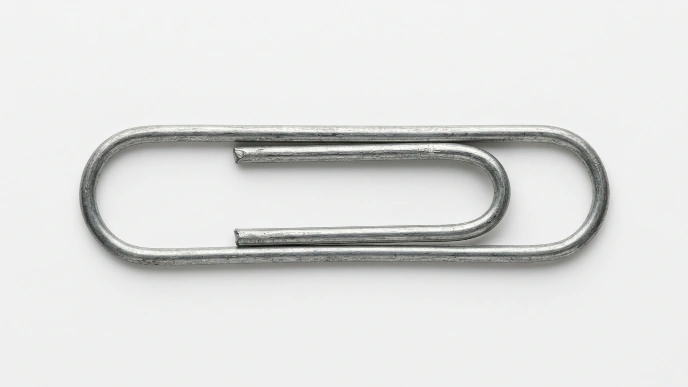
A small paper clip is one of the most widely used comparisons for approximately one gram. Standard lightweight steel clips often sit around this range, although larger, thicker, coated, or heavy-duty clips can weigh noticeably more.
Paper clips are common in offices, schools, filing cabinets, stationery drawers, and home workspaces. Their simple construction—a short piece of steel wire bent into shape—makes them compact while still providing enough mass to be felt when placed individually in your hand.
If you want a quick mental picture of a gram, imagine a small paper clip. It is among the easiest objects to remember and gives a useful approximation without requiring an unfamiliar scientific reference.
10. A Thumbtack
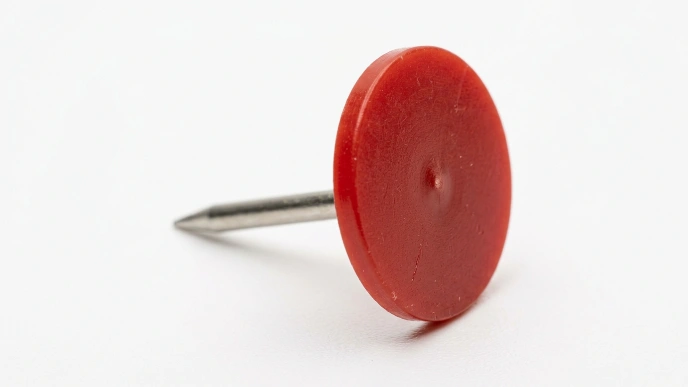
A small thumbtack can weigh around a gram, depending on the size of its metal pin and the material used for its head. Lightweight plastic-headed models may approach this amount, while larger brass, steel, or decorative push pins can be significantly heavier.
Thumbtacks are commonly used on corkboards, notice boards, walls, classrooms, offices, and planning boards. Their compact combination of a sharp metal point and a small head makes them another useful example of an object with very little total mass.
Place one lightweight thumbtack beside a small paper clip and the two provide a practical gram-scale comparison. Their actual weights can differ, but both demonstrate how small and light an object near this measurement can feel.
1 Gram Measurement
A gram is a base-scale unit commonly used for everyday mass measurements in the metric system. Technically, the SI base unit of mass is the kilogram, with one gram defined as 0.001 kilogram. Its symbol is g, and it should not be confused with units that describe length or volume.
Gram measurements are useful whenever kilograms would be too large for convenient precision. Food ingredients, nutritional quantities, precious metals, powders, cosmetics, postage items, and laboratory samples are frequently measured on this scale. Smaller quantities can then be expressed in milligrams.
For practical measurement, use a digital scale capable of displaying at least 1 g increments. If you need to distinguish fractions of a gram, such as 0.1 g or 0.01 g, a more sensitive precision scale is required.
How Much Is 1 Gram in Weight?
One gram is an extremely light amount of mass. In imperial units, it equals approximately 0.03527 ounces or 0.002205 pounds. In other words, roughly 28.35 grams are required to make one ounce, showing how small an individual gram is by comparison.
In your hand, this amount may feel almost weightless. A single US dollar bill or small paper clip provides a useful physical reference. By comparison, a typical smartphone weighs well over 100 grams, so one gram represents only a tiny fraction of its total mass.
The word “weight” is commonly used in everyday conversation, although grams technically measure mass. For normal cooking, shopping, and household comparisons, this distinction usually does not affect how the unit is used.
1 Gram in Milligrams
One gram equals exactly 1,000 milligrams (mg). The prefix “milli” means one-thousandth, so a single milligram represents 0.001 gram. This relationship makes conversion straightforward: multiply grams by 1,000 to obtain milligrams.
For example, 0.5 g equals 500 mg, while 2 g equals 2,000 mg. Milligrams are useful when quantities become too small to express conveniently in whole grams, particularly in scientific measurements, nutritional information, ingredient specifications, and other precision-based applications.
The conversion works in reverse as well. Divide the number of milligrams by 1,000 to convert it into grams. Therefore, 250 mg is 0.25 g, 500 mg is 0.5 g, and 1,000 mg is exactly 1 g.
1 Gram in Kilograms
One gram equals exactly 0.001 kilograms (kg). Since a kilogram contains 1,000 grams, converting grams to kilograms simply requires dividing the gram value by 1,000. This makes the metric relationship easy to calculate without complicated conversion factors.
To visualize the difference, consider a one-kilogram package of sugar or flour. If that package were theoretically divided into 1,000 equal portions by mass, each portion would contain one gram. This illustrates the large difference between the two commonly used metric units.
The conversion also works in the opposite direction. Multiply kilograms by 1,000 to obtain grams. For example, 0.5 kg equals 500 g, while 2 kg equals 2,000 g.
Is 1 Gram Equal to 1 mL?
A gram and a milliliter measure different properties, so they are not universally equal. Grams measure mass, whereas milliliters measure volume. The numerical values happen to be very close for water because water has a density of approximately one gram per milliliter under ordinary conditions.
The relationship changes when the substance changes. One milliliter of cooking oil generally weighs less than one gram because oil is less dense than water. Dense liquids and materials can weigh more than a gram for the same one-milliliter volume.
To convert accurately between grams and milliliters, you need the substance’s density. For water-based everyday estimates, 1 g ≈ 1 mL is often practical, but it should not be treated as a universal conversion.
Why Objects With the Same Weight Can Look Different
Two objects with identical mass can have dramatically different dimensions because density determines how much space a material occupies. A dense material such as metal can concentrate considerable mass into a small volume, while foam, cotton, or other lightweight materials require more space to reach the same mass.
This explains why visual comparisons should focus on approximate weight rather than assuming every gram-sized object has similar dimensions. Several factors can change the result:
- Material density affects the object’s required volume.
- Thickness can increase mass without greatly changing length.
- Manufacturing differences create small weight variations.
- Moisture can change the mass of paper and some foods.
- Packaging can add weight to products such as silica gel.
For casual visualization, familiar household items work well. When a recipe, experiment, or other task requires an exact quantity, use a properly calibrated scale rather than relying on object comparisons.
Read: How Long Is 21 Inches?
Read: How Long Is 2 Feet?
Read: How Long Is 3 Feet?
Read: How Tall Is 70 Inches?
Read: How Long Is 200 Feet?
Read: How Long Is 40 Inches?
Read: How Long Is 40 Feet?
Read: How big is 9mm?
Read: How Long Is 50 Inches?
Read: How Long Is 23 Inches?
Frequently Asked Questions
How many milligrams are in a gram?
There are exactly 1,000 milligrams in a gram. To convert grams to milligrams, multiply the number of grams by 1,000. For example, 0.25 g equals 250 mg.
How many grams make one ounce?
One avoirdupois ounce equals approximately 28.35 grams. Therefore, a single gram represents about 0.03527 ounces, making it much lighter than one full ounce.
Does a paper clip weigh exactly a gram?
Not necessarily. A small lightweight paper clip may weigh around a gram, but its exact mass depends on wire thickness, length, coating, and manufacturer. It is best used as an approximate comparison.
Does a dollar bill weigh a gram?
A US banknote weighs approximately one gram, making it a convenient real-world reference. Small differences may occur because of wear, moisture, contamination, or physical condition.
Can a kitchen scale measure such a small amount accurately?
It depends on the scale. A kitchen scale displaying only whole grams may be unsuitable for very precise quantities near its minimum capacity. For small measurements, a scale with 0.1 g or 0.01 g resolution provides better precision.
Final Thoughts
1 Gram is a very small amount of mass equal to 1,000 milligrams, 0.001 kilograms, and approximately 0.03527 ounces. Familiar items such as a US dollar bill, small paper clip, lightweight button, or tiny thumbtack can help put this quantity into everyday perspective.
Remember that these objects provide approximate comparisons rather than standardized weights. Materials, dimensions, and manufacturing differences can change their actual mass. When precision matters, use a suitable digital scale; when you simply need a mental picture, a dollar bill or small paper clip offers an easy reference.