
Quick Answer:
2 centimeters is equal to 0.787 inches, 20 millimeters, 0.02 meters, or about 0.066 feet. It is roughly comparable to the width of an adult fingertip.
When you need to picture a very short length, a number on a ruler does not always make the size immediately obvious. Everyday comparisons can make small dimensions much easier to understand, especially when measuring craft materials, hardware, jewelry, stationery, or household items.
2 Centimeters is a relatively small distance, but it appears surprisingly often in daily life. Looking at buttons, fingertips, small pieces of hardware, and other familiar objects gives you a practical visual reference when a ruler or measuring tape is unavailable.
This guide explains the size from several angles. You will find accurate conversions, visual comparisons, 14 familiar objects, and simple techniques for estimating the distance at home or while traveling.
2 Centimeters Conversion Chart
Quick and accurate measurement conversions
| Unit | Converted Value |
|---|---|
| Feet | 0.0656 ft |
| Inches | 0.7874 in |
| Centimeters | 2 cm |
| Millimeters | 20 mm |
| Meters | 0.02 m |
How Big Is 2 Cm?
A length of 2 cm is quite small. In the metric system, it equals exactly 20 millimeters and is slightly less than four-fifths of an inch. On a standard metric ruler, you can see this distance by starting at zero and counting across 20 individual millimeter marks, ending at the second centimeter line.
For a real-world sense of scale, look at the width of an adult fingertip or a medium-to-large shirt button. These familiar references can come reasonably close, although their exact dimensions vary. The measurement is also a little smaller than the diameter of a U.S. quarter, which measures about 2.43 cm across.
Because the distance is short, even a difference of a few millimeters can be noticeable. Everyday objects are therefore best treated as estimating aids rather than precision measuring tools.
What Does a Length of 2 Centimeters Represent?
In metric terms, this length represents two hundredths of a meter. That may sound tiny, but it is large enough to notice easily when comparing small objects side by side. It is commonly relevant when describing button diameters, jewelry pieces, craft components, small hardware, gaps, margins, and compact household items.
Imagine placing two 1-centimeter sections end to end. Together they create the full distance. Another way to picture it is to start with one inch and remove about one-fifth of its length. The remaining distance is close to 2 cm, since one inch equals exactly 2.54 centimeters.
These relationships make the dimension easier to understand without memorizing conversions. For precise work, however, a ruler, caliper, or measuring tape remains the better option.
What Does 2 Centimeters Look Like Visually?
Visually, 2 cm appears as a short span that can fit comfortably across part of a finger. On a ruler, it covers the space from the zero mark to the number 2. Since every centimeter contains ten millimeters, there are 20 small millimeter intervals within this distance.
An adult fingertip can provide one of the simplest visual references because finger widths commonly fall near this general range. A large shirt button can also work. A U.S. quarter is slightly wider at 24.26 mm, so imagining a distance about 4 mm shorter than the coin’s diameter gives another useful reference.
Small dimensions are easier to judge when you compare them directly rather than trying to picture them in isolation. Keep in mind that manufactured and natural objects can vary considerably in size.
Quick Comparison Table
The following table provides a fast overview of familiar items that can help you judge this small distance. Some are close to the target size, while others require a minor adjustment or depend heavily on the specific version of the object.
Measurements for everyday products are not universally standardized. Buttons, keys, erasers, markers, tablets, marbles, and fingertips can all differ between manufacturers or individuals. The figures below should therefore be treated as practical estimates rather than exact specifications.
For the easiest comparisons, choose an object whose actual dimensions you already know. Coins and standardized stationery can sometimes provide more consistent references than naturally variable items.
| Object | Approximate Size | How It Compares |
|---|---|---|
| Shirt button | 18–20 mm diameter | Often very close |
| U.S. quarter | 24.26 mm diameter | About 4.3 mm larger |
| Thumbtack pin | Around 10–20 mm, depending on type | Some styles approach 2 cm |
| Skittle | Around 12–14 mm wide | Noticeably smaller |
| Standard staple | Around 12–13 mm crown width | Smaller than 2 cm |
| Two stacked pencils | Around 14–16 mm total thickness | Usually slightly smaller |
| Paper clip width | Around 8–12 mm | Usually smaller |
| Eraser thickness | Around 10–20 mm | Larger styles can be close |
| Small key width | Around 18–22 mm | Often close |
| Marker cap thickness | Around 15–20 mm | Thick caps can be close |
| Aspirin tablet | Around 8–12 mm diameter | Usually smaller |
| Small marble | Around 14–20 mm diameter | Larger small marbles can be close |
| Dice width | Around 16–20 mm | Some dice are close |
| Fingertip width | Around 15–20+ mm | Often a useful estimate |
Everyday Objects That Measure Around 2 Centimeters
Small objects are particularly useful for understanding short metric measurements because they can be placed directly beside the space you want to estimate. Buttons, coins, dice, fingertips, and stationery are easy to find, making them convenient visual references when no measuring tool is nearby.
Not every object in the following list measures exactly 20 mm. Some come very close, while others are slightly smaller or larger and work best when you know the difference. This distinction matters because a variation of only 3 or 4 mm represents a significant percentage of such a short length.
The comparisons below explain both the typical size of each object and how to adjust your estimate when the item does not match the target exactly.
1. Shirt Button

Medium and large shirt buttons are often manufactured in diameters approaching 2 cm, although clothing buttons come in many sizes. A button measuring 20 mm across matches the target exactly, while an 18 mm button falls short by only 2 mm. Smaller dress-shirt buttons may be considerably narrower.
Buttons are found on shirts, coats, cardigans, uniforms, and many other garments. Because they are flat and circular, their diameter is easy to compare with a short straight distance. You may also have several button sizes available in the same wardrobe.
If you can identify a button that is approximately 20 mm across, its diameter provides a convenient visual guide. For better accuracy, check the button size first rather than assuming every shirt button has the same dimensions.
2. US Quarter

A U.S. quarter has an official diameter of 24.26 mm, or 2.426 cm. That makes it about 4.26 mm wider than the target distance. It is therefore not an exact match, but its standardized diameter makes it a predictable reference once you account for the difference.
Quarters are common in wallets, coin jars, cash drawers, and pockets throughout the United States. Their circular shape makes the diameter particularly easy to visualize, and unlike many household objects, the size does not change significantly from one example to another.
To estimate the target using a quarter, picture a span slightly smaller than the coin’s full width. Removing roughly one-sixth of its diameter brings the visual estimate much closer to 20 mm.
3. Thumbtack Pin
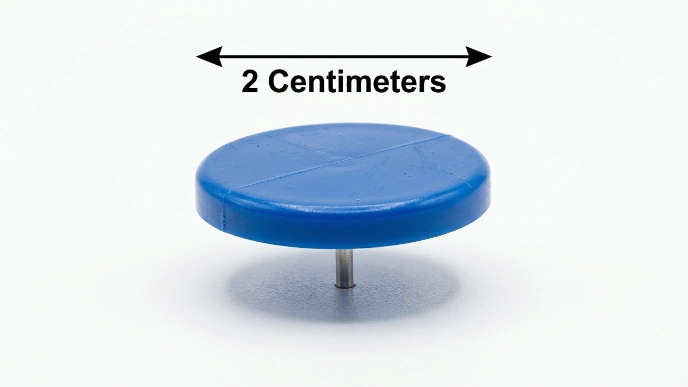
Thumbtacks vary substantially by design. The pin shaft may be around 10 mm long on some models, while larger pushpins and decorative tacks can have overall dimensions approaching 20 mm or more. For this reason, the specific tack should be checked before using it as a reference.
These small fasteners are commonly used to attach notes, photographs, schedules, maps, and reminders to corkboards or soft surfaces. Their compact form makes them familiar objects in classrooms, offices, studios, and home workspaces.
A larger thumbtack or pushpin can help you visualize a short metric distance when its known dimension is close to 20 mm. Standardization is limited, however, so it should be considered a rough comparison rather than an exact measuring device.
4. Skittle
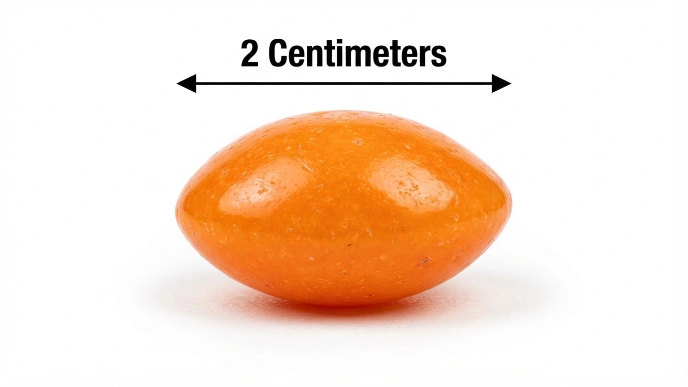
A single Skittle is generally around 12 to 14 mm across, depending on the individual candy and variety. That equals roughly 1.2 to 1.4 cm, making one piece noticeably smaller than the target distance. Its rounded shape can also make visual measurement less precise.
Skittles are familiar bite-sized candies sold in packets, sharing bags, and small boxes. Their compact size makes them useful for understanding the scale of centimeters and millimeters, even though one candy does not provide a direct 20 mm match.
When using a Skittle as a reference, imagine its width plus approximately another half-Skittle width. That combined visual span gets you into the neighborhood of 2 cm, although it remains only an informal estimate.
5. Standard Staple

A common office staple often has a crown width of approximately 12 to 13 mm, while the legs may be around 6 mm long. Staple specifications vary by type and manufacturer, so the exact dimensions should be checked on the packaging when accuracy matters.
Staples are widely found in offices, classrooms, libraries, and home desks. Before being driven through paper, the rectangular shape makes the crown especially easy to compare against other small distances.
Because a typical staple crown is shorter than 20 mm, you need to mentally add another 7 to 8 mm. It is not a one-to-one reference, but it can still help establish the general scale of such a short measurement.
6. Two Stacked Pencils

A standard wooden pencil is commonly around 7 to 8 mm thick across its body. Stacking two pencils side by side or vertically therefore creates a combined thickness of approximately 14 to 16 mm, depending on whether the pencils are round, hexagonal, or slightly oversized.
Pencils are among the easiest comparison objects to find at home, school, or work. Their relatively consistent bodies make them useful for rough estimates, especially when several identical pencils are placed together.
Two ordinary pencils generally fall several millimeters short of 2 cm. Visualizing a small additional gap beyond the combined thickness can bring the estimate closer to the intended dimension. Oversized pencils may produce a different result.
7. Paper Clip Width
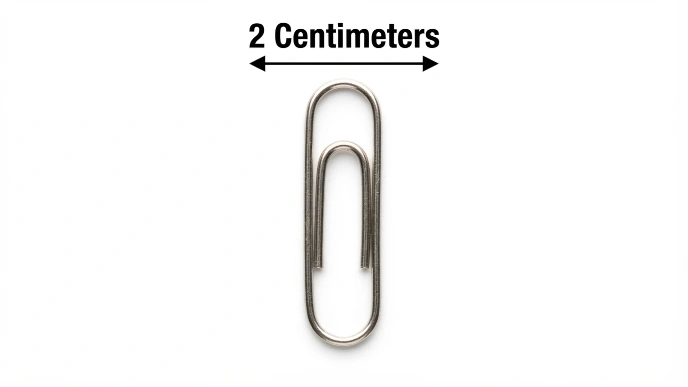
The narrow dimension of a common paper clip is often around 8 to 12 mm, depending on its design and size. Larger clips can be wider, while miniature clips may be substantially smaller. Its total length is usually much greater than the short dimension considered here.
Paper clips are routinely used to organize documents, receipts, notes, and paperwork without permanently fastening the pages. Their simple wire construction makes them readily available in desks, stationery boxes, offices, and classrooms.
A typical clip’s width is usually only about half of the target distance. Two widths placed mentally side by side can provide a rough 2 cm reference, particularly when each clip is approximately 10 mm wide.
8. Eraser Thickness
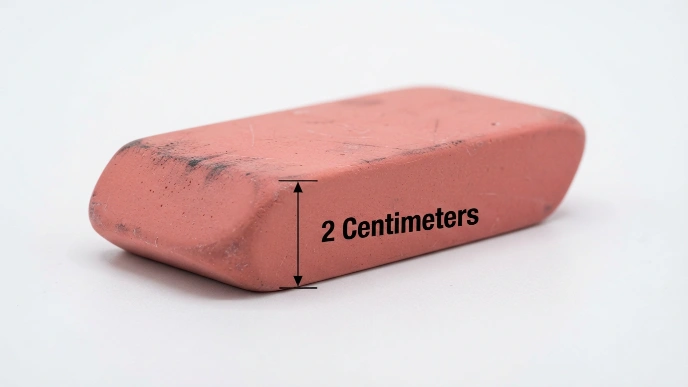
Rectangular pencil erasers vary widely, but their thickness or narrow width can range from approximately 10 to 20 mm. Larger school erasers may therefore have one dimension very close to 2 cm, while slim pencil-top erasers are considerably smaller.
Erasers are common in pencil cases, classrooms, offices, art studios, and home desks. Their straight edges make rectangular versions especially convenient for visual comparison because you can align one edge directly with the space being estimated.
If your eraser has a narrow side measuring around 20 mm, that edge becomes a useful reference. Since eraser dimensions are not standardized, checking it once with a ruler can turn that particular eraser into a reusable estimation tool.
9. Small Key Width
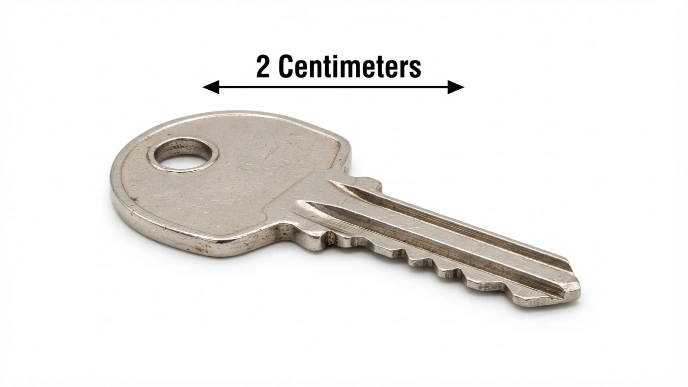
The head of a small household key can measure approximately 18 to 22 mm across, although key styles differ considerably. The blade itself is usually narrower. A compact key with a 20 mm-wide head would provide an almost exact comparison for this measurement.
Keys are familiar objects carried on key rings and used for doors, cabinets, padlocks, mailboxes, luggage, and storage units. Because people often have them available while away from home, they can become useful improvised references.
Look at the widest part of the key’s head rather than its overall length. If that width is close to 20 mm, it offers a convenient visual guide, but measuring your specific key once beforehand will make future estimates more dependable.
10. Marker Cap Thickness
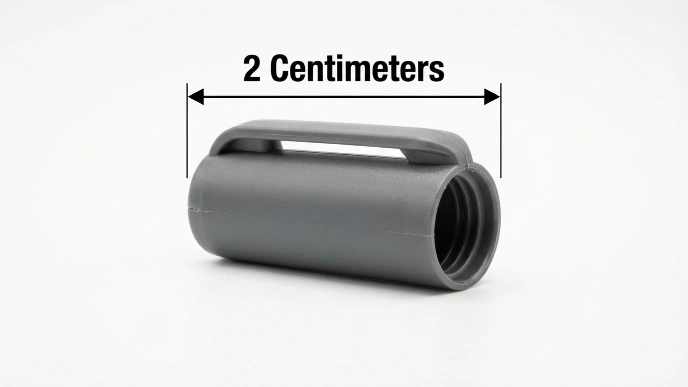
The outside diameter or width of a marker cap can range from roughly 15 to 20 mm for many common markers. Broad permanent markers and chunky children’s markers may be close to the upper end, whereas fine-tip pens have much slimmer caps.
Marker caps are familiar in classrooms, offices, workshops, art supplies, and home stationery collections. Their compact cylindrical or slightly flattened shapes make them easy to position beside another small object for comparison.
A thick marker cap measuring approximately 20 mm across can closely represent the target. Thin markers will underestimate it, so the comparison works best with broad-bodied models rather than assuming that every marker cap is the same size.
11. Aspirin Tablet
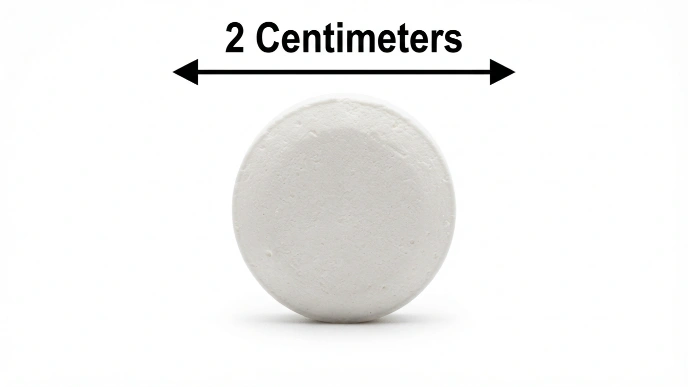
Aspirin tablets vary by dosage, manufacturer, coating, and shape, but many conventional tablets are roughly 8 to 12 mm across. This is considerably smaller than 20 mm, meaning a single tablet should not be treated as an exact representation of the target distance.
Tablets are commonly stored in medicine cabinets, pill organizers, travel containers, and first-aid supplies. Their compact circular or oval shapes make them useful for understanding millimeter-scale dimensions, although product sizes differ.
A tablet around 10 mm wide represents approximately half of 2 cm. Two such tablet widths placed side by side would therefore provide a much closer visual comparison, provided the individual tablets are actually about 10 mm across.
12. Small Marble

Marbles are produced in numerous sizes. Smaller examples may measure around 14 to 16 mm in diameter, while larger common marbles can approach 20 mm or more. A marble with a 20 mm diameter would correspond directly to the target dimension across its widest point.
Marbles are used in children’s games, decorative displays, crafts, collections, and sometimes educational activities. Their spherical shape makes diameter the relevant dimension when comparing them with a straight-line measurement.
Choose one of the larger small marbles if you want a close reference. A 16 mm marble falls 4 mm short, whereas a 20 mm version provides a direct visual match from one side of the sphere to the other.
13. Dice Width

Many standard gaming dice are approximately 16 mm wide, or 1.6 cm, from one flat face to the opposite face. Larger dice measuring around 18 to 20 mm are also widely available, so the exact size depends on the game and manufacturer.
Dice appear in board games, tabletop games, educational activities, and gaming sets. Their cube shape is particularly useful for measurement comparisons because every edge on a standard six-sided die has the same length.
A typical 16 mm die is about 4 mm shorter than 2 cm. If you have a larger 20 mm die, however, one edge gives you an excellent direct reference. Checking your dice once can establish which type you own.
14. Fingertip Width

An adult fingertip can measure roughly 15 to 20 mm or more across, depending on the person and which finger is used. Some fingertips therefore come surprisingly close to 2 cm, although human body dimensions naturally vary and should never be treated as standardized measurements.
Your fingers are always available, which makes this one of the most practical ways to estimate short distances when you have no tools. Fingertip widths can help with quick judgments involving spacing, object sizes, margins, or other everyday dimensions.
Measure the width of your own fingertip with a ruler once. If it happens to be close to 20 mm, you gain a personalized reference that can be reused almost anywhere without carrying a separate measuring object.
Ways to Estimate 2 Centimeters Without Using a Ruler
The easiest way to estimate this distance without a ruler is to use an everyday object whose dimensions are already known. A roughly 20 mm button, a suitable fingertip, or a known 20 mm die can provide a quick physical reference. Standardized objects are generally more dependable than objects whose sizes vary considerably.
You can also build the distance from smaller known units. If you have an object approximately 10 mm wide, placing two of those widths together gives about 20 mm. Another option is to use a U.S. quarter and remember that the desired distance is approximately 4.3 mm shorter than its 24.26 mm diameter.
These techniques work well for rough visual judgments, crafts, spacing, or quick comparisons. Precision tasks such as engineering, fitting parts, or cutting materials should still be completed with an appropriate measuring instrument.
Simple Methods to Judge 2 Centimeters at Home Without Tools
At home, begin with objects you use frequently and can measure once for future reference. A fingertip, button, key head, eraser, or gaming die can become a useful personal measuring guide after you know its actual dimensions. This is much more reliable than assuming every example has a universal size.
Another simple method is visual subdivision. One centimeter equals 10 mm, so two 1 cm references placed end to end create the desired distance. If you know the width of a particular household object is about 1 cm, mentally duplicating that width can produce a reasonable estimate.
Repeated comparison also improves your visual judgment. Look at the 0-to-2 cm section of a ruler several times and compare it with nearby objects. Over time, recognizing a distance around 20 mm becomes considerably easier.
How to Approximate 2 Centimeters While Traveling Without Tools
When traveling, the most convenient measuring references are objects you already carry. Your fingertip, a familiar key, a coin, or another item with a known dimension can provide a quick approximation. The key is knowing the object’s actual size before relying on it.
If you have a U.S. quarter available, remember that its diameter is 24.26 mm. The target distance is therefore a little narrower than the coin. Alternatively, a fingertip that you have previously measured at approximately 20 mm can serve as a direct personal reference anywhere.
These approaches are useful for checking small gaps, accessories, souvenirs, or compact objects on the go. For purchases where dimensions affect fit or compatibility, verify the measurement with a proper tool before making a final decision.
How Accurate Are Everyday Object Comparisons?
Everyday comparisons are excellent for visualization but have clear limits. Manufactured products can differ between brands, and natural references such as fingers vary from person to person. A stated object size should therefore be treated as approximate unless the dimensions are standardized or have been measured directly.
A few habits can improve your estimates:
- Use objects with known or standardized dimensions whenever possible.
- Measure your own fingertip, key, or favorite reference object once.
- Avoid assuming all buttons, dice, tablets, or marbles are identical.
- Use two smaller known dimensions when they are easier to visualize.
- Switch to a ruler or caliper when millimeter-level accuracy matters.
For casual size comparisons, these techniques are usually sufficient. For construction, manufacturing, medical, mechanical, or other precision-dependent tasks, an estimated household comparison should not replace an actual measuring instrument.
Read: How Big Is 5cm?
Read: How Tall Is 40 Inches?
Read: How Big Is 40cm?
Read: How Big Is 7cm?
Read: How Big Is 3 Centimeters?
Read: How long is 16 Inches?
Read: How Big Is 10mm?
Read: How Long Is 12 Inches?
Read: How Big Is 7mm?
Read: How Long Is 20 Feet?
Frequently Asked Questions
How many millimeters are in 2 cm?
There are exactly 20 millimeters in 2 cm. Since every centimeter contains 10 millimeters, multiplying 2 by 10 gives 20 mm. This conversion is exact rather than approximate.
How many inches is this length?
It equals approximately 0.7874 inches. Because one inch is exactly 2.54 centimeters, this distance is a little less than four-fifths of an inch.
Is a U.S. quarter about the same size?
A quarter is slightly larger. Its diameter is 24.26 mm, or 2.426 cm, which makes it approximately 4.26 mm wider than the target measurement. It is useful as a visual reference if you account for that difference.
Can I use my finger to estimate the distance?
Yes, but measure your own finger first. Adult fingertip widths vary considerably. If one of your fingertips is close to 20 mm across, it can become a convenient personal reference for quick estimates.
What common object is closest to this size?
A 20 mm shirt button or 20 mm gaming die provides a particularly simple comparison because its diameter or edge can match the measurement closely. A fingertip may also work, depending on the individual.
Is 2 Centimeters the same as 0.02 meters?
Yes. One meter contains 100 centimeters, so dividing 2 by 100 gives exactly 0.02 meters. The same length is also equal to 20 millimeters and approximately 0.787 inches.
Conclusion
2 Centimeters is a short distance equal to 20 millimeters, 0.02 meters, approximately 0.787 inches, or about 0.066 feet. Familiar references such as a 20 mm button, a larger gaming die, or the width of some fingertips can make this dimension much easier to picture.
For rough estimates, choose an object whose size you already know rather than relying on assumptions about variable household items. Once you memorize what 20 mm looks like on a ruler—or measure one convenient personal reference—you can judge this small distance surprisingly well in everyday situations.