

Quick Answer:
17 inches equals 43.18 cm, 431.8 mm, 1.4167 feet, or 0.4318 meters. It is roughly comparable to the width of a large laptop or a full-size keyboard.
When you see a dimension listed in inches, the number alone may not give you a clear sense of its actual size. Comparing it with something familiar is usually much easier than trying to picture the distance on an imaginary ruler.
At 17 inches, the length is a little under one and a half feet. That makes it comparable to many objects found around a home, office, kitchen, or while traveling. A laptop, keyboard, serving tray, pillow, or suitcase can provide a useful visual reference.
This guide explains the exact conversions, what this measurement looks like in everyday settings, and how tall or far it is. You will also find 16 practical object comparisons that make the dimension easier to estimate without measuring equipment.
17 Inches Conversion Chart
Quick and accurate measurement conversions
| Unit | Converted Value |
|---|---|
| Feet | 1.4167 ft |
| Centimeters | 43.18 cm |
| Millimeters | 431.8 mm |
| Meters | 0.4318 m |
How Long Is 17 Inches?
A length of 17 inches is equal to 1 foot and 5 inches. In metric measurements, it converts to exactly 43.18 centimeters or 431.8 millimeters. Since one foot contains 12 inches, this dimension extends another five inches beyond a standard one-foot ruler. It is also just seven inches short of two feet.
For a practical visual reference, imagine a large laptop measured across its screen or the width of many full-size computer keyboards. Some kitchen cutting boards, serving trays, backpacks, and decorative frames also fall close to this range. These familiar objects make the dimension much easier to understand than a numerical conversion alone.
Exact dimensions vary between products, so everyday objects should be treated as approximate references rather than measuring tools. For precise work, a ruler or tape measure remains the better choice.
What Does 17 Inches Look Like?
Visually, this dimension looks moderately long when placed on a desk or countertop. It is noticeably longer than a 12-inch ruler but considerably shorter than a standard 24-inch measurement. If you placed a one-foot ruler down and imagined another five inches continuing from its end, you would have an accurate visual representation.
Another useful approach is to think about electronics and household items. A large laptop can measure close to this distance across its body, while a full-size keyboard may be approximately 17 to 18 inches wide. Medium serving trays and cutting boards can also provide similar visual references.
The apparent size can change depending on orientation. Seventeen inches standing vertically may look fairly tall, while the same distance across a tabletop can appear relatively compact.
Common Items That Are About 17 Inches Long
Many everyday objects have at least one dimension close to this length. Product designs differ, so not every laptop, tray, pillow, or suitcase will measure exactly the same. However, these examples provide useful visual benchmarks when you do not have a ruler nearby.
Some references are especially useful because they are standardized or commonly manufactured within a predictable size range. Others, such as shelves and storage baskets, vary more widely but can still help you develop a general sense of scale.
Here is a quick comparison before looking at each object in more detail.
| Object | Approximate Length | How It Compares |
|---|---|---|
| 17-inch laptop screen | 17 in diagonal | Exact diagonal reference |
| Full-size keyboard | 17–18 in wide | Very close |
| Large pizza tray | 16–18 in | Close |
| Medium wall shelf | 16–18 in | Close |
| Carry-on suitcase | 14–17 in wide | Similar |
| Kitchen cutting board | 16–18 in long | Very close |
| Decorative picture frame | 16–18 in | Similar |
| Large serving tray | 16–18 in long | Very close |
| Guitar neck section | About 17 in | Similar |
| Small coffee table | 16–20 in wide | Approximate |
| Bed pillow | 18–20 in short side | Slightly longer |
| Backpack | 15–18 in wide | Similar |
| Closed folding umbrella | 15–18 in | Similar |
| Large floor tile | 16–18 in | Close |
| Large wall clock | 16–18 in diameter | Similar |
| Storage basket | 16–18 in long | Close |
1. 17-Inch Laptop Screen
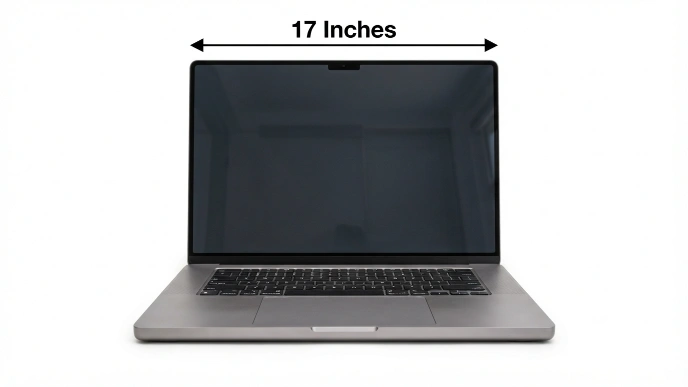
A 17-inch laptop provides one of the most obvious references, but there is an important detail: screen size is measured diagonally, not horizontally from one side to the other. A screen advertised as 17 inches therefore has a diagonal measurement of about 43.18 cm. Its actual width will be less and depends on its aspect ratio.
Large laptops of this class are commonly used for gaming, creative work, video editing, engineering applications, or desktop-replacement setups. Their screens provide more viewing space than typical 13-, 14-, or 15-inch laptops, although the overall computer body is larger than the advertised diagonal screen measurement.
If you have access to a laptop in this size category, imagine a straight line running diagonally from one corner of the display to the opposite corner. That line provides an excellent representation of the target length.
2. Full-Size Computer Keyboard
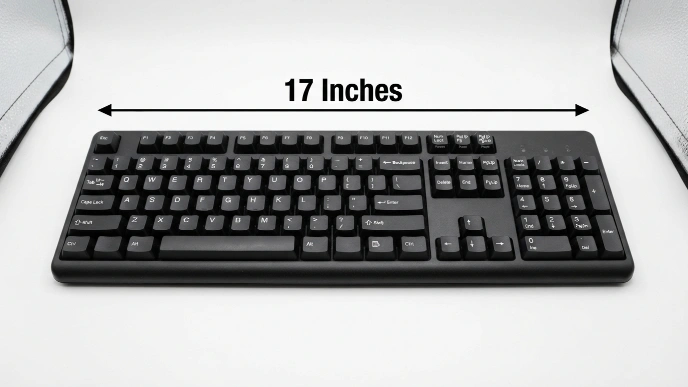
A conventional full-size computer keyboard commonly measures around 17 to 18 inches wide, or approximately 43 to 46 centimeters. Models containing a complete number pad tend to be wider than compact, tenkeyless, and 60% keyboards. Some slim office keyboards come especially close to the 17-inch mark.
These keyboards are common in offices, schools, gaming setups, reception areas, and home workstations. Because they are familiar objects positioned directly in front of users every day, their overall width is easy to visualize without needing a ruler.
Picture the distance from the far-left edge of a typical full-size keyboard to nearly the far-right edge. That span gives you a practical approximation of this length, though individual keyboard dimensions vary by manufacturer.
3. Large Pizza Tray
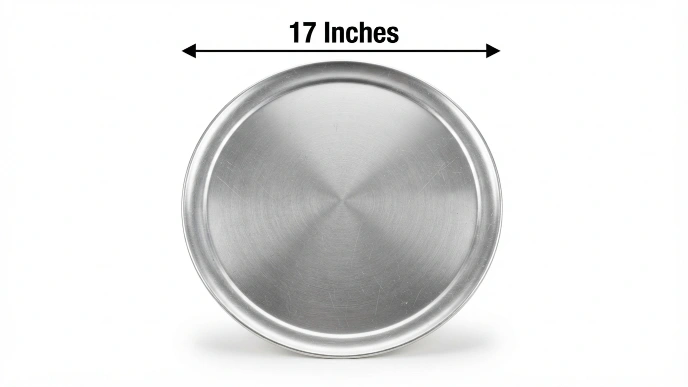
Large pizza trays are commonly produced in diameters around 16 to 18 inches, making a 17-inch tray an excellent circular reference. A diameter of 17 inches equals 43.18 centimeters and represents a straight line passing through the center of the tray from one edge to the opposite edge.
You will typically see trays of this size in pizzerias, commercial kitchens, restaurants, and homes where large pizzas are prepared. Their broad circular shape can make the measurement appear larger than a narrow object of exactly the same length.
If you picture a large pizza tray stretching across a kitchen counter, its edge-to-edge diameter gives a simple approximation. A 16-inch tray would be one inch shorter, while an 18-inch version would extend one inch farther.
4. Medium Wall Shelf
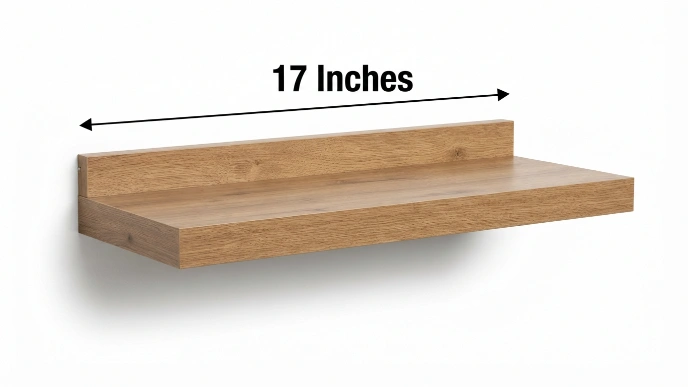
A compact or medium wall shelf may measure around 16 to 18 inches long, although shelving is manufactured in many different sizes. A shelf measuring exactly 17 inches would span 43.18 centimeters from one end to the other, making it suitable for a few books, decorative objects, or small plants.
Short shelves are often installed in bedrooms, kitchens, bathrooms, home offices, and entryways. Floating designs are particularly useful references because their straight horizontal edges make their overall length easy to judge visually.
Imagine a compact shelf holding two or three decorative items. If its width is around 17 inches, that horizontal span provides a useful reference. Unlike screen dimensions, shelf lengths are generally measured directly from end to end.
5. Carry-On Suitcase Width
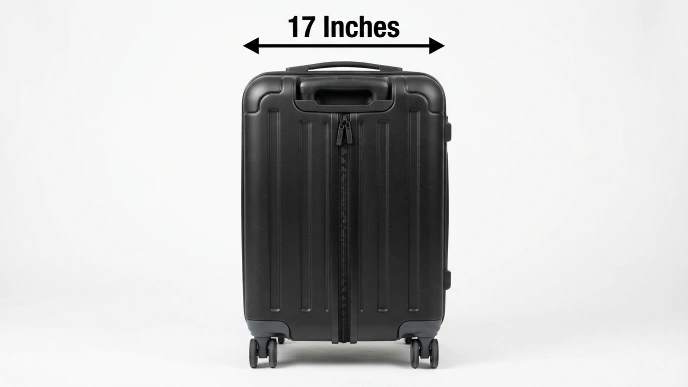
Many carry-on suitcases are approximately 14 to 17 inches wide, depending on the airline-friendly design and manufacturer. A suitcase with a 17-inch width measures about 43.18 centimeters across its front. Its height will usually be substantially greater, often around 20 to 22 inches.
Carry-on luggage is designed to fit overhead storage compartments, which keeps its overall dimensions relatively compact. Travelers frequently encounter cases in this general size range at airports, hotels, train stations, and luggage stores.
To visualize the measurement, focus only on the suitcase’s side-to-side width rather than its height. A wider carry-on near the upper end of the typical range can provide a convenient approximation of the distance.
6. Kitchen Cutting Board
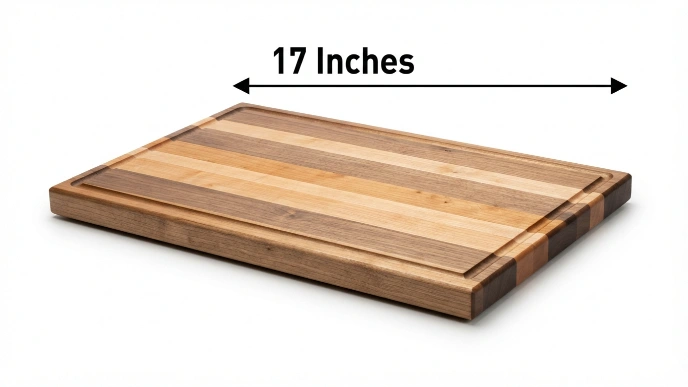
A medium-to-large kitchen cutting board often measures approximately 16 to 18 inches along its longest side. A board measuring 17 inches long spans exactly 43.18 centimeters, providing enough preparation space for vegetables, meat, bread, fruit, and other everyday ingredients.
Cutting boards are particularly useful visual references because most have simple rectangular shapes. They are commonly stored on countertops, inside cabinets, beside sinks, or near food-preparation areas, making them easy household objects to use for a rough comparison.
Imagine the longest edge of a generously sized cutting board. If it falls between common 16- and 18-inch models, the midpoint is almost exactly the length being visualized here.
7. Decorative Picture Frame
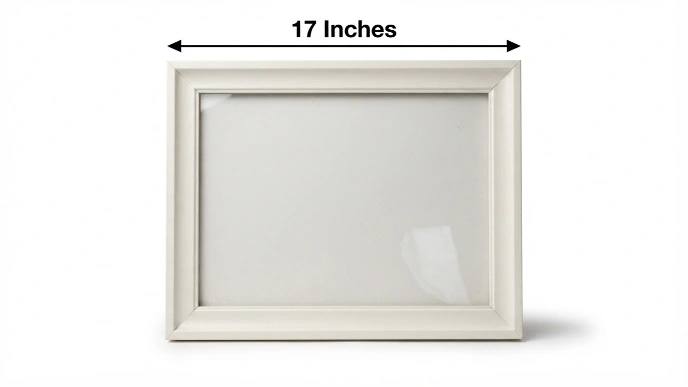
Medium and large decorative picture frames frequently have one external dimension around 16 to 18 inches. The listed photo size may be smaller because the frame border adds extra width and height. A 17-inch outer edge corresponds to approximately 43.18 centimeters.
Frames in this general range are commonly displayed on living-room walls, desks, shelves, hallways, and gallery arrangements. Their rectangular shape makes it straightforward to focus on a single edge when estimating distance.
If you have a medium-sized wall frame nearby, look at its longer or shorter side depending on the frame format. An edge close to 17 inches offers a useful visual benchmark, although frame dimensions differ considerably by style.
8. Large Serving Tray
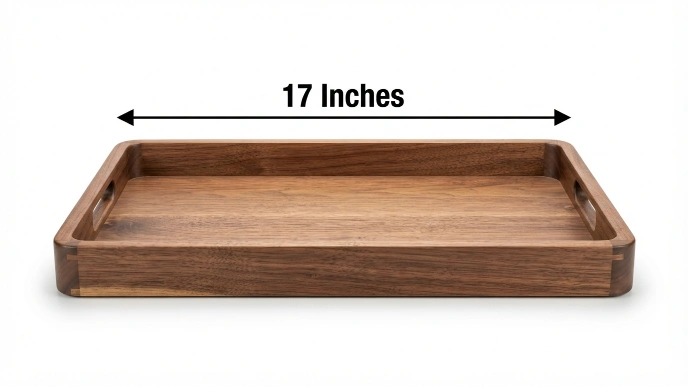
A large rectangular serving tray can measure around 16 to 18 inches long, placing many designs close to the target dimension. A 17-inch tray has a long edge measuring 43.18 centimeters, while its width may be somewhere around 11 to 14 inches.
Serving trays are commonly used to carry drinks, breakfast, snacks, dishes, or tea. You may find them in homes, hotels, restaurants, cafés, and catering settings. Their broad surface area can make the length feel larger than it does on a thin ruler.
Visualize the tray from handle to handle or along its longest straight edge. A model sitting between common 16-inch and 18-inch sizes provides an intuitive approximation of this distance.
9. Guitar Neck Section
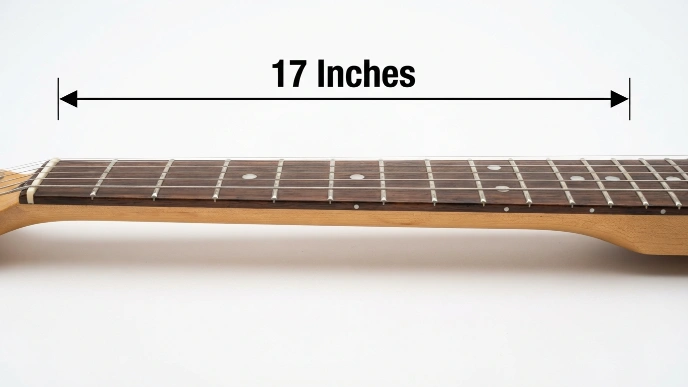
A section of a guitar neck can provide another useful reference, although guitar dimensions vary considerably by instrument type and design. A span of roughly 17 inches, or 43.18 centimeters, can cover a substantial portion of the neck rather than necessarily representing its entire length.
Guitar necks are familiar to musicians and are seen on acoustic, electric, and classical instruments. Scale lengths are generally longer than 17 inches, commonly extending well beyond two feet, so the comparison should be made only with a selected neck section.
Imagine measuring a straight 17-inch portion along the neck rather than from the instrument’s headstock all the way to its body. This provides a reasonable visual reference without implying that an entire guitar neck has a standardized 17-inch length.
10. Small Coffee Table Width
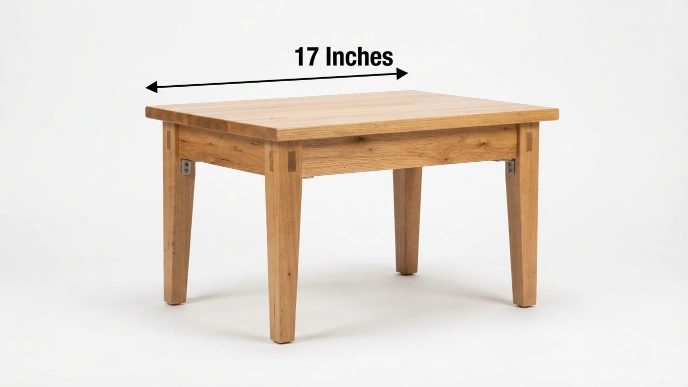
A compact coffee table can have a width or depth somewhere around 16 to 20 inches, depending on its shape. Narrow tables measuring approximately 17 inches across provide a 43.18-centimeter reference, although their length is typically much greater.
Coffee tables are found in living rooms, apartments, lounges, waiting areas, and hotel seating spaces. Smaller designs are especially common where floor space is limited. Rectangular tables may have a short side close to this dimension.
Look at the front-to-back depth or shorter edge rather than the table’s full length. If that side is roughly halfway between 16 and 18 inches, it gives a practical sense of the measurement being discussed.
11. Bed Pillow Length
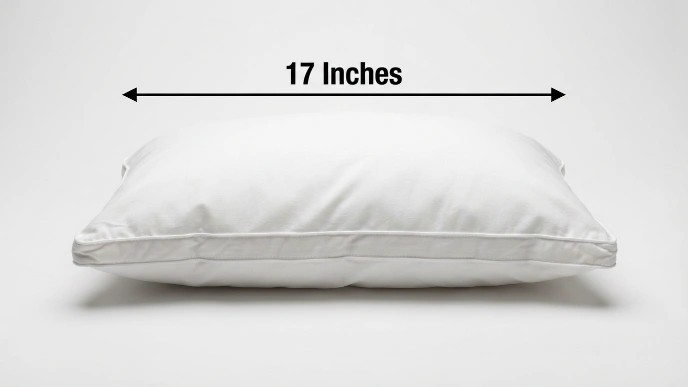
A standard U.S. bed pillow is commonly around 20 inches wide, so it is somewhat longer than 17 inches along its shorter dimension. Compressing the pillow or visually removing about three inches from its width gives a reasonably close comparison.
Pillows are particularly familiar objects because they are found in almost every bedroom, hotel room, and bedding department. Unlike rigid objects, however, their soft construction means the apparent dimensions can change slightly when compressed, folded, or stuffed into a pillowcase.
For estimation, picture a standard pillow’s 20-inch side and subtract roughly three inches. This is less precise than using a keyboard or measured screen, but it remains an accessible household reference when you need a quick mental comparison.
12. Backpack Width
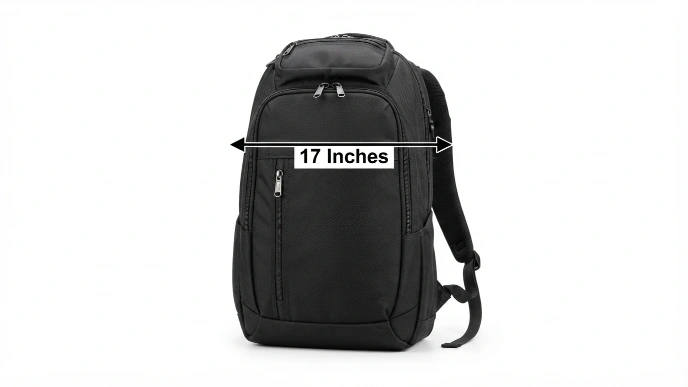
Larger backpacks can measure roughly 15 to 18 inches across at their widest point, although many everyday models are narrower. A broad backpack approaching 17 inches in width provides a side-to-side span of approximately 43 centimeters.
Backpacks in this size range may be used for travel, school, hiking, commuting, photography equipment, or carrying laptops. Their exact dimensions depend on capacity, padding, pocket design, and whether the bag is empty or fully packed.
If you own a fairly broad travel or laptop backpack, look across its widest horizontal section. A model close to 17 inches wide gives a convenient reference, though its soft sides make it less precise than a rigid rectangular object.
13. Closed Folding Umbrella
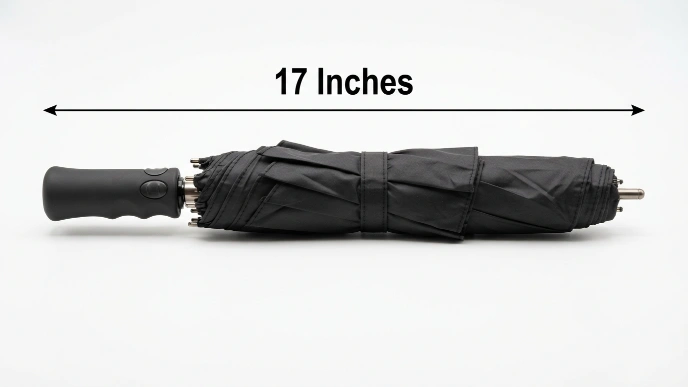
Some compact and medium folding umbrellas measure around 15 to 18 inches when closed, particularly models with larger canopies or longer handles. A closed umbrella measuring 17 inches has an end-to-end length of 43.18 centimeters.
Folding umbrellas are commonly stored inside backpacks, cars, office drawers, travel bags, and entryway cabinets. Their narrow, elongated form makes them useful for understanding linear distance because there is little distraction from width or overall surface area.
Picture a medium folding umbrella lying flat on a table. A model near 17 inches from the tip to the end of its handle offers a simple physical representation that is easy to compare with other objects.
14. Large Floor Tile
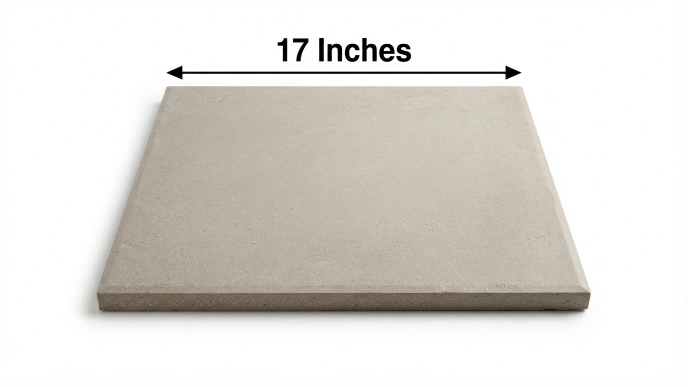
Large floor tiles are manufactured in numerous dimensions, including 16-inch, 18-inch, and larger formats. A hypothetical or specialty tile with a 17-inch side would measure 43.18 centimeters across, sitting almost exactly between the familiar 16- and 18-inch square formats.
Tiles of this general size are used in kitchens, bathrooms, hallways, entryways, commercial spaces, and open-plan living areas. Because they are rigid and geometric, their edges make excellent references for visualizing straight-line dimensions.
If you are looking at an 18-inch square tile, imagine removing one inch from one edge. Alternatively, add one inch mentally to a 16-inch tile. Either approach produces a close visual approximation of the desired span.
15. Large Wall Clock Diameter
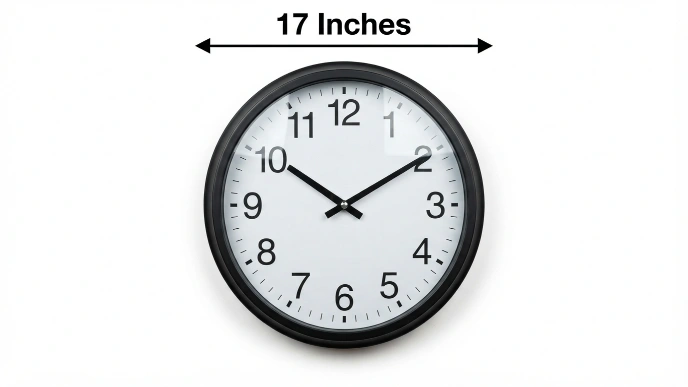
Large decorative wall clocks often have diameters in the 16-to-18-inch range, although oversized designs can be considerably larger. A clock with a 17-inch diameter measures 43.18 centimeters directly across its center from one outer edge to the opposite edge.
Wall clocks of this scale are frequently used in kitchens, offices, classrooms, living rooms, cafés, and reception spaces. The circular shape gives the dimension a different visual appearance than the same length shown along a ruler or keyboard.
To use one as a reference, imagine drawing a straight horizontal line through the clock’s center. If the clock is approximately 17 inches in diameter, that edge-to-edge line represents the measurement very closely.
16. Storage Basket
Medium-to-large storage baskets often measure around 16 to 18 inches along their longest side. A 17-inch basket would therefore have a length of 43.18 centimeters, although its width and height could be substantially smaller.
These baskets are commonly used for clothing, towels, toys, pantry items, bathroom supplies, blankets, and household organization. Plastic, woven, fabric, and wire versions may all fall within this general dimensional range.
Look at the basket’s longest straight edge rather than its handles or curved rim. A medium model between 16 and 18 inches long gives a straightforward household reference and can be particularly useful when estimating shelf or cabinet space.
How Tall Is 17 Inches?
Standing vertically, 17 inches reaches 1 foot 5 inches high, or about 43.18 centimeters. That is noticeably taller than a standard 12-inch ruler but still well below two feet. When positioned upright, the dimension often appears more substantial than when the same distance is viewed horizontally across a desk.
For comparison, imagine placing a one-foot ruler vertically on a table and extending the line another five inches upward. A large desktop monitor’s visible height with its stand, a tall storage container, or certain compact household appliances may occupy a broadly similar vertical space.
Height should always be measured from the lowest point to the highest relevant point. Product feet, handles, stands, and lids can change the overall measurement, so check exactly which points are included when comparing dimensions.
How Far Is 17 Inches?
As a distance, 17 inches equals 43.18 centimeters, 1.4167 feet, or approximately 0.432 meters. It is a relatively short span that can easily fit across a desktop, countertop, cabinet shelf, or similar household surface.
Imagine placing a standard 12-inch ruler on a table. After reaching its end, continue another five inches in the same direction. That extra section is slightly shorter than the length of a typical smartphone, depending on the model. Together, the two portions create the full distance.
This scale is useful when planning storage, furniture placement, equipment clearance, or product dimensions. For tasks where fit matters, use an actual tape measure rather than relying solely on visual estimation.
Common Mistakes About 17 Inches
One common mistake is assuming that an object described as 17 inches has every side measuring that amount. In reality, product specifications may refer to width, height, depth, diameter, or diagonal size. A 17-inch laptop, for example, refers to its screen diagonal rather than its physical width.
Another issue is treating everyday comparison objects as standardized measuring devices. Keyboards, trays, backpacks, shelves, and baskets can vary by several inches between models. These examples are designed primarily to provide visual context, not exact measurements.
It is also easy to confuse decimal feet with feet-and-inches notation. 1.4167 feet does not mean 1 foot 41 inches. It represents approximately 1 foot plus 5 inches.
How to Estimate This Length Without a Ruler
You can make a reasonably useful estimate without measuring equipment by starting with an object whose dimensions you already know. A standard U.S. letter sheet, for example, is 11 inches long, so 17 inches is one sheet length plus another six inches.
Another method is to use a 12-inch ruler-sized reference and mentally add five inches. A full-size keyboard can also work when its known width is around 17 to 18 inches. For rough household estimates, medium cutting boards and serving trays may provide similar references.
- Start with 12 inches and add another 5 inches.
- Compare the distance with a full-size keyboard.
- Look for a cutting board around 16–18 inches long.
- Use a known 18-inch object and mentally subtract 1 inch.
These techniques are suitable for visualization and rough planning. If you are cutting materials, ordering furniture, checking luggage restrictions, or fitting an item into a specific space, use a proper measuring tool.
Read: How Long Is 18 Inches?
Read: How Big Is 3 Inches?
Read: How Tall Is 40 Inches?
Read: How long is 16 Inches?
Read: How Long Is 12 Inches?
Read: How Tall is 60 Inches?
Read: How Long Is 14 Inches?
FAQs
Is 17 inches more than one foot?
Yes. One foot equals 12 inches, so this measurement is five inches longer than one foot. In feet-and-inches notation, it is written as 1 ft 5 in.
How many centimeters are in 17 inches?
There are exactly 43.18 centimeters. The calculation uses the standard conversion of 1 inch = 2.54 centimeters.
Is this measurement close to half a meter?
Yes, but it is shorter. Half a meter equals 50 centimeters, while this distance equals 43.18 centimeters. The difference is 6.82 centimeters, or about 2.69 inches.
What common object is closest to this size?
A full-size computer keyboard is one of the easiest comparisons because many are around 17 to 18 inches wide. A large cutting board or serving tray may also be close.
Is a 17-inch laptop actually 17 inches wide?
Usually not. The advertised size refers to the diagonal screen measurement. The display width is shorter than 17 inches, while the complete laptop body may have different external dimensions depending on its bezels and design.
Conclusion
17 inches equals 43.18 centimeters, 431.8 millimeters, 1 foot 5 inches, or about 0.432 meters. While the numerical conversions are useful, familiar objects such as a full-size keyboard, large serving tray, cutting board, wall clock, or laptop screen can make the dimension much easier to picture.
For quick estimation, think of a 12-inch ruler with another five inches added to its end. Everyday comparisons are useful for understanding scale, but whenever exact fit or dimensions matter, confirm the distance with a ruler or measuring tape.