

Quick Answer:
30 inches is equal to 2.5 feet, 76.2 centimeters, 762 millimeters, or 0.762 meters. It is roughly the length of a youth baseball bat or the width of some bathtubs.
Trying to picture 30 inches without a measuring tape can be harder than it sounds. The number itself gives you an exact measurement, but it does not immediately show how much space that length actually covers in front of you.
In everyday terms, 30 Inches equals 2.5 feet or 76.2 centimeters. That is a useful size to understand when checking furniture dimensions, luggage, shelves, doors, sports equipment, or available space around the home. Comparing it with familiar objects makes the measurement much easier to judge visually.
This guide breaks the length down using accurate conversions and recognizable everyday items. From two bowling pins and ten hockey pucks to a youth baseball bat and narrow interior door, these examples provide practical ways to understand what this measurement looks like in real life.
How Long Is 30 Inches?
Thirty inches is a moderate length that equals 2 feet 6 inches. In metric units, it converts to exactly 76.2 centimeters or 762 millimeters. That makes it slightly shorter than one yard, which measures 36 inches. If you have a standard 12-inch ruler, placing two and a half rulers end to end gives you this exact distance.
It can be difficult to visualize a measurement from numbers alone. Everyday objects make the scale much easier to understand. A youth baseball bat, narrow interior door, bathtub width, or a row of several beverage cans can all provide useful references, depending on their exact dimensions.
Understanding 30 Inches can be useful when measuring furniture, luggage, doors, shelves, sports equipment, and household spaces. Below, you’ll find accurate conversions followed by 15 familiar comparisons that show what this length looks like in practical situations.
30 Inches Conversion Chart
Quick and accurate measurement conversions:
| Unit | Converted Value |
|---|---|
| Feet | 2.5 ft |
| Feet and Inches | 2 ft 6 in |
| Centimeters | 76.2 cm |
| Millimeters | 762 mm |
| Meters | 0.762 m |
| Yards | 0.833 yd |
Quick Comparison Table
The following objects provide convenient visual references. Some are almost exactly 30 inches, while others need to be arranged together or fall within a typical size range.
| Object | Approximate Measurement | How It Compares |
|---|---|---|
| Five U.S. Dollar Bills | 30.7 in | Very close |
| Nine Bank Cards | 30.3 in | Very close |
| Six Beverage Cans | About 29–30 in | Close |
| Average Man’s Footstep | About 30 in | Approximate |
| Ten Hockey Pucks | 30 in | Exact by diameter |
| Two Bowling Pins | 30 in | About exact |
| Standard Bathtub Width | 30 in | Common size |
| Four U.S.-Sized Bricks | About 30.5 in | Very close |
| Youth Baseball Bat | 30 in | Common size |
| Kitchen Counter Height | 36 in | 6 inches taller |
| Small Coffee Table | About 30 in | Possible compact size |
| Office Desk Depth | 24–30 in | Upper end of range |
| Large Suitcase | About 28–30 in | Close |
| Wall Shelf | 30 in | Common shelf length |
| Narrow Interior Door | 30 in | Common width |
How Long Is 30 Inches Compared to an Object?
The easiest way to understand this distance is to compare it with objects you already recognize. Thirty inches is long enough to be noticeable but still easy to visualize indoors. It is longer than two standard rulers placed end to end but six inches shorter than three full 12-inch rulers.
Some objects naturally measure around this length, while smaller items can be arranged in a straight line to create nearly the same distance. Ten hockey pucks placed edge to edge, for example, provide an especially convenient reference because a regulation puck has a diameter of approximately three inches.
Keep in mind that manufactured products such as furniture, suitcases, cans, and shelves are available in multiple sizes. These comparisons are therefore visual references rather than substitutes for a measuring tape when exact dimensions are required.
1. Five U.S. Dollar Bills

A U.S. banknote is approximately 6.14 inches long and 2.61 inches tall. Placing five bills lengthwise in a straight line produces a total length of about 30.7 inches, or roughly 78 centimeters. That is only around 0.7 inch beyond the target distance.
Dollar bills are particularly useful references because all modern U.S. paper currency denominations have the same physical dimensions. Whether you have $1, $5, $10, or $20 bills, their length remains essentially the same.
If you lined up five bills short-edge to short-edge, the resulting row would give you an excellent visual estimate. Since the difference is less than an inch, this comparison works well when you need a quick mental picture without a ruler.
2. Nine Bank Cards
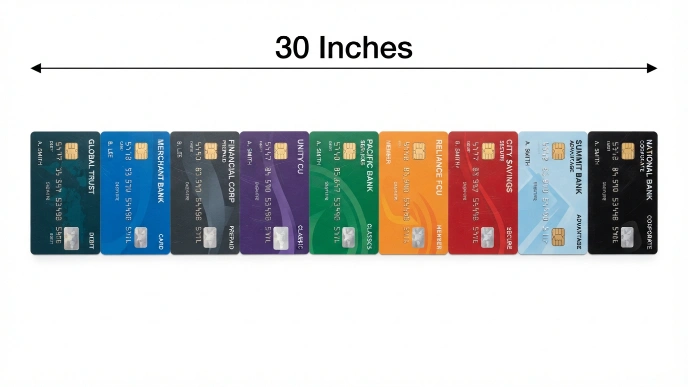
A standard credit, debit, or identification card using the common ID-1 format is approximately 3.37 inches wide. Nine cards placed side by side along their longer edges would span roughly 30.3 inches, making this another remarkably close comparison.
Bank cards are familiar objects carried in wallets and purses, so their dimensions are easy to recognize. Credit cards, many debit cards, and numerous identification cards use essentially the same standardized dimensions for compatibility with wallets, readers, and payment terminals.
Imagine nine cards arranged lengthwise across a table. The complete row would be just a fraction longer than the target measurement, making this one of the more practical small-object references on the list.
3. Six Standard Beverage Cans

Many standard 12-fluid-ounce beverage cans stand around 4.8 inches tall, although exact dimensions vary slightly by manufacturer and can design. Six cans arranged end to end by height would therefore span roughly 29 inches, putting the result close to 30 inches.
These cans are commonly found in supermarkets, refrigerators, vending machines, restaurants, and convenience stores. Because their general shape and height are familiar, they provide an accessible way to estimate medium-sized dimensions around the home.
Picture six standard soda cans lying in a straight line from base to top. Depending on the specific cans used, the row will fall around the target length rather than matching it perfectly. This makes cans useful for visualization, but not for precision measurement.
4. Average Man’s Footstep

An adult walking step can cover roughly 2.5 feet, although actual step length varies significantly with height, walking speed, stride pattern, and individual anatomy. A 2.5-foot step corresponds to approximately 30 inches.
Footsteps are frequently used for rough distance estimation when no measuring equipment is available. Taller people generally take longer steps, while shorter individuals may cover less distance with each normal step. A deliberate pace can therefore provide only an approximate reference.
If your normal step length happens to be around 30 inches, one step from the heel position of one foot to the next corresponding foot placement provides a simple visualization. For accurate measurements, however, measuring your personal step length first is necessary.
5. Ten Hockey Pucks

A regulation ice hockey puck has a diameter of approximately 3 inches. If ten pucks are placed edge to edge in a perfectly straight row, their combined length is 30 inches, assuming each puck conforms to the standard diameter.
Hockey pucks are compact, dense rubber discs used in ice hockey. Their standardized diameter makes them particularly useful for understanding measurements in multiples of three inches. Five pucks span 15 inches, while ten double that distance.
This is one of the cleanest comparisons available. Imagine ten black hockey pucks touching edge to edge across the floor or a tabletop. From the outside edge of the first puck to the outside edge of the tenth, the row represents the target distance almost exactly.
6. Two Bowling Pins

A regulation bowling pin stands approximately 15 inches tall. Placing two bowling pins end to end along their height creates a combined distance of about 30 inches, making this another straightforward comparison.
Bowling pins are familiar from ten-pin bowling alleys, where ten pins are arranged at the end of each lane. Their distinctive narrow-necked shape can sometimes make them appear smaller than their actual height when viewed from a distance.
Visualize one bowling pin standing directly above another without a gap. Together, their heights equal approximately 2.5 feet. Even if you do not have bowling pins nearby, remembering the height of two stacked pins can make this measurement much easier to picture.
7. Standard Bathtub Width

Many alcove bathtubs are approximately 30 inches wide, although models can be narrower or considerably wider. A common residential tub might measure around 60 inches long and 30 inches wide, making its shorter exterior dimension a useful reference.
Bathtubs are installed in bathrooms of many different sizes, and their dimensions depend on the design and available space. Standard alcove models tend to follow relatively familiar dimensional ranges because they must fit between finished walls.
If you have seen a typical 30-inch-wide bathtub, imagine the distance across it from one outer side to the other. That width provides a strong household reference, particularly when estimating similarly sized furniture, openings, or storage spaces.
8. Four U.S.-Sized Bricks

A common U.S. modular brick is approximately 7⅝ inches long. Four of these bricks placed end to end without mortar joints would span around 30.5 inches, only half an inch longer than 30 inches.
Bricks are familiar construction materials used in walls, facades, fireplaces, pathways, and landscaping. However, brick dimensions are not universal. Modular, standard, engineer, utility, and other brick types can have noticeably different dimensions.
Using modular bricks specifically, imagine four lined up lengthwise with their ends touching. The resulting row would provide a close visual approximation. Mortar joints would increase the overall span, so the comparison works best when considering only the physical bricks themselves.
9. Youth Baseball Bat
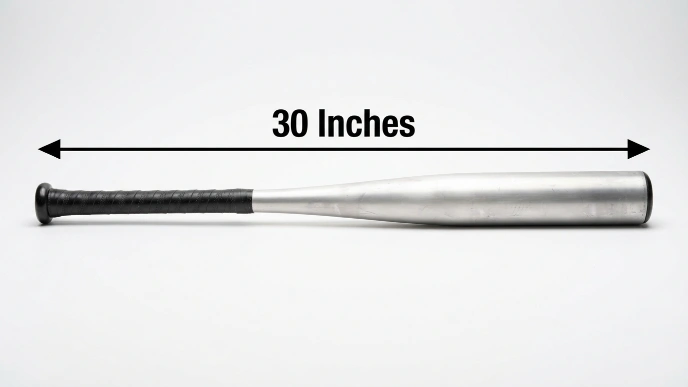
Youth baseball bats are manufactured in numerous lengths, and 30 inches is a common option for younger players. Bat selection depends on factors such as the player’s age, height, strength, league rules, and preferred weight-to-length ratio.
A baseball bat is an especially intuitive comparison because its full length is easy to see from the knob at the bottom of the handle to the end of the barrel. Unlike arranging several small objects together, a single appropriately sized bat represents the distance.
If you have handled a 30-inch youth bat, its length gives you a direct sense of the measurement. Picture the bat lying horizontally on a table or floor, and you have a convenient representation of 2.5 feet.
10. Standard Kitchen Counter Height

A standard kitchen countertop is usually around 36 inches above the finished floor, so it is important to note that it is not exactly 30 inches high. Thirty inches would sit approximately six inches below the top of a typical standard-height kitchen counter.
Kitchen counters are familiar fixed references in most homes, which makes the comparison useful despite the difference. Standardized counter heights are designed to provide a practical working surface for food preparation, appliances, sinks, and other everyday kitchen activities.
To visualize the target height using your kitchen, look at a standard 36-inch counter and imagine a point six inches below its surface. The distance from the floor to that point is approximately 30 inches. This is therefore a relative comparison rather than an exact object match.
11. Small Coffee Table Length

Compact coffee tables can measure around 30 inches long, although furniture dimensions vary widely by style and manufacturer. Larger rectangular models commonly extend well beyond this size, while small tables designed for apartments or limited spaces may stay near the 30-inch range.
Coffee tables usually sit in front of sofas or between seating areas, providing space for drinks, books, decorative pieces, or remote controls. Their familiar placement makes their horizontal dimensions relatively easy to visualize.
Picture a compact coffee table whose top extends about 2.5 feet from one end to the other. That gives you a useful household representation. Because coffee tables are not standardized, check the dimensions of a specific model before treating it as an exact reference.
12. Office Desk Depth
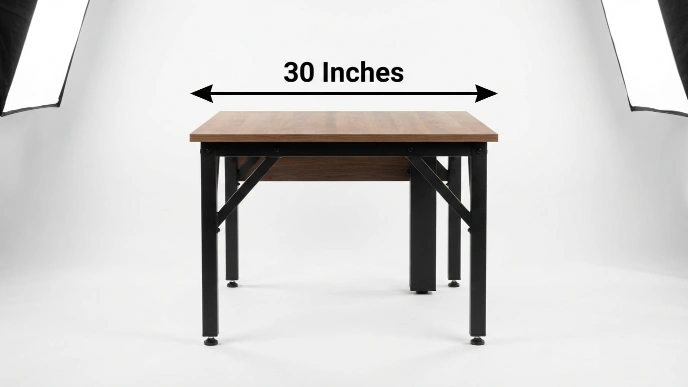
Office desks often have depths in the general range of 24 to 30 inches, with 30 inches providing a relatively spacious work surface. A desk at the upper end of this range therefore offers a convenient way to visualize the measurement from its front edge to its back.
Desk depth matters because it determines how much room is available for monitors, keyboards, notebooks, and other equipment. Deeper desks can also create more comfortable viewing distance between the user and a computer screen.
If you work at a desk that is exactly 30 inches deep, simply imagine the distance from the edge nearest your chair to the rear edge. That span represents 2.5 feet and can serve as an easy everyday reference without arranging multiple smaller objects.
13. Large Suitcase Height

Large checked suitcases frequently fall somewhere around 28 to 30 inches in height, excluding or including wheels depending on how the manufacturer reports dimensions. Some oversized luggage can be taller, so there is no single universal suitcase measurement.
Large suitcases are designed for longer trips and typically provide substantially more packing capacity than carry-on luggage. Their height is easy to recognize because they commonly reach somewhere around the upper leg when standing upright, though this varies with both luggage and person.
A large suitcase close to 30 inches tall gives you an excellent visual approximation. Imagine it standing upright from the floor to its top edge. If the case is a 30-inch model, that vertical distance corresponds directly to the measurement discussed here.
14. Wall Shelf Length
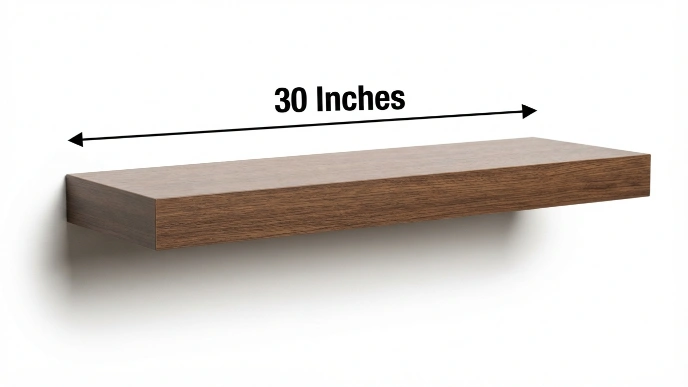
Wall shelves are available in many standardized and custom dimensions, and 30-inch shelves are readily used for compact storage or display arrangements. Such a shelf extends 2.5 feet horizontally from one end to the other.
Shelves of this general size can hold books, small plants, photographs, collectibles, kitchen items, or decorative objects. They are large enough to provide useful storage without occupying the wall space required by longer 36-, 48-, or 60-inch shelves.
A 30-inch wall shelf is one of the simplest single-object references because no multiplication is required. Look across its full horizontal span from left to right, and you have a direct representation of the target distance.
15. Narrow Interior Door Width

A 30-inch-wide interior door is a common size for certain residential openings, although door widths vary according to room type, building design, accessibility requirements, and local codes. Wider interior doors measuring 32 or 36 inches are also frequently encountered.
Interior doors provide an excellent visual reference because most people regularly pass through them. Their width is substantial enough to make 30 inches easier to understand than comparisons involving several tiny objects arranged together.
If you stand in front of a 30-inch door, the horizontal distance across the door slab gives you a direct representation of 2.5 feet. Just remember to distinguish the actual door width from the complete framed opening, which can be wider.
How to Estimate 30 Inches Without a Measuring Tape
If you do not have a ruler or measuring tape available, familiar standardized objects can help you make a rough estimate. The best references are objects with dimensions that remain relatively consistent rather than furniture or household products whose sizes vary considerably.
For example:
- Two bowling pins: roughly 15 inches each, totaling about 30 inches.
- Ten hockey pucks: approximately 3 inches in diameter each.
- Five U.S. bills: about 30.7 inches when placed lengthwise.
- Nine bank cards: about 30.3 inches along their longer dimension.
- A 30-inch youth baseball bat: provides a direct one-object reference.
These methods are useful for visualization and rough estimates. For furniture installation, construction, appliance clearance, or any task where fractions of an inch matter, use a proper measuring tool instead.
Read: How Long Is 18 Inches?
Read: How Big Is 3 Inches?
Read: How Tall Is 40 Inches?
Read: How long is 16 Inches?
Read: How Long Is 12 Inches?
Read: How Tall is 60 Inches?
Read: How Long Is 14 Inches?
Frequently Asked Questions
How many feet is 30 inches?
Thirty inches equals 2.5 feet, or 2 feet 6 inches. Divide the number of inches by 12 to convert inches to feet: 30 ÷ 12 = 2.5.
How many centimeters is 30 inches?
Thirty inches equals exactly 76.2 centimeters. Since one inch equals exactly 2.54 centimeters, multiplying 30 by 2.54 gives 76.2 cm.
Is 30 inches the same as 3 feet?
No. Three feet equals 36 inches, so 30 inches is six inches shorter. It equals exactly 2.5 feet.
What common object is about 30 inches long?
A 30-inch youth baseball bat is one of the simplest examples. Other useful references include a 30-inch wall shelf, a narrow 30-inch door, or ten 3-inch hockey pucks arranged edge to edge.
Is 30 inches close to one yard?
Yes, but it is not a full yard. One yard equals 36 inches, meaning 30 Inches is six inches, or half a foot, shorter than one yard.
Conclusion
30 Inches equals 2.5 feet, 76.2 centimeters, 762 millimeters, or 0.762 meters. Familiar references such as a youth baseball bat, narrow interior door, two bowling pins, ten hockey pucks, or a 30-inch wall shelf can make this distance much easier to visualize.
For quick estimation, standardized objects such as bank cards, U.S. bills, and hockey pucks are particularly useful because their dimensions are relatively consistent. When accuracy matters, however, use a ruler or measuring tape rather than relying solely on visual comparisons.